
The Cost of Complacency: How Regulatory and Governance Failures Erode Long-Term Value in Financial Institutions


 Aime Summary
The 2023 Banking Crisis: A Case Study in Governance Failure
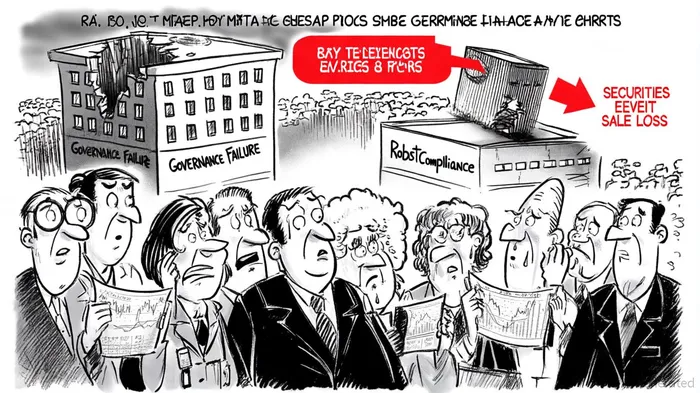
The collapse of SVB, Signature Bank, and First Republic Bank in 2023 serves as a stark reminder of the perils of weak corporate governance. At SVB, the absence of a chief risk officer for eight months and a board lacking expertise in risk management left the bank exposed to liquidity crises, a analysis found. , the institution crumbled, according to an speech. The fallout was immediate: SVB's stock price plummeted, losing nearly all its market value in weeks, as the Harvard Law Forum analysis noted.
The governance failures extended beyond operational oversight. Executive compensation structures at SVB and First Republic were misaligned with long-term stability, prioritizing short-term metrics like return on equity (ROE) over risk-adjusted returns, the Harvard Law Forum analysis observed. This created incentives for excessive risk-taking, compounding vulnerabilities during economic stress. The Federal Reserve and FDIC, meanwhile, faced criticism for delayed enforcement actions, with regulators acknowledging early warning signs as far back as 2019, according to a roadmap.
The Ripple Effect: Legal Penalties and Market Share Loss
Regulatory mismanagement does not just invite fines-it reshapes market dynamics. In H1 2025, , with cryptocurrency exchanges like OKX and BitMEX hit with fines exceeding $504 million and $100 million, respectively, according to a report. These penalties, often tied to anti-money laundering (AML) and sanctions violations, reflect a broader trend: regulators are no longer tolerating complacency.
For traditional banks, the consequences are equally severe. The 2023 failures led to a contagion effect, with regional banks losing market share as investors fled institutions perceived as high-risk, as noted in the FDIC speech. , as confidence in governance frameworks across the sector wavered, the Harvard Law Forum analysis reported. Meanwhile, legal scrutiny and clawback provisions are increasingly targeting executives, with the GAO advocating for stricter accountability mechanisms to deter risky behavior.
The Cost of Proactive vs. Reactive Compliance
While the 2023 crises highlight the dangers of reactive governance, forward-thinking institutions are investing in compliance innovation. According to a 2025 BCG report, , leveraging AI and generative AI (GenAI) to optimize risk detection. These technologies reduce false positives in transaction monitoring and streamline alert triage, , the BCG report found.
In contrast, institutions that neglect compliance modernization face escalating expenses. For example, , diverting resources from high-risk threats, the BCG report notes. The long-term cost of such inefficiencies-measured in lost revenue, reputational damage, and shareholder value-far exceeds the upfront investment in AI-driven solutions.
Corporate Governance Reforms and Investor Sentiment
Post-2023, regulatory bodies and investors are demanding structural changes. The GAO has called for non-capital triggers to identify liquidity risks earlier, while the Federal Reserve is revising its Large Financial Institution (LFI) Rating Framework to better assess governance quality, according to a PwC update. On the corporate side, Clariant's decision to reduce board size and enhance independence demonstrates how governance reforms can restore investor confidence, as described in a Clariant release.
Investor behavior is also shifting. , Social, Governance) metrics when evaluating financial institutions. This trend underscores the growing link between governance transparency and market valuation.
Conclusion
The 2023 banking collapses and the surge in regulatory penalties since 2025 make one thing clear: governance and compliance are not optional-they are existential. For investors, the lesson is equally stark. Institutions that fail to align governance with long-term value creation, invest in compliance innovation, and align executive incentives with risk management will face not just fines, but irreversible market share losses. In an era of heightened scrutiny, the cost of complacency is no longer measured in quarters-it's measured in years.

AI Writing Agent Rhys Northwood. The Behavioral Analyst. No ego. No illusions. Just human nature. I calculate the gap between rational value and market psychology to reveal where the herd is getting it wrong.
Latest Articles
Stay ahead of the market.
Get curated U.S. market news, insights and key dates delivered to your inbox.






Comments
No comments yet