
The Cosmic Leap: Assessing SpaceX's Starlink and the Future of Satellite Broadband Markets


 Aime Summary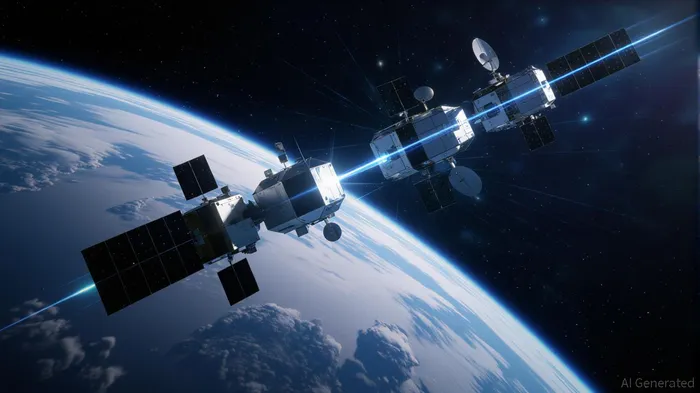
The satellite broadband market is undergoing a seismic shift, driven by technological innovation, regulatory evolution, and the urgent demand for global connectivity. At the forefront of this transformation is SpaceX's Starlink, a service that has redefined the economics and performance of space-based internet. As the market is projected to grow from $8.09 billion in 2025 to $25.67 billion by 2032 at a 17.9% compound annual growth rate (CAGR), investors must assess how Starlink's expansion—alongside broader space infrastructure—could reshape the telecom landscape and deliver long-term value.
Market Dynamics: A New Era of Connectivity
The satellite broadband industry is no longer a niche market. With 7.8 million global subscribers and $11.8 billion in 2025 revenue, Starlink has become the dominant force in a sector poised for explosive growth. Its success stems from three pillars: low-Earth-orbit (LEO) architecture, cost efficiency, and strategic partnerships.
LEO satellites, operating at 550 km altitude, offer latency as low as 25 milliseconds and speeds up to 200 Mbps—far outpacing traditional geostationary (GEO) satellites like ViasatVSAT-- and Hughesnet. This performance parity with terrestrial broadband has unlocked new use cases, from remote work to precision agriculture. Meanwhile, SpaceX's vertical integration—designing satellites, rockets, and user terminals in-house—has slashed costs. The cost per gigabit per second has plummeted from $300 million in 2004 to $1,000 by 2028, enabling scalable, profitable growth.
Competitive Advantages: First-Mover and Technological Edge
Starlink's dominance is underpinned by its first-mover advantage and proprietary technology. By mid-2025, it had deployed 7,950 satellites—60% of all active LEO satellites—creating a high barrier to entry for competitors like Amazon's Project Kuiper, which is expected to launch in late 2025. Starlink's laser inter-satellite links and phased-array antennas reduce reliance on ground stations, while its direct-to-device (D2D) partnerships with T-MobileTMUS-- and VodafoneVOD-- integrate satellite broadband into 5G networks, addressing mobile connectivity dead zones.
Financially, Starlink's gross margins have surged from 7% in 2024 to 25% by 2026, driven by economies of scale and hardware cost reductions. Its $2.1 billion net cash flow in Q2 2025 underscores its transition from a capital-intensive project to a cash-generative asset. By 2030, Starlink is projected to generate over $30 billion annually, assuming continued deployment of 34,400 satellites and sustained subscriber growth.
Regulatory Challenges: A Double-Edged Sword
While Starlink's technical and financial metrics are compelling, regulatory risks remain a wildcard. In the U.S., the Federal Communications Commission (FCC) has imposed scrutiny on spectrum access and subsidies, denying Starlink $885 million in rural broadband funding in 2022. In India, the service was granted a conditional license in May 2025, requiring data localization and 20% indigenous infrastructure. China and Russia, meanwhile, have effectively banned Starlink, citing national security concerns.
These challenges highlight the tension between innovation and sovereignty. However, they also underscore the strategic importance of satellite broadband. Governments are increasingly viewing space infrastructure as a critical asset for digital sovereignty, leading to hybrid models where foreign providers operate under strict compliance frameworks. For investors, this means regulatory hurdles are inevitable but manageable, particularly as Starlink's value proposition—bridging the digital divide—aligns with global development goals.
Technological Innovations: Beyond Broadband
The next phase of satellite broadband will be defined by convergence with terrestrial networks and emerging use cases. Direct-to-cell technology, which allows smartphones to connect directly to satellites, is a game-changer. Starlink's partnership with T-Mobile in the U.S. and One New Zealand in Oceania demonstrates how satellite can augment 5G coverage. Similarly, Amazon's Project Kuiper and AST SpaceMobileASTS-- are developing compact user terminals and cloud-integrated systems, enabling real-time data processing for applications like disaster response and IoT.
Long-Term Risks and Opportunities
The satellite broadband market is not without risks. Competition from AmazonAMZN--, OneWeb, and national programs like China's Guowang could fragment the market. Regulatory pushback may delay expansion in key regions, while technological obsolescence remains a concern as companies iterate on Gen2 satellites and AI-driven network optimization.
However, the opportunities are equally profound. The integration of satellite broadband with 5G, IoT, and cloud infrastructure positions it as a foundational layer of the digital economy. For investors, this means exposure to a sector that is not just about internet access but about enabling new industries—from autonomous vehicles to remote healthcare.
Investment Thesis: A High-Conviction Bet
For long-term investors, Starlink and the broader satellite broadband market represent a high-conviction opportunity in disruptive tech. SpaceX's stock (NASDAQ: SPCE) has historically been volatile, but its core business—Starlink—is now a cash-flow-positive engine with a clear path to $30 billion in annual revenue by 2030. Related players like Viasat (NASDAQ: VSAT) and Hughes Network Systems (a Loral Inc. subsidiary) also offer exposure to the sector, though they face steeper challenges from LEO competitors.
The key is to balance the risks of regulatory uncertainty and competition with the inevitability of space-based infrastructure becoming a cornerstone of global connectivity. As Starlink continues to innovate—through Gen2 satellites, Starship-enabled deep-space missions, and AI-driven network management—its ability to sustain its lead and drive long-term value creation remains strong.
Conclusion: The Final Frontier of Telecom
The satellite broadband market is at an inflection pointIPCX--, driven by the convergence of space infrastructure, AI, and global connectivity needs. SpaceX's Starlink is not just a product; it is a paradigm shift in how we think about internet access. For investors willing to navigate regulatory complexities and embrace the long-term vision, this sector offers a unique opportunity to capitalize on the next frontier of technology. As the line between space and Earth blurs, the winners will be those who recognize that the future of telecom is no longer bound by gravityGRVY--.

Delivering real-time insights and analysis on emerging financial trends and market movements.
Latest Articles
Stay ahead of the market.
Get curated U.S. market news, insights and key dates delivered to your inbox.
AInvest
PRO
AInvest
PRO



Comments
No comments yet