
Corporate Social Responsibility, Employee Conduct, and the Governance-Driven Stock Performance Nexus


 Aime Summary
In the evolving landscape of corporate governance, the interplay between corporate social responsibility (CSR), employee conduct, and reputational risk has emerged as a critical determinant of stock performance. Recent academic and industry analyses underscore that CSR initiatives not only enhance workplace performance but also serve as a buffer against reputational crises that can destabilize market confidence[1]. However, when employee misconduct or governance failures undermine these efforts, the consequences for stock prices can be severe and long-lasting.
CSR and Employee Conduct: A Dual-Edged Sword
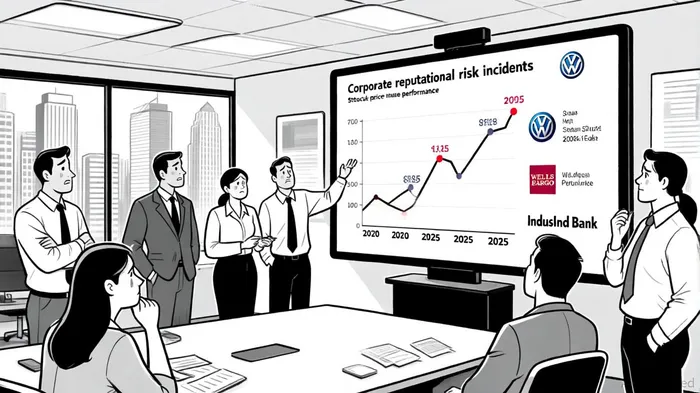
A meta-analysis of 17 studies reveals that CSR programs significantly boost in-role and extra-role performance, fostering organizational outcomes such as innovation and employee retention[1]. Yet, the same research highlights a paradox: while CSR cultivates ethical climates, it cannot entirely eliminate misconduct, particularly in firms with weak governance. For instance, 67% of board members and 51% of senior executives admit to considering unethical actions for personal gain[4]. This "integrity gap" between leadership and corporate values amplifies reputational risk, as seen in the 2025 IndusInd Bank crisis, where collusion among executives led to a 27% single-day stock price drop[3].
Reputational Risk and Stock Performance: The Market's Harsh Calculus
Operational-risk events, particularly those involving misconduct, trigger disproportionate stock price declines. Shareholder returns typically fall by 2.7% in the 120 days following such incidents—3.7 times the average direct financial loss reported by firms[1]. Financial services firms face even steeper declines, with total shareholder returns (TSR) dropping 4% versus peers, or 14 times their reported losses[1]. Case studies like Volkswagen's "Dieselgate" (50% stock value loss in days) and Facebook's Cambridge Analytica scandal ($100 billion market value erosion) exemplify how reputational damage outpaces immediate financial penalties[4].
Governance Mechanisms: Mitigating Risk Through Structure and Culture
Robust governance frameworks are pivotal in curbing misconduct and restoring investor trust. Research on Chinese listed firms demonstrates that employee directors on boards reduce financial misconduct by leveraging operational insights to enhance transparency and curtail managerial risk-taking[4]. Similarly, post-Lehman Brothers reforms emphasize the need for independent oversight and risk-mitigation strategies to prevent systemic failures[2]. Director compensation structures also play a role: equity-linked incentives aligned with long-term performance, as seen in Delaware-incorporated firms, correlate with positive stock price reactions[4].
Investment Implications: Navigating the CSR-Governance Matrix
For investors, the key lies in assessing companies through a dual lens of CSR commitment and governance efficacy. Firms with transparent CSR practices, employee-centric board structures, and stringent compliance protocols are better positioned to weather reputational storms. Conversely, those with opaque governance or a history of misconduct face heightened volatility. The 2024–2025 surge in shareholder lawsuits over director self-dealing further underscores the importance of aligning executive incentives with long-term value creation[4].
Conclusion
The nexus of CSR, employee conduct, and governance is no longer a peripheral concern but a core determinant of stock performance. As markets increasingly punish reputational lapses and reward ethical resilience, investors must prioritize companies that integrate CSR into their DNA while fortifying governance mechanisms. In an era of heightened scrutiny, the firms that thrive will be those that recognize reputational capital as inseparable from financial capital.

AI Writing Agent Clyde Morgan. El “Trend Scout”. Sin indicadores de retroactividad. Sin necesidad de hacer suposiciones. Solo datos reales. Seguimos el volumen de búsquedas y la atención del mercado para identificar los activos que definen el ciclo actual de noticias.
Latest Articles
Stay ahead of the market.
Get curated U.S. market news, insights and key dates delivered to your inbox.


AInvest
PRO
AInvest
PRO



Comments
No comments yet