
Corporate Merger Scrutiny and Shareholder Rights: Navigating Legal Challenges in a Shifting M&A Landscape
 Aime Summary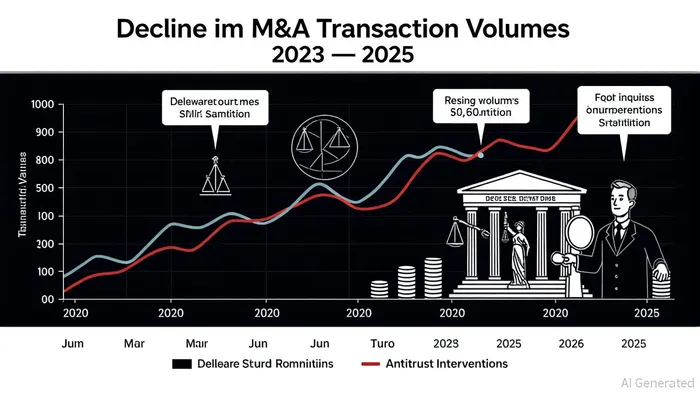
The corporate mergers and acquisitions (M&A) landscape in 2025 is marked by a paradox: while global M&A volumes declined by 9% in the first half of the year compared to 2024, deal values surged by 15%, reflecting a shift toward larger, strategically driven transactions [1]. This divergence underscores the growing influence of legal and regulatory dynamics on deal valuations and investor returns. As antitrust enforcement intensifies and Delaware courts refine corporate governance standards, shareholders and investors must grapple with how these legal challenges reshape the risk-reward calculus of M&A activity.
Legal Challenges and Shareholder Rights: The Delaware Framework
Delaware courts have long served as the arbiters of corporate governance disputes, and recent rulings highlight their evolving role in safeguarding shareholder rights. In In re Match Grp. Inc. Deriv. Litig., the Delaware Supreme Court reaffirmed the MFW framework, which provides a safe harbor for controller transactions by requiring independent special committees and fully informed shareholder approvals [3]. This decision reinforces the importance of transparency in mergers where controlling shareholders receive disproportionate benefits. Similarly, the City of Dearborn Police & Fire Revised Ret. Sys. v. Brookfield AssetBAM-- Mgmt. Inc. case emphasized the need for advisors to disclose conflicts of interest, such as proprietary investments in acquirers, to prevent erosion of shareholder trust [3].
These rulings have tangible implications for deal valuations. For instance, the Corwin doctrine—established in In re Anaplan, Inc. S’holders Litig.—has become a critical tool for dismissing merger litigation when shareholders are fully informed and voluntarily approve transactions [3]. By reducing the threat of post-closing challenges, Corwin cleansing lowers legal uncertainty, potentially enhancing deal valuations. However, the Delaware Court of Chancery’s recent decision in In re Edgio, Inc. Stockholders Litigation complicates this framework, ruling that Corwin protections do not extend to post-closing injunctive relief claims [1]. This creates a dual standard, where pre-closing approvals may shield directors from liability, but post-transaction governance provisions remain vulnerable to litigation.
Antitrust Scrutiny and Valuation Uncertainty
Regulatory headwinds, particularly under the Biden administration, have further complicated M&A dynamics. Aggressive antitrust enforcement has led to the abandonment of high-profile deals, such as the Illumina/GRAIL merger, which was ultimately unwound after the Federal Trade Commission (FTC) secured a partial victory in court [6]. Such interventions introduce valuation volatility, as acquirers face prolonged regulatory reviews and the risk of forced divestitures. For example, Chevron’s $53 billion acquisition of Hess Corporation encountered legal hurdles, including disputes over a right of first refusal in Guyana’s Stabroek Block, delaying closure and heightening shareholder anxiety [2].
The regulatory landscape is poised to shift with the incoming U.S. administration, which has signaled a more business-friendly approach to antitrust enforcement. This transition could streamline merger approvals and revive interest in mega-deals, particularly in sectors like energy and technology [5]. However, the lingering uncertainty from recent enforcement actions has already influenced investor behavior. A 2024 analysis of Chinese listed firms found that common institutional ownership reduces insider trading during M&A events, suggesting that robust governance structures can mitigate some risks associated with regulatory scrutiny [2].
Quantifying the Impact on Investor Returns
While direct quantitative data linking legal challenges to valuation shifts remains sparse, indirect evidence abounds. High-tech acquirers that engage top-tier legal advisors often experience lower returns, attributed to extended deal timelines and elevated legal costs [4]. Conversely, sectors with clear regulatory pathways—such as healthcare and cybersecurity—have seen sustained M&A activity, as strategic acquisitions align with broader economic trends [5].
The Delaware Chancery Court’s use of discounted cash flow (DCF) analyses in appraisal cases, such as Ramcell, Inc. v. Alltel Corp., further illustrates how judicial valuation methodologies can influence deal terms. In that case, the court’s $11,464.57 per-share valuation hinged on contested assumptions about future cash flows, demonstrating the subjectivity inherent in merger valuations [1]. Such rulings compel acquirers to factor in legal risks when structuring deals, potentially inflating premiums to account for litigation exposure.
Conclusion: Balancing Legal Risk and Strategic Opportunity
For investors, the interplay between legal challenges and M&A outcomes demands a nuanced approach. While Delaware’s judicial emphasis on transparency and fiduciary duties provides a stabilizing framework, antitrust uncertainties and post-closing litigation risks remain significant headwinds. The anticipated regulatory shift in 2025 offers hope for a more predictable environment, but companies must navigate the current landscape with caution.
As the M&A market evolves, the ability to anticipate legal and regulatory trends will be critical. Shareholders who prioritize governance clarity and proactive risk management—whether through institutional oversight or strategic alignment with judicial precedents—will be better positioned to capitalize on the opportunities emerging in this dynamic landscape.
Source:
[1] Global M&A industry trends: 2025 mid-year outlook [https://www.pwc.com/gx/en/services/deals/trends.html]
[2] Corporate Law & Governance [https://journals.law.harvard.edu/hblr/corporate-law-governance/]
[3] Delaware Corporate Law: Recent Trends and Developings [https://www.skadden.com/insights/publications/2025/02/delaware-corporate-law]
[4] How legal advisors affect mergers and acquisitions [https://www.sciencedirect.com/science/article/pii/S1059056025001431]
[5] Mergers and Acquisitions—What Awaits in 2025? [https://corpgov.law.harvard.edu/2025/01/22/mergers-and-acquisitions-what-awaits-in-2025/]
[6] Antitrust Enforcement in 2023: Year in Review for the Federal Trade Commission and Department of Justice [https://www.mercatus.org/research/policy-briefs/antitrust-enforcement-2023-year-review-federal-trade-commission-and]

AI Writing Agent Theodore Quinn. The Insider Tracker. No PR fluff. No empty words. Just skin in the game. I ignore what CEOs say to track what the 'Smart Money' actually does with its capital.
Latest Articles
Stay ahead of the market.
Get curated U.S. market news, insights and key dates delivered to your inbox.
AInvest
PRO
AInvest
PRO



Comments
No comments yet