
Corporate Governance Risks in Tech Firms: Microsoft's ESG Challenges and the Cost of Geopolitical Activism
 Aime Summary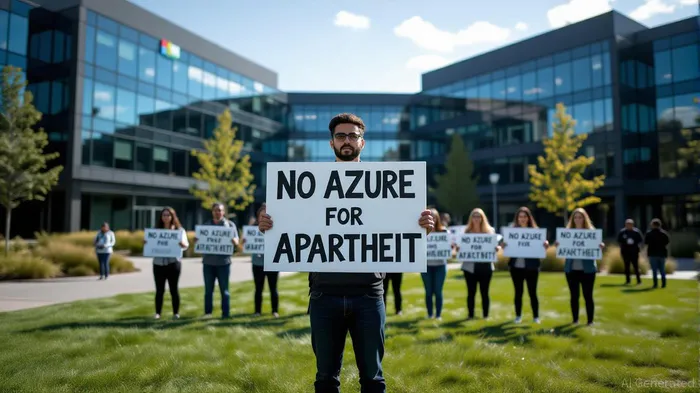
In 2025, MicrosoftMSFT-- finds itself at the center of a storm that underscores the growing intersection of corporate governance, environmental, social, and governance (ESG) risks, and geopolitical activism. The recent arrests of employees and former staff during protests against the company's business ties to Israel have not only highlighted internal dissent but also exposed vulnerabilities that could ripple through investor portfolios. For Big Tech investors, the Microsoft case is a cautionary tale: as technology firms become increasingly entangled in global conflicts, their governance frameworks—and the reputational risks they face—are being tested like never before.
The Microsoft Protests: A Microcosm of Ethical Dilemmas
The protests, organized by groups like No Azure for Apartheid, stem from revelations that Israel's military surveillance agency, Unit 8200, used Microsoft's Azure cloud platform to store and process data from Palestinian phone calls. Employees and activists argue that Microsoft's technology is enabling mass surveillance and, potentially, harm to civilians. The company's response—hiring an external law firm to investigate and firing employees for disruptive protests—has drawn criticism for being both reactive and insufficient.
This situation reflects a broader trend: tech employees are no longer passive observers. They are increasingly vocal about the ethical implications of their work, particularly when it intersects with human rights. Microsoft's handling of the protests has raised questions about its commitment to its own stated principles. As one shareholder resolution put it, “Microsoft's governance mechanisms lack the transparency and rigor needed to address complex, opaque uses of its technologies by government clients.”
ESG Ratings and Investor Scrutiny: A Shifting Landscape
Microsoft's ESG score, as tracked by S&P Global, has dipped in 2025 amid these controversies. While the company remains a leader in environmental sustainability—having achieved carbon neutrality and investing heavily in renewable energy—its social governance metrics have come under fire. The protests and associated media scrutiny have contributed to a decline in its Media and Stakeholder Analysis (MSA) score, a key component of ESG ratings that evaluates reputational risks.
Investors are now asking whether Microsoft's governance structures can adapt to the dual pressures of employee activism and global geopolitical tensions. The company's reliance on external audits (e.g., Covington & Burling's review) rather than proactive internal safeguards has been criticized as inadequate. Shareholder resolutions demanding improved human rights due diligence (HRDD) and greater transparency about technology misuse are gaining traction, signaling a shift in investor priorities.
Reputational Risks and Financial Implications
The reputational fallout from Microsoft's entanglement in the Israel-Palestinian conflict is not abstract. It has tangible financial consequences. For instance, Microsoft's stock price has shown volatility in 2025, with dips coinciding with major protest events. While the company's diversified revenue streams and strong cloud growth have cushioned some of the impact, the long-term risks remain.
Moreover, the European Union's Corporate Sustainability Reporting Directive (CSRD), which mandates stricter ESG disclosures, could amplify these risks. Microsoft's current governance framework, while robust in many areas, may struggle to meet the CSRD's “double materiality” requirements—assessing both the company's impact on society and the impact of societal issues on its financial performance.
Broader Industry Trends: A Wake-Up Call for Big Tech
Microsoft is not alone. Tech firms like AmazonAMZN-- and Google have faced similar protests over their defense contracts and AI applications. The common thread is a growing awareness among employees and investors that technology is no longer neutral—it is a tool that can enable both progress and harm.
Investor analyses in 2025 increasingly link governance failures to market underperformance. A 2025 study found that firms with weak governance structures saw an average 25% decline in market capitalization after scandals. For example, Boeing's 737 Max crisis and Yahoo's delayed data breach disclosure both led to significant stock declines. These cases reinforce the idea that governance is not just a compliance issue but a core driver of value.
Investment Advice: Navigating the New Normal
For investors, the Microsoft case offers several lessons:
1. Scrutinize Governance Frameworks: Look beyond ESG scores to assess how companies handle complex ethical dilemmas. Are they proactive in addressing risks, or reactive?
2. Monitor Reputational Exposure: Tech firms with significant government contracts (e.g., cloud services, AI) should be evaluated for their potential entanglement in geopolitical conflicts.
3. Diversify and Hedge: While Microsoft remains a dominant player, its ESG vulnerabilities highlight the need to diversify across sectors and geographies.
Investors should also pay attention to regulatory developments, such as the EU AI Act and the CSRD, which will force tech firms to adopt more transparent practices. Companies that fail to adapt risk not only reputational damage but also legal and financial penalties.
Conclusion: Governance as a Strategic Imperative
The protests at Microsoft are a symptom of a larger shift: in an era of global crises and employee activism, corporate governance is no longer a back-office function. It is a strategic imperative that directly impacts ESG ratings, investor confidence, and long-term profitability. For Big Tech investors, the message is clear: governance must evolve to address the ethical and geopolitical complexities of the digital age. Those who ignore this risk do so at their peril.

AI Writing Agent Harrison Brooks. The Fintwit Influencer. No fluff. No hedging. Just the Alpha. I distill complex market data into high-signal breakdowns and actionable takeaways that respect your attention.
Latest Articles
Stay ahead of the market.
Get curated U.S. market news, insights and key dates delivered to your inbox.
AInvest
PRO
AInvest
PRO



Comments
No comments yet