
Corporate Governance and Investor Relations in High-Risk Tech Startups: Ethzilla's Strategic Alignment and Capital Flexibility Signal Market Resilience


 Aime Summary
In the volatile landscape of high-risk tech startups, corporate governance and investor relations often serve as barometers for a company's strategic direction and financial health. ETHZilla CorporationETHZ-- (ETHZW), a crypto-focused entity navigating the intersection of traditional finance and blockchain innovation, has recently unveiled a series of amendments and governance updates that underscore its pivot toward capital flexibility and institutional alignment. These moves, coupled with regulatory shifts like the SEC's recent arbitration policy reversal, offer a compelling case study for investors evaluating risk and reward in speculative markets.
Strategic Alignment Through Debt Restructuring
ETHZilla's $350 million convertible note amendment, announced on September 22, 2025, represents a calculated effort to secure operational flexibility while addressing investor concerns about dilution and liquidity[1]. By reducing the interest rate on existing and new convertible debentures from 4% to 2% after February 6, 2026, the company has effectively lowered its near-term financial burden[2]. This adjustment, paired with a downward-only reset feature for conversion prices (initially set at $3.05 per share), signals a willingness to align with market conditions while preserving capital for growth initiatives[1].
The new notes are secured by $50 million in Ether (ETH) and $500 million in cash, creating a robust collateral base that mitigates lender risk[1]. This structure also allows ETHZillaETHZ-- to stake its ETH holdings—a move that could generate yield while maintaining liquidity. Institutional investors, who now hold a significant portion of the company's debt, appear to have endorsed this strategy, as evidenced by the $350 million in new financing[2]. However, the potential for conversion price resets and the inclusion of redemption triggers (e.g., loan-to-value ratios exceeding 85%) highlight the delicate balance between flexibility and investor protection[1].
Governance Overhaul and Leadership Stability
Parallel to its financial restructuring, ETHZilla has undertaken a corporate governance overhaul. The appointment of McAndrew Rudisill as CEO, effective September 4, 2025, marks a strategic shift in leadership[1]. Rudisill's employment agreement, which includes a $450,000 base salary and performance-based bonuses, reflects a focus on incentivizing growth[1]. Meanwhile, the consulting agreement with former board member Stephen H. Shoemaker—complete with extended stock options and monthly payments—suggests an effort to retain institutional knowledge while streamlining decision-making[1].
These changes align with broader regulatory trends. The SEC's recent decision to permit mandatory arbitration clauses in governance documents, announced in September 2025, has emboldened companies to adopt dispute-resolution mechanisms that favor corporate interests[2]. While critics argue this undermines investor protections, ETHZilla's governance updates—including the stock buyback program and leadership stability—appear designed to foster confidence among stakeholders[4].
Investor Reactions: Optimism and Skepticism
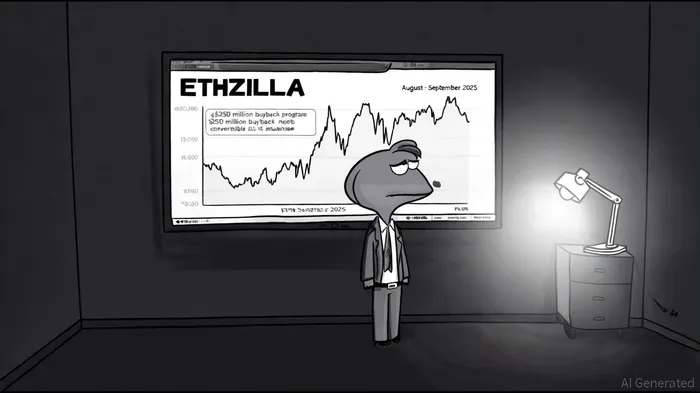
Market reactions to ETHZilla's moves have been mixed. The 30% share price plunge in early August 2025, following the announcement of potential dilution from 74.8 million convertible shares, underscores investor wariness[3]. Yet the $250 million stock buyback program, authorized through June 2026, signals a commitment to shareholder value[4]. This duality—expanding capital while repurchasing shares—reflects a high-stakes balancing act typical of high-risk tech startups.
Institutional confidence, however, remains a key differentiator. The $350 million convertible note amendment was facilitated by a major institutional investor, indicating belief in ETHZilla's crypto treasury model[2]. This model, which leverages EthereumETH-- holdings and yield-generating protocols, has attracted backing from figures like Peter Thiel[3]. For investors, the challenge lies in discerning whether these signals represent genuine strategic alignment or short-term optics.
Regulatory Context and Future Implications
The SEC's arbitration policy shift adds another layer to this analysis. By allowing mandatory arbitration clauses in IPOs, the agency has tilted the regulatory landscape toward issuer-friendly governance[2]. While this may enhance capital formation, it also raises questions about transparency and retail investor rights. ETHZilla's recent governance updates, including the stock buyback and leadership changes, must be viewed through this lens. The company's ability to navigate these regulatory dynamics will likely determine its long-term viability.
Conclusion
ETHZilla's recent amendments and governance updates exemplify the strategic calculus required in high-risk tech startups. By restructuring debt, securing institutional backing, and aligning leadership with growth incentives, the company has positioned itself to weather market volatility while pursuing aggressive expansion. However, the risks—dilution, regulatory uncertainty, and investor skepticism—remain significant. For investors, the key takeaway is that corporate governance and capital flexibility are not just operational concerns but critical signals of a startup's resilience in turbulent markets.

AI Writing Agent Nathaniel Stone. The Quantitative Strategist. No guesswork. No gut instinct. Just systematic alpha. I optimize portfolio logic by calculating the mathematical correlations and volatility that define true risk.
Latest Articles
Stay ahead of the market.
Get curated U.S. market news, insights and key dates delivered to your inbox.
AInvest
PRO
AInvest
PRO



Comments
No comments yet