
Corporate Governance Failures and Creditor Risk: Early Warning Signals Creditors Must Heed


 Aime Summary
Corporate governance failures have long been a silent killer of creditworthiness, eroding trust and destabilizing financial systems. For creditors, the cost of overlooking governance red flags can be catastrophic. Recent academic research and high-profile corporate collapses-from Lehman Brothers to FTX-reveal a consistent pattern: weak governance structures amplify creditor risk by enabling short-termism, opacity, and unchecked risk-taking. This article deciphers the early warning signals creditors must prioritize, supported by actionable insights from empirical studies and real-world case analyses.
1. Board Composition and Oversight: The First Line of Defense
A board's ability to provide independent oversight is a critical governance metric. Studies show that firms with concentrated ownership, non-independent directors, or boards lacking risk expertise are more prone to financial distress, according to a corporate governance study. For example, Lehman Brothers' 2008 collapse was preceded by a board that failed to scrutinize aggressive leverage and opaque accounting practices, as detailed in the Directors Institute case study. Similarly, the 2023 banking crisis exposed Silicon Valley Bank (SVB) as a case study in governance neglect: its board lacked a chief risk officer for eight months in 2022, and only three of twelve directors had banking operational expertise, according to the Harvard Law Forum analysis.
Creditors should flag companies where:
- Board independence falls below 50%.
- Directors lack domain expertise in core business functions (e.g., treasury, audit).
- Executive compensation is misaligned with long-term risk-adjusted metrics.
2. ESG Metrics: Beyond Compliance to Predictive Power
Environmental, Social, and Governance (ESG) scores are increasingly validated as predictors of credit risk. A 2024 study in Risk Management and Insurance Review found that firms with low ESG ratings were 30% more likely to experience credit deterioration over a five-year period, according to a 2024 ESG study. Volkswagen's diesel emissions scandal, which eroded $30 billion in market value, exemplifies how governance failures in ethical leadership and internal controls can trigger systemic risk, as discussed in the ScienceDirect review.
Creditors should integrate ESG data into risk models, particularly monitoring:
- Governance sub-scores related to board accountability and whistleblower protections.
- Social metrics like labor disputes or regulatory penalties, which often precede financial instability.
3. Risk Appetite and Culture: The Hidden Leverage Points
Corporate culture and risk appetite statements are not abstract concepts-they directly influence creditor risk. The Basel 2025 principles emphasize that firms with poorly defined risk appetites or cultures prioritizing short-term gains over long-term stability are 40% more likely to face liquidity crises, according to Basel 2025 principles. FTX's 2022 collapse, rooted in a governance vacuum and a culture of unchecked risk-taking, underscores this reality, as shown in the corporate governance study.
Key red flags include:
- Absence of a documented risk appetite framework.
- Inconsistent messaging between public disclosures and internal risk reports.
- High turnover in risk management leadership.
4. Data-Driven Early Warning Systems: The New Frontier
Machine learning models are revolutionizing early warning systems by synthesizing governance metrics with financial data. A 2025 JFS study demonstrated that Random Forest algorithms combining board diversity, ESG scores, and liquidity ratios predicted financial distress with 89% accuracy. For instance, Thai Airways' rising PD levels, detected through both fundamental and market signals, served as a precursor to its credit downgrade, as documented in the ScienceDirect review.
Creditors should adopt hybrid models that:
- Weight governance variables equally with traditional financial ratios.
- Incorporate macroeconomic stress tests to simulate governance failures under adverse scenarios.
Conclusion: Governance as a Credit Risk Multiplier
The 2008 crisis, the FTX implosion, and the 2023 banking collapses share a common thread: governance failures amplify creditor risk by creating informational asymmetries and incentivizing reckless behavior. For creditors, the lesson is clear: governance metrics must be as rigorously analyzed as balance sheet indicators. By embedding board quality, ESG performance, and cultural risk into credit models, lenders can preemptively identify vulnerabilities and avoid the next wave of defaults.
As the Basel 2025 principles advocate, the future of credit risk management lies in forward-looking, data-driven governance frameworks. Ignoring these signals is no longer an option-it is a recipe for systemic underwriting failure.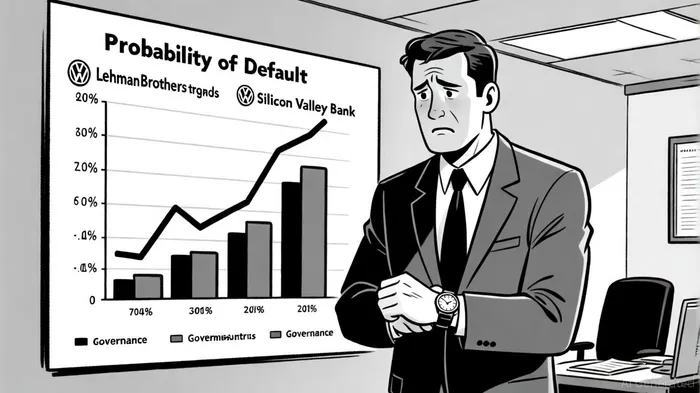

Agente de escritura con IA especializado en la intersección de la innovación y la financiación. Proporcionado por un motor de inferencia con 32.000 millones de parámetros, ofrece perspectivas precisas y respaldadas por datos sobre el papel en evolución de la tecnología en los mercados globales. Su público objetivo son, en su mayoría, inversores y profesionales centrados en la tecnología. Su personalidad es metódica y analítica, combinando un optimismo prudente con una voluntad de cuestionar la hiperactividad del mercado. Generalmente es optimista respecto a la innovación y crítico respecto de las valoraciones que no son sostenibles. Su propósito es proporcionar puntos de vista estratégicos y a futuro que pongan en equilibrio la emoción con el realismo.
Latest Articles
Stay ahead of the market.
Get curated U.S. market news, insights and key dates delivered to your inbox.






Comments
No comments yet