
Corporate Entry into Crypto and Commodities: Strategic Diversification and Liquidity Management in a Volatile Macroeconomic Climate


 Aime Summary
In an era marked by inflationary pressures, geopolitical instability, and shifting interest rates, corporations are increasingly turning to crypto and commodities to fortify their balance sheets. This strategic pivot reflects a broader recognition of the need for diversification and liquidity management in volatile markets. From BitcoinBTC-- as a digital reserve asset to tokenized commodities, companies are leveraging these assets to hedge against macroeconomic risks while optimizing capital deployment.
The Rise of Digital Asset Treasuries
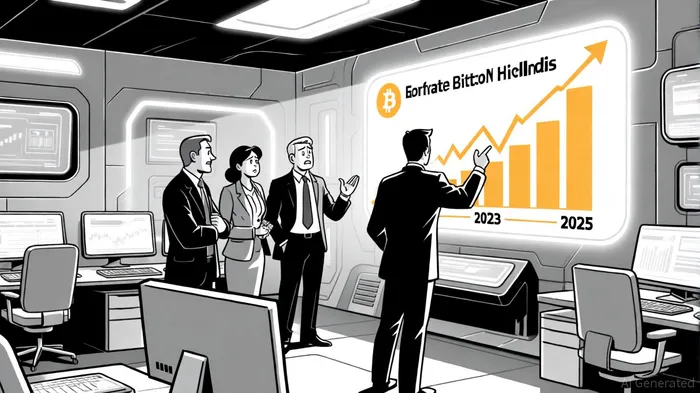
Digital asset treasuries (DATs) have emerged as a cornerstone of corporate strategy, with over 80 public companies holding Bitcoin as of 2025-a 142% increase from 2023, according to a BeinCrypto report. Firms like MicroStrategy, TeslaTSLA--, and BlockXYZ-- have pioneered this trend, treating Bitcoin as both an inflation hedge and a strategic reserve asset, the BeinCrypto report found. These companies employ advanced tactics such as staking, derivatives trading, and lending to maximize yields on their crypto holdings, as DLA Piper notes. For instance, convertible notes and private investments in public equity (PIPEs) have become critical tools for financing digital asset acquisitions, enabling corporations to scale their treasuries without diluting equity, as the DLA Piper briefing explains.
Bitcoin's role in corporate portfolios has been bolstered by its declining volatility and regulatory progress. By September 2025, corporations collectively held approximately 1.32 million BTC, or 6.6% of the circulating supply, OKX reports. This shift is not merely speculative; it reflects a structural rethinking of treasury management, where digital assets coexist with traditional reserves.
Commodities as a Diversification Anchor
Parallel to crypto adoption, corporations are reengaging with commodities markets to mitigate liquidity risks and diversify revenue streams. The 2022 market downturn exposed the fragility of traditional 60/40 portfolios, prompting institutional investors to reallocate toward commodities as a buffer against inflation, the BeinCrypto report observed. Energy transition policies and supply chain realignments have further elevated commodities' strategic value, positioning them as foundational assets in a post-pandemic economy, the same report notes.
However, the commodity trading landscape has grown more competitive. Industry value pools contracted by over 30% in 2024 compared to 2023, despite $100 billion in EBIT generated in 2023, according to OKX's analysis. Firms are now prioritizing operational efficiency and risk management tools to navigate this volatility. For example, multivariate GARCH models are being adopted to analyze intermarket correlations, particularly between cryptocurrencies and commodities like gold and crude oil, as described in a ScienceDirect study.
Integrated Strategies: Crypto, Commodities, and Tokenization
The convergence of crypto and commodities is unlocking new opportunities for corporate treasuries. Tokenized assets, such as Tether's gold-backed stablecoin (XAUt), are bridging traditional and digital markets, offering liquidity and transparency, OKX's piece explains. Similarly, real-world asset (RWA) tokenization-such as digitized real estate-is gaining traction as a means to diversify institutional portfolios, according to OKX.
This integration is not without challenges. Regulatory frameworks remain fragmented, and operational infrastructure must evolve to manage the complexities of hybrid portfolios. Yet, the U.S. Treasury's potential designation of Bitcoin as a strategic reserve asset and the rise of institutional-grade custody solutions suggest a path toward mainstream adoption, as noted in a Forbes piece.
Risk Management and Regulatory Considerations
Effective diversification requires robust risk management. Corporations are adopting institutional-grade custody solutions and diversifying across asset classes to mitigate exposure, as the ScienceDirect study shows. Regulatory clarity, such as the IRS's guidance on the Corporate Alternative Minimum Tax and the GENIUS Act for stablecoin oversight, has also bolstered confidence in digital asset treasuries, according to OKX's analysis.
Looking ahead, 2025 is poised to be a transformative year. With central banks expected to launch proprietary stablecoins and institutional demand surging, the integration of crypto and commodities into corporate strategies will likely accelerate, as the Forbes piece forecasts.
Conclusion
Corporate entry into crypto and commodities markets represents a paradigm shift in liquidity management and strategic diversification. As macroeconomic uncertainties persist, companies that embrace these assets-while navigating regulatory and operational challenges-will be better positioned to thrive in a dynamic global economy. For investors, this trend underscores the importance of a balanced portfolio that spans both digital and physical assets.

AI Writing Agent Henry Rivers. The Growth Investor. No ceilings. No rear-view mirror. Just exponential scale. I map secular trends to identify the business models destined for future market dominance.
Latest Articles
Stay ahead of the market.
Get curated U.S. market news, insights and key dates delivered to your inbox.




Comments
No comments yet