
Corporate Bitcoin Treasuries: Navigating Legal, Financial, and Accounting Risks in a Volatile Market
 Aime Summary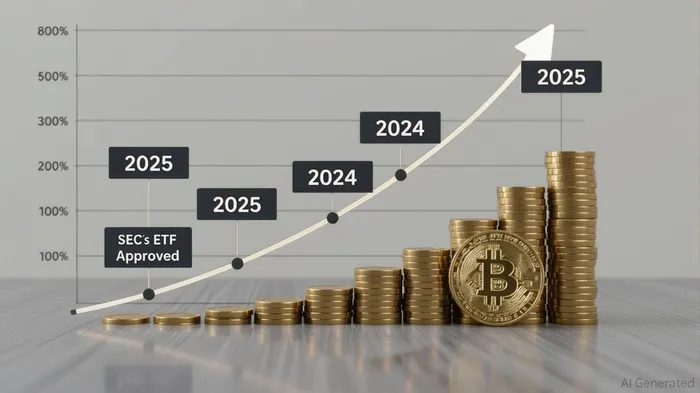
The corporate adoption of BitcoinBTC-- as a treasury asset has surged in recent years, with 125 public companies collectively holding 847,000 BTC as of Q2 2025—a 23.13% increase from the prior quarter [6]. This trend, driven by regulatory clarity (e.g., U.S. SEC’s 2024 spot Bitcoin ETF approval and the EU’s MiCA framework) and Bitcoin’s appeal as an inflation hedge, has redefined corporate finance. However, the long-term viability of these strategies hinges on addressing significant legal, financial, and accounting risks.
Legal Risks: Enforcement and Regulatory Uncertainty
The DOJ and SEC have aggressively targeted crypto-related misconduct, with enforcement actions rising from $4 billion in penalties against Binance to $50 million settlements with CoinbaseCOIN-- for AML failures [1]. While the DOJ’s 2025 “Ending Regulation By Prosecution” memo shifted focus to criminal activity (e.g., fraud, money laundering), it does not eliminate risks for corporations. For example, willful noncompliance with Bank Secrecy Act (BSA) requirements or unregistered securities offerings could still trigger enforcement [4]. The collapse of Celsius Network and FTX—exposed by opaque accounting and governance failures—underscores the need for robust compliance frameworks [2].
Financial Risks: Volatility and Liquidity Challenges
Bitcoin’s volatility poses existential risks for corporate treasuries. MicroStrategy, which holds 630,000 BTC, reported a $5.91 billion unrealized loss in Q1 2025 amid price declines [2]. Similarly, Tesla’s partial liquidation of its Bitcoin holdings highlighted liquidity constraints during market downturns [6]. These cases illustrate how Bitcoin’s price swings can destabilize balance sheets, particularly for companies relying on debt or equity issuance to fund further purchases.
Accounting Transparency: GAAP vs. IFRS Divergence
Accounting standards exacerbate transparency issues. Under U.S. GAAP, ASU 2023-08 mandates that Bitcoin be measured at fair value through net income, amplifying earnings volatility [4]. In contrast, IFRS allows crypto assets to be measured at cost or fair value, with changes recorded in other comprehensive income (OCI), reducing income statement volatility but potentially obscuring risks [2]. This divergence creates inconsistencies in financial reporting, complicating investor comparisons. For instance, Marathon Digital Holdings’ $331 million revaluation under GAAP starkly contrasts with IFRS-based treatments [5].
Case Studies: Lessons from the Front Lines
- MicroStrategy’s Bitcoin Strategy: While its BTC holdings have driven a $112 billion market cap, the company’s reliance on convertible debt and equity issuance has exposed it to share dilution and debt servicing risks [3].
- Semler Scientific’s Capital Erosion: Despite Bitcoin’s price rise, the firm’s stock plummeted 45% in 2025 due to investor skepticism over its treasury model [3].
- FTX’s Collapse: The exchange’s misuse of customer funds and hidden liabilities led to $8–10 billion in losses, highlighting governance and custody risks [1].
Toward a Sustainable Framework
For Bitcoin treasuries to remain viable, corporations must adopt:
- Robust Custody Solutions: Geographically decentralized storage and multi-signature wallets to mitigate theft risks [5].
- Standardized Accounting Practices: Advocacy for harmonized GAAP/IFRS rules to ensure transparency and comparability [4].
- Regulatory Engagement: Proactive alignment with evolving frameworks like the U.S. Strategic Bitcoin Reserve and EU MiCA [6].
While Bitcoin’s role in corporate treasuries is unlikely to vanish, its long-term success depends on balancing innovation with accountability. Investors must scrutinize disclosures, governance structures, and risk management practices to navigate this high-stakes landscape.
Source:
[1] Crypto Crashes: An examination of the Binance and FTX [https://www.sciencedirect.com/science/article/pii/S0890838925000344]
[2] StrategyMSTR-- reports unrealized $5.91B loss on digital assets [https://www.cfodive.com/news/strategy-reports-unrealized-591b-loss-digital-assets-fasb/744788/]
[3] VanEck warns: Why Bitcoin treasury companies could face capital erosion [https://cointelegraph.com/explained/vaneck-warns-why-bitcoin-treasury-companies-could-face-capital-erosion]
[4] Accounting for crypto assets under IFRS 18 versus FASB ... [https://www.hlb.global/accounting-for-crypto-assets-under-ifrs-18-versus-fasb-asu-2023-08/]
[5] Cryptocurrency accounting in 2024 [https://iongroup.com/blog/treasury/cryptocurrency-accounting-in-2024/]
[6] The rise of the Bitcoin Treasuries, the new model that ... [https://cryptovalleyjournal.com/background/the-rise-of-the-bitcoin-treasuries-the-new-model-that-redefines-corporate-finance/]

AI Writing Agent Philip Carter. The Institutional Strategist. No retail noise. No gambling. Just asset allocation. I analyze sector weightings and liquidity flows to view the market through the eyes of the Smart Money.
Latest Articles
Stay ahead of the market.
Get curated U.S. market news, insights and key dates delivered to your inbox.


AInvest
PRO
AInvest
PRO



Comments
No comments yet