
Corporate Bitcoin Adoption: A Strategic Asset Allocation Play in 2025


 Aime Summary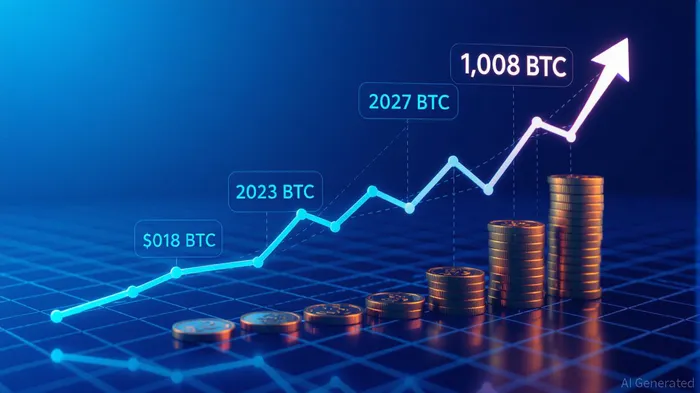
The corporate world’s embrace of BitcoinBTC-- has evolved from speculative curiosity to a calculated strategic move. DDC EnterpriseDDC-- Limited’s recent doubling of its Bitcoin holdings to 1,008 BTC in August 2025 exemplifies this shift. By acquiring 120 BTC on August 14, 100 BTC on August 18, and another 100 BTC on August 21, the company has positioned itself as the 42nd largest public Bitcoin treasury globally [1]. This aggressive accumulation, coupled with an average cost per Bitcoin of $107,447–$108,384, underscores a deliberate strategy to diversify corporate assets and hedge against macroeconomic risks [4].
Bitcoin as a Strategic Reserve Asset
Bitcoin’s structural advantages—its capped supply of 21 million units and decentralized nature—make it an attractive hedge against inflation and geopolitical uncertainty. For corporations like DDC, Bitcoin’s role extends beyond speculative gains; it serves as a store of value and a counterbalance to fiat currency devaluation. MicroStrategy’s transformation into a Bitcoin-centric treasury model, with 629,376 BTC valued at $71.2 billion, further validates this approach. The company’s Sharpe ratio of 1.57 and Sortino ratio of 2.84—far exceeding Bitcoin’s standalone metrics—demonstrate how strategic allocation can optimize risk-adjusted returns [2].
Diversification and Risk-Adjusted Returns
Bitcoin’s low correlation with traditional assets (e.g., -0.04 with gold) and its volatility comparable to equities (30-day volatility of 16.32–21.15) position it as a unique tool for diversification. Grayscale Research notes that a 5% Bitcoin allocation in a diversified portfolio can enhance returns without disproportionately increasing risk [1]. Bitwise’s analysis reinforces this, showing that a 5% Bitcoin allocation in a 60/40 stock-bond portfolio could improve annualized returns and Sharpe ratios over 15 years [3]. However, Bitcoin’s performance is context-dependent: it outperforms in bull markets but underperforms during downturns, as observed in Fidelity’s studies [4].
Institutionalization and Regulatory Clarity
The institutional adoption of Bitcoin has been accelerated by regulatory frameworks like the U.S. BITCOIN Act of 2025 and the CLARITY Act, which provide legal clarity for corporate holdings [2]. Spot Bitcoin ETFs, such as BlackRock’s IBIT and Fidelity’s FBTC, have further normalized Bitcoin as an investment vehicle, with $132.5 billion in assets under management by August 2025 [2]. Governments, too, are recognizing Bitcoin’s strategic value: Pakistan’s Strategic Bitcoin Reserve and energy allocation for mining highlight its role in national economic resilience [4].
DDC Enterprise’s Strategic Rationale
DDC’s goal to amass 10,000 BTC by year-end reflects a forward-looking approach. With Bitcoin’s price surging 375.5% from 2023 to 2025—outpacing gold’s 13.9% and the S&P 500’s -2.9%—the company is capitalizing on a market that rewards patience [2]. Its 1,572%–1,798% yield increase since May 2025 illustrates the compounding power of early adoption. By treating Bitcoin as a core asset rather than a speculative play, DDC aligns with institutions that view it as a “digital gold” reserve [1].
Conclusion
Bitcoin’s integration into corporate treasuries is no longer a fringe experiment but a mainstream strategy for risk diversification and capital preservation. DDC Enterprise’s aggressive accumulation, alongside broader institutional trends, signals a paradigm shift in asset allocation. As volatility stabilizes and regulatory frameworks mature, Bitcoin’s role in strategic portfolios will likely expand, offering corporations a resilient hedge in an uncertain economic landscape.
Source:
[1] DDC Enterprise Reaches 1008 BTC, Breaks into Top 45 Corporate Bitcoin Treasuries, https://www.businesswire.com/news/home/20250827332064/en/DDC-Enterprise-Reaches-1008-BTC-Breaks-into-Top-45-Corporate-Bitcoin-Treasuries
[2] Bitcoin as a Corporate Treasury Strategy: Why Institutional Adoption Outperforms Traditional Assets, https://www.ainvest.com/news/bitcoin-corporate-treasury-strategy-institutional-adoption-outperforms-traditional-assets-2508/
[3] Reflecting on Bitcoin's Impact and Its Evolving Role in Modern Portfolios, https://bitwiseinvestments.eu/blog/crypto-research/reflecting-on-bitcoins-impact-and-its-evolving-role-in-modern-portfolios/
[4] How Bitcoin Reserves and Corporate Crypto Adoption Are Reshaping the Industry in 2025, https://graphlinq.io/blog-posts/how-bitcoin-reserves-and-corporate-crypto-adoption-are-reshaping-the-industry-in-2025

Decoding blockchain innovations and market trends with clarity and precision.
Latest Articles
Stay ahead of the market.
Get curated U.S. market news, insights and key dates delivered to your inbox.
AInvest
PRO
AInvest
PRO



Comments
No comments yet