
Corpay’s Earnings Call: Vehicle Credit Underwriting and Divestiture Growth Claims Clash
 Aime Summary
Date of Call: Aug 5, 2026
Financials Results
- Revenue: $1.34B, up 21% YOY
- EPS: $7 cash EPS, up 36% YOY
- Operating Margin: 57.3% adjusted EBITDA margin, up 100 basis points YOY
Guidance:
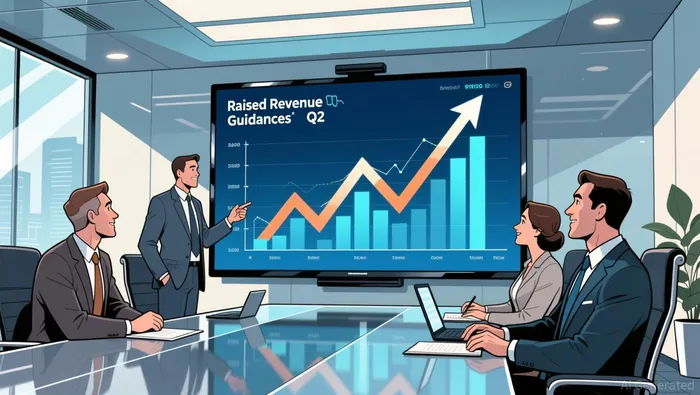
- Full year 2026 revenue guidance raised to $5.31B at the midpoint, up 17% YOY.
- Full year 2026 cash EPS guidance raised to $27.35 at the midpoint, up 28% YOY.
- Q3 revenue guide is $1.355B at the midpoint, up 16% YOY.
- Q3 organic revenue growth expected in the range of 9% to 11%.
- Expect 10% organic revenue growth for full year 2026.
- Corporate payments segment expected to maintain mid-teens plus organic growth.
- Lodging segment expected to accelerate to mid-single digits.
- Expect EPICS divestiture to reduce 2026 revenue by ~$40M but be EPS neutral via share repurchases.
Business Commentary:
Strong Financial Performance:
- CorePay reported
revenueof$1.34 billionfor Q2 2026, up21%year-on-year, exceeding expectations by$45 million. - The growth was driven by favorable macroeconomic conditions and strong underlying business performance, with cash EPS up
36%.
Organic Growth and Segment Performance:
- CorePay's
organic revenue growthwas10%, led by the corporate payments segment at16%and the vehicle payment segment at8%. - This performance was supported by sales growth of
30%and a retention rate of93%.
Raised Guidance and Strategic Focus:
- The company raised its full-year 2026
revenue guidanceto$5.31 billion, reflecting17%year-on-year growth, and increased its cash EPS guidance to$27.35. - This adjustment was driven by the Q2 revenue beat, expected macroeconomic favorability, and strategic divestitures like the EPICS sale.
Portfolio Repositioning and Growth Strategy:
- CorePay plans to simplify its portfolio by divesting subscale businesses and focusing on spend management, vehicle, and cross-border segments.
- The strategy aims to capitalize on a large revenue opportunity, targeting significant growth in these key areas.
M&A and Divestitures:
- CorePay announced the divestiture of the EPICS business, expected to close in September 2026, with a revenue reduction of
$40 million. - The company remains focused on accretive M&A, with some deals returning to a realistic valuation range, supporting its capital allocation strategy.
Sentiment Analysis:
Overall Tone: Positive
- Statements include: 'Q2 results were very, very good', 'an outstanding quarter', 'we're raising full-year revenue guidance', 'we've never felt clearer about the way forward than or even more excited about the prospects of the company', 'we're really in a great spot', 'we are delighted with the Q2 performance', 'we're confident in our raised second half guide'.
Q&A:
- Question from Ramsey Ellisella (Cantor Fitzgerald): As freight prices remain healthy... do you see an opportunity to open up the credit box a little bit more, maybe lean in harder to some slightly higher risk parts of the market to drive on the vehicle side of the business?
Response: Management acknowledged higher credit risk from fuel prices but stated they will not weaken underwriting standards to gain business.
- Question from Ramsey Ellisella (Cantor Fitzgerald): Should we think about [the EPICS divestiture] as more trimming more of these very small kind of embedded business lines, or is there an appetite... for larger, you know, simplification of something like a lodging segment?
Response: Management indicated they have identified a few more subscale businesses for divestiture over the next 6-12 months, focusing on simplification.
- Question from Ramsey Ellisella (Cantor Fitzgerald): Has the bar changed at all for M&A and buybacks given pipeline valuations?
Response: Management stated the bar has not changed and that some acquisition deals have returned to a realistic range, positioning the company well.
- Question from Ramsey Ellisella (Cantor Fitzgerald): How broad-based was the strong bookings growth? Where are you outperforming?
Response: Bookings growth was broad-based but particularly strong in corporate payments (sales growth ~40%) and vehicle segments, driven by strategic sales investments.
- Question from Ramsey Ellisella (Cantor Fitzgerald): Can the corporate payments organic growth rate of 16% sustain itself if not accelerate?
Response: Management believes the growth rate is driven by strong retention (~96-97%) and positive sales momentum, with the current plan involving balanced investment.
- Question from Ramsey Ellisella (Cantor Fitzgerald): Do the identified divestitures accelerate the revenue growth rate?
Response: Management indicated the divestitures are of subscale businesses and would be slightly growth dilutive, with the focus on adding billions of revenue through other means.
- Question from Mahira Bhatia (Bank of America): I was wondering if you could give us an update on the MasterCard, the FI channel... are you still expecting a couple of points of cross-border acceleration?
Response: The MasterCard FI partnership is progressing better than expected with 10 FIs closed and 100+ in the pipeline; management remains bullish on it.
- Question from Mahira Bhatia (Bank of America): Just thinking about the global banking... what's like is the monetization timeframe and expectations?
Response: Management expects a big step-up in monetization next year from the enhanced global banking product, which ties multiple local foreign accounts together.
- Question from Darren Peller (Wolf Research): Where are you thinking about cross-selling fleet management products into the spend management customer base?
Response: Management is embedding fleet networks into the spend management platform, selling the same platform to both fleet-intensive and traditional companies, which is a core advantage.
- Question from Darren Peller (Wolf Research): Should we expect further margin expansion and how much investment is needed to sustain 10%+ organic growth?
Response: Management achieved strong margins (57%) driven by macro flow-through and believes they are already invested at the right level, with no plan for significant further expansion.
- Question from Dave Coning (Baird): How much better would the quarter have been if Brazil was running normal? How's the Google partnership going?
Response: Brazil was slightly slower, but management has other initiatives to maintain performance. The Google search partnership is still an issue, but they have new ideas to mitigate it.
- Question from Dave Coning (Baird): The other revenue stream was up a lot sequentially. Does that create a tough comp?
Response: Yes, the volatility in the gift business and prior-year car changeover create a tougher comparison for the 'other' revenue stream in the back half.
- Question from Nate (Unknown Firm): Could you give more color on the 'Go Left' strategy? What products will help clients with vendor selection, and how big is that opportunity?
Response: The 'Go Left' strategy involves using AI to help clients make vendor/expense decisions before payment approval, leveraging partnerships and existing client base for revenue acceleration.
- Question from Nate (Unknown Firm): What came in better than expected in Q2 and what is expected to be better than expected for the rest of the year?
Response: Management emphasized confidence in achieving the raised second half guide, focusing on absolute growth rates (cash EPS exit rate over $29) rather than segment-specific variances.
- Question from Madison Sir (Raymond James): Touch on your confidence level around sustaining high single-digit organic vehicle growth given resource reallocation.
Response: Management is confident due to the durability and profitability of the business, improved retention and same-store sales from a better sales mix, and the focus now being on sales investment level.
- Question from Madison Sir (Raymond James): What are you seeing on the cross-border versus payable sides within corporate payments?
Response: Growth rates are similar between cross-border and payables, with potential upside from new offerings like the global banking product and international expansion.
- Question from Michael Infante (Morgan Stanley): How do you think about the Swift volume mix shift and the decision between Swift real-time and private blockchain rails like Conexus?
Response: Management is indifferent as long as speed and cost are favorable, viewing bank-led blockchain initiatives as increasing the likelihood of tokenized fiat currency adoption for faster, cheaper transfers.
- Question from Michael Infante (Morgan Stanley): Can you share anything on Avid's underlying split between software and payments revenue and supplier willingness to pay for software?
Response: Avid is performing well with revenue growth expected to tick up double digits; software revenue is stable with low single-digit growth, and the company is successfully monetizing new features and AI enhancements.
Contradiction Point 1
Underwriting Standards for Vehicle Credit
Contradiction on willingness to take on more credit risk for growth.
What are your thoughts on the company's recent financial performance? - Ramsey Ellisella (Cantor Fitzgerald)
2026Q2: We are experienced with fuel prices rising and the associated demand, which naturally increases credit risk. We have taken a provision for that in the quarter. However, we will not weaken our underwriting standards to gain business. - Peter Walker(CFO)
Given strong freight prices and improved fleet operator conditions, do you see an opportunity to expand credit terms to higher-risk segments to drive incremental growth in the vehicle business? - Ramsey El-Assal (Cantor Fitzgerald)
2026Q2: While there is experience with higher fuel prices leading to increased credit risk, a slight provision was taken in the quarter. Underwriting standards will not be weakened to gain business. - Peter, CFO, Corpay
Contradiction Point 2
Divestiture Impact on Growth
Contradiction on whether divested businesses are growth contributors or dilutive.
Questioner (Not Named) - Questioner (Not Named)
2026Q2: The EPICS and previous parking business divestitures were growth contributors (10-11% growers). - Ron Clark(CEO)
Do the divestitures you've identified accelerate revenue growth, and what are your thoughts on the M&A market for acquisitions? - Sanjay Sakhrani (KBW)
2026Q2: Divestitures like epyx and the previously mentioned parking business are slightly growth-dilutive as they were high growers. - Ron Clarke, Chairman and CEO, Corpay
Contradiction Point 3
Monetization Timeline for Global Banking
Contradiction on the expected timing for a significant revenue step-up from the global banking product.
Mahira Bhatia (Bank of America) - Mahira Bhatia (Bank of America)
2026Q2: We expect to see a big step-up next year. - Ron Clark(CEO)
What is the monetization timeline and revenue expectations for global banking over the next year or two? - Mihir Bhatia (Bank of America)
2026Q2: A significant step-up is expected next year. - Ron Clarke, Chairman and CEO, Corpay
Contradiction Point 4
Growth Outlook and Revenue Guidance for the Lodging Business
Contradiction in the expected performance and growth trajectory of the lodging segment.
Ramsey Ellisella (Cantor Fitzgerald) - Ramsey Ellisella (Cantor Fitzgerald)
2026Q2: The lodging business is not specifically called out as a growth driver. The focus is on divesting smaller, subscale businesses and expects to see more divestitures over the next 6 to 12 months. - Ron Clark(CEO)
Is the company's simplification strategy focused on trimming small embedded business lines or does it aim to streamline larger segments like lodging? - Ramsey El-Assal (Cantor Fitzgerald)
2026Q1: The business has stabilized... The pipeline is solid, and the company expects lodging to return to mid-to-high single-digit growth in the second half, helping improve overall growth rates. - Ron Clarke(CEO)
Contradiction Point 5
Partnership with Mastercard and Its Expected Contribution
Contradiction in the progress and expected near-term contribution from the Mastercard partnership.
Mahira Bhatia (Bank of America) - Mahira Bhatia (Bank of America)
2026Q2: The partnership with MasterCard is going better than expected... We have now closed 10 FIs and have 100 additional active FIs in the pipeline. The selling cycle with FIs is longer than with corporates, but we remain bullish on the opportunity. - Ron Clark(CEO)
Can you provide an update on the MasterCard FI channel pipeline and whether cross-border acceleration is still expected? - Michael Infante (Morgan Stanley)
2026Q1: They have secured a few sales contracts (~$5 million run rate) and have a pipeline of ~50 accounts. The sales cycle is slower than for end-businesses... The company remains bullish on its potential. - Ron Clarke(CEO)

Discover what executives don't want to reveal in conference calls
Latest Articles
Stay ahead of the market.
Get curated U.S. market news, insights and key dates delivered to your inbox.


AInvest
PRO
AInvest
PRO




Comments
No comments yet