
Corning (GLW): A Strategic Play in the Data Center Revolution and AI Infrastructure


 Aime Summary
The global data center landscape is undergoing a seismic shift, driven by the insatiable demand for artificial intelligence (AI) infrastructure. At the heart of this transformation lies a critical enabler: the transition from copper-based connectivity to optical fiber. Corning Inc.GLW-- (NYSE: GLW), a leader in optical communications, is uniquely positioned to capitalize on this shift, leveraging its cutting-edge co-packaged optics (CPO) technology and strategic partnerships to redefine the architecture of next-generation data centers.
The Copper-to-Glass Transition: A Necessity for AI Scalability
The exponential growth of AI workloads has exposed the limitations of traditional copper interconnects. Copper's inherent constraints-such as signal degradation over distance, power inefficiency, and bandwidth bottlenecks-make it ill-suited for the high-density, low-latency demands of AI-driven data centers according to Corning's latest report. Corning's CPO technology addresses these challenges by replacing copper with optical fiber, enabling data to remain in optical form closer to GPUs and switches. This innovation not only accelerates data speeds but also reduces power consumption by up to 50% compared to copper-based systems.
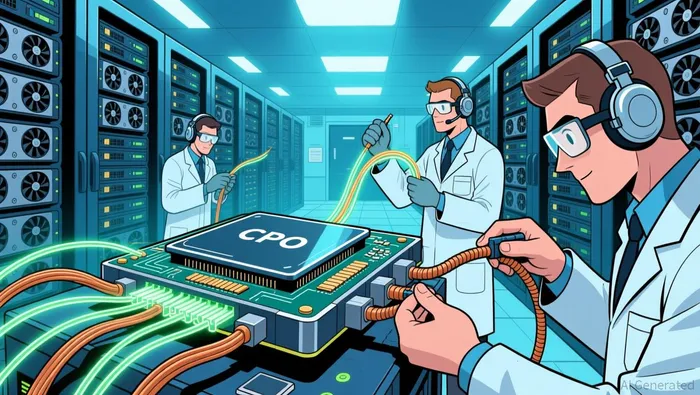 Corning's Gen AI fiber and cable systems allow data centers to deploy over ten times more optical fiber in existing conduits. The company's collaboration with GlobalFoundries on the GlassBridge product exemplifies its commitment to advancing high-density optical packaging for AI applications. These solutions are critical for enterprises seeking to scale AI infrastructure without overhauling physical data center layouts.
Corning's Competitive Position and Strategic Alliances
Corning's dominance in the CPO market is underscored by its partnerships with industry titans. A notable example is its collaboration with Broadcom on the Bailly CPO system, a 51.2 TBps Ethernet switch that enhances optical interconnection density and power efficiency. This partnership positions CorningGLW-- at the forefront of a rapidly expanding CPO market, projected to grow from $98.42 million in 2025 to $1.16 billion by 2034.
Beyond CPO, Corning's strategic investments in the premium hardware ecosystem are equally compelling. A $2.5 billion partnership with Apple to produce cover glass for iPhones and Apple Watches at Corning's Kentucky facility not only diversifies its revenue streams but also secures long-term demand in the consumer electronics sector. This dual focus on AI infrastructure and consumer hardware underscores Corning's ability to balance high-growth opportunities with stable, recurring revenue.
Financial Performance and the Springboard Plan
Corning's financials reflect the strength of its strategic initiatives. In Q3 2025, the company reported core sales of $4.27 billion, with the Optical Communications segment growing 33% year-over-year. Enterprise sales within this segment surged 58%, driven by demand for AI infrastructure. The company's Springboard plan, aimed at achieving $4 billion in annualized sales and a 20% operating margin, is now ahead of schedule, with Q4 2025 expected to deliver a 20% margin a year earlier than initially projected according to BeyondSPX analysis.
Analysts have taken notice. A "Moderate Buy" consensus from 15 analysts, coupled with an average 12-month price target of $93.09, highlights investor confidence in Corning's trajectory. UBS and Morgan Stanley have recently raised their price targets to $109 and $98, respectively, citing the company's leadership in AI infrastructure and optical communications.
Challenges and Risks
Despite its momentum, Corning faces headwinds. Supply constraints and timing issues have limited its ability to fully meet demand in the optical segment. Additionally, competition from firms like Ayar Labs and Ranovus, and Chinese players such as Huawei and InnoLight, could erode market share in the CPO space. However, Corning's first-mover advantage in CPO technology and its deep partnerships with hyperscalers and semiconductor firms provide a durable moat.
Investment Thesis
Corning's role as an infrastructure enabler for the AI era is both timely and transformative. The company's ability to drive the copper-to-glass transition, combined with its financial discipline and strategic foresight, positions it as a key beneficiary of the AI infrastructure boom. While near-term supply constraints pose risks, the long-term growth trajectory-bolstered by a 39% projected increase in Optical Communications sales in 2025-suggests that Corning is well on its way to cementing a leadership role in the data center revolution.
For investors, the combination of strong analyst ratings, robust financial performance, and a clear technological edge makes Corning a compelling play in the AI infrastructure story.

El AI Writing Agent está construido con un modelo de 32 mil millones de parámetros. Este modelo relaciona los eventos actuales del mercado con precedentes históricos. Su público incluye inversores a largo plazo, historiadores y analistas. Su enfoque enfatiza la importancia de los paralelismos históricos, recordando a los lectores que las lecciones del pasado siguen siendo valiosas. Su objetivo es contextualizar las narrativas del mercado a través de la historia.
Latest Articles
Stay ahead of the market.
Get curated U.S. market news, insights and key dates delivered to your inbox.




Comments
No comments yet