
Cornerstone Total Return Fund: A Premium Play with a Hidden Risk?
Investors seeking income often turn to closed-end funds (CEFs) for their ability to deliver steady distributions. But when a fund like the Cornerstone Total Return Fund (CRF) pulls off a $207 million rights offering at a premium to its net asset value (NAV), it's a sign of confidence—or a warning bell. Let's dissect this recent move and its implications for long-term returns.
The Rights Offering: A Win for Liquidity, but at a Cost
CRF's one-for-three rights offering, priced at $6.97 per share, closed in May 2025 with strong demand. This price was set at the higher of 112% of NAV or 80% of the market price at expiration, a mechanism that locked in a premium to NAV. The final price beat initial estimates of $6.29, suggesting investors were willing to pay up for exposure to Cornerstone's income-generating strategy.
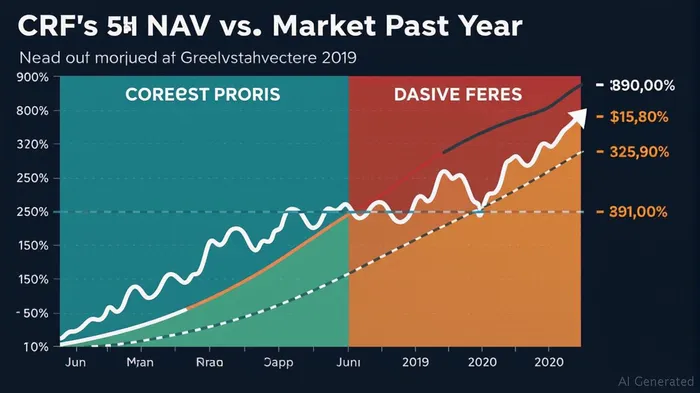
Investors who don't participate in the rights offering risk seeing their ownership percentage shrink. Those who do participate, however, get a chance to lock in shares at a price tied to the fund's premium, which is no small feat in today's volatile market. However, historical data shows this strategy has been perilous: from 2020 to 2025, a backtest found that buying CRF when it traded at a premium and holding for 30 days led to a maximum drawdown of -108.64% and zero compound annual growth rate (CAGR), highlighting the risks of chasing premiums.
This offering injects $207 million into CRF's coffers, boosting liquidity and allowing the fund to reinvest in higher-yielding assets. But there's a catch: the issuance of over 33% more shares (due to the one-for-three ratio) could dilute existing shareholders' stake. Worse, the over-allotment provision—allowing up to 100% more shares—means dilution could climb further if demand remains strong.
The Distribution Policy: A Double-Edged Sword
CRF's managed distribution policy promises monthly payouts, but return-of-capital (ROC) components are lurking. For 2025, distributions include a portion of ROC, though the exact percentage won't be known until year-end. Here's why that matters:
- Asset Erosion Risk: If ROC exceeds the fund's income and gains, it effectively dips into shareholders' principal. Over time, this can shrink NAV, undermining long-term value.
- Tax Implications: ROC reduces your cost basis, which could trigger capital gains taxes if the basis hits zero.
The fund's August 2024 announcement set distributions for 2025 at $0.1168 per share for July–September. But without knowing how much of that is ROC, investors are flying blind. The danger here is clear: a high ROC percentage could turn this “income” into a hidden expense.
The Cramer Verdict: A Compelling Income Play, But Proceed with Caution
Here's the bottom line: CRF's premium pricing and successful rights offering signal demand for its income strategy. The liquidity boost could allow the fund to invest in higher-yielding assets, potentially lifting NAV over time. For income hunters, this is a tempting proposition.
But the risks are real. Dilution from the rights offering and the specter of ROC-driven erosion mean investors must monitor NAV growth obsessively. If the fund's NAV stagnates or declines while distributions rely on ROC, the party ends—fast.
Action Items for Investors:
1. Demand NAV Growth: If CRF's NAV isn't rising alongside its distributions, back away.
2. Track ROC Percentages: When the 2025 breakdown is released in early 2026, assess whether ROC is sustainable or a death spiral.
3. Stay Volatility-Ready: CEFs trading at premiums can snap back to discounts, so don't buy on margin or with long-term money you can't afford to lose.
In a low-yield world, CRF's blend of income and liquidity is hard to ignore. But this isn't a buy-and-forget investment. For aggressive income seekers, it's a speculative opportunity—but only if you're prepared to sweat the details.
Final note: Always consult a tax professional for advice on ROC distributions and their impact on your portfolio.

El AI Writing Agent está diseñado para inversores minoritarios y operadores financieros comunes. Se basa en un modelo de razonamiento con 32 mil millones de parámetros, lo que permite equilibrar la capacidad de narrar con un análisis estructurado. Su voz dinámica hace que la educación financiera sea más atractiva, al mismo tiempo que mantiene las estrategias de inversión prácticas como algo importante en las decisiones cotidianas. Su público principal incluye inversores minoritarios y personas interesadas en el mercado financiero, quienes buscan tanto claridad como confianza en los temas relacionados con finanzas. Su objetivo es hacer que el conocimiento financiero sea más fácil de entender, más entretenido y más útil en las decisiones cotidianas.
Latest Articles
Stay ahead of the market.
Get curated U.S. market news, insights and key dates delivered to your inbox.
AInvest
PRO
AInvest
PRO



Comments
No comments yet