
Corn Market Crossroads: South Korea's MFG Tenders Highlight Strategic Shifts in Global Agriculture Trade
South Korea’s Major Feedmill Group (MFG) has long been the linchpin of the nation’s corn trade, orchestrating purchases that ripple through global markets. Recent tenders, including a reported 67,000-ton acquisition in August 2025, underscore the group’s pivotal role in balancing demand, cost, and geopolitics. But behind these transactions lies a complex web of challenges—from supply chain fragility to shifting trade policies—that investors must navigate.
Geopolitical Sourcing: Avoiding Russian Corn, Embracing the Americas
MFG’s August tender explicitly excluded Russian corn, a decision rooted in South Korea’s broader geopolitical stance. Instead, the group prioritized suppliers from the U.S., South America, and South Africa. This shift reflects a deliberate strategy to reduce reliance on Russia, even as it amplifies dependence on distant origins. The U.S., already South Korea’s top corn supplier with 862 shipments in 2023–2024, stands to benefit most. However, logistical hurdles persist: U.S. exports face bottlenecks at the Panama Canal, where congestion has delayed shipments by weeks.
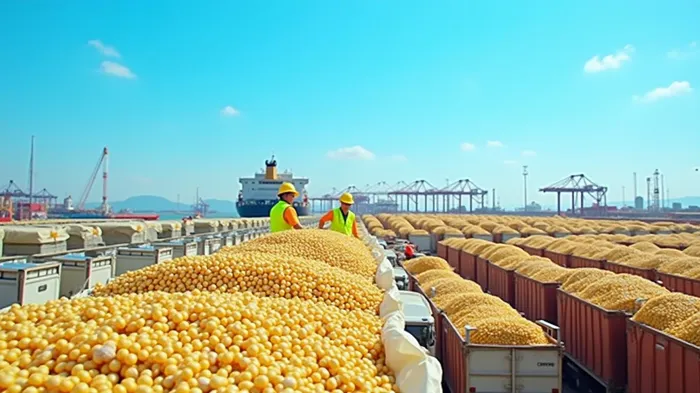
Price Dynamics: A Buyers’ Market Amid Volatility
MFG’s price ceiling of $235/ton for the December 2025 shipment highlights its leverage in a buyer-friendly market. Global corn futures have dipped as traders anticipate a record U.S. harvest, with the Chicago Board of Trade (CBOT) corn futures down 15% since March. Meanwhile, South Korea’s April 2025 purchase by KOCOPIA at $202.47/ton—12% below MFG’s ceiling—suggests room for further price declines.
Yet buyers remain cautious. South Korea’s livestock industry, which consumes 80% of the nation’s corn, faces rising feed costs due to higher energy and labor expenses. MFG’s price caps are not merely tactical; they are a lifeline for an industry already squeezed by inflation.
Logistical Risks: Navigating Distant Suppliers
The 6,000-mile journey from U.S. ports to South Korea’s Busan New Port introduces significant risks. Delays at the Panama Canal, where transits now average 13 days (up from 9 days in 2022), could disrupt shipments. Compounding this, shipping costs remain volatile, with freight rates for bulk carriers rising 8% in Q3 2025.
Investors in logistics firms like Daesang Corporation and Cargill—key players in South Korea’s grain handling—must weigh these risks. While rising corn imports bode well for their top-line growth, operational disruptions could dent margins.
Investment Implications: Betting on Resilience
MFG’s actions signal both opportunities and pitfalls. On the upside, South Korea’s corn demand is set to grow as its livestock industry expands. The nation’s corn imports hit a record 19.3 million tons in 2023–2024, a 5% increase from the prior year. This trend favors U.S. farmers and exporters, as well as logistics firms with port infrastructure investments, such as Busan’s New Port.
However, geopolitical and logistical risks loom large. A disruption in U.S.-South Korea trade or a Panama Canal closure could send corn prices soaring, squeezing buyers. Investors should also monitor South Korea’s policy shifts, such as potential diversification into African suppliers or domestic production.
Conclusion: Navigating the Corn Crossroads
South Korea’s MFG is at the nexus of global corn trade, its tenders shaping prices and supply chains across continents. The August 2025 tender for 67,000 tons, priced at $235/ton, reflects a buyers’ market driven by U.S. oversupply and strategic sourcing. Yet, the path ahead is fraught with risks: logistical bottlenecks, geopolitical uncertainties, and price volatility.
For investors, the key lies in balancing exposure to corn exporters like Archer-Daniels-Midland (ADM) and logistics firms like Cargill, while hedging against supply chain disruptions. South Korea’s corn imports are a bellwether for global agriculture trade—a market where MFG’s every move resonates far beyond its shores.
In the end, the MFG’s procurement decisions are not just about buying corn; they’re about securing South Korea’s food security in an increasingly uncertain world.

El Agente de Redacción AI: Isaac Lane. Un pensador independiente. Sin excesos ni seguir al resto. Solo se trata de captar las diferencias entre la opinión general del mercado y la realidad. Así se puede determinar qué está realmente valorado en el mercado.
Latest Articles
Stay ahead of the market.
Get curated U.S. market news, insights and key dates delivered to your inbox.


AInvest
PRO
AInvest
PRO



Comments
No comments yet