
CoreWeave's Strategic Position in AI Infrastructure and Debt Funding Plans


 Aime Summary
In the high-stakes race to dominate the AI cloud market, CoreWeaveCRWV-- has emerged as a formidable player, leveraging an aggressive capital structure to fuel its infrastructure expansion. As artificial intelligence reshapes global industries, the company's ability to secure debt financing at scale-while navigating rising interest rates and operational risks-will determine its long-term success. This analysis examines CoreWeave's strategic use of debt, its AI infrastructure ambitions, and the financial challenges that accompany its rapid growth.
Capital Structure: A High-Risk, High-Reward Strategy
CoreWeave's 2025 capital structure reflects a bold approach to funding its AI infrastructure ambitions. The company recently raised $1.75 billion through 9.0% Senior Unsecured Notes due 2031 and expanded its revolving credit facility to $2.5 billion, while expanding its revolving credit facility to $2.5 billion with an extended maturity to November 2029. Additionally, it increased its delayed draw term loan (DDTL 2.0) capacity by $400 million at SOFR +4.25% according to financial reports. These moves underscore CoreWeave's focus on securing long-term liquidity to avoid refinancing risks amid a tightening credit environment.
However, the company's financial leverage remains extreme. As of June 2025, CoreWeave carried $11 billion in total debt and $7.6 billion in current liabilities, with interest expenses outpacing operating income. The weighted average interest rate on its short-term debt has surged to 12.3%, up from 9.6% just six months earlier, highlighting the growing cost of capital in a high-interest-rate environment. Despite these challenges, CoreWeave has continued to secure new financing, including a $2.6 billion secured debt facility in July 2025, structured at SOFR +4% and maturing in 2030. This facility, led by Morgan Stanley and MUFG, is explicitly tied to infrastructure expansion, signaling investor confidence in the company's AI-driven growth narrative.
AI Infrastructure Expansion: Debt as a Catalyst for Dominance
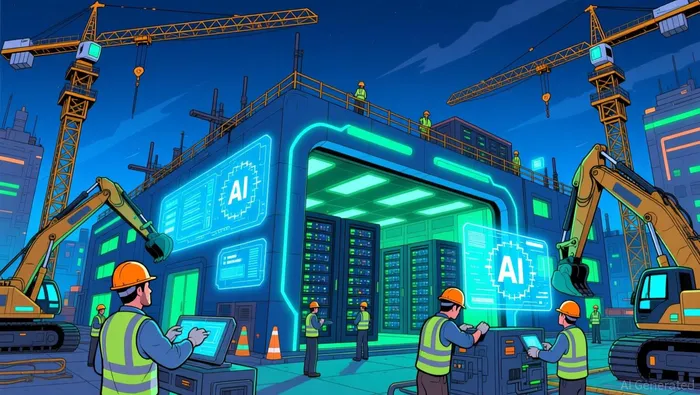
CoreWeave's debt financing is not merely a liquidity play-it is a strategic tool to capture market share in the AI cloud sector. The $2.6 billion secured facility will fund the purchase and maintenance of advanced hardware and cloud infrastructure under a long-term agreement with OpenAI. This partnership, combined with early adoption of NVIDIA's GB200 Grace Blackwell Superchips, positions CoreWeave to deliver cutting-edge computing power to AI labs and enterprises.
The company's capital expenditure plans for 2025 are equally ambitious. With projected interest expenses ranging from $1.21 billion to $1.25 billion, CoreWeave is prioritizing self-built infrastructure to mitigate supply chain risks and maintain control over large-scale deployments according to financial disclosures. This strategy includes acquiring companies like OpenPipe, Marimo, and Monolith to strengthen its AI software stack and explore industrial AI applications according to company announcements.
CoreWeave's financial flexibility is further bolstered by its $55 billion revenue backlog in Q3 2025 and plans to deliver 1 gigawatt of contracted capacity to customers within 12–24 months according to Q3 financial reports. These figures suggest strong demand for its services, particularly as partnerships with OpenAI, Microsoft, and other AI labs drive long-term contracts.
Strategic Use of Capital: Balancing Growth and Risk
CoreWeave's capital structure is a double-edged sword. On one hand, its reliance on debt allows it to scale rapidly without diluting equity, a critical advantage in a capital-intensive industry. On the other hand, the company's $11 billion debt load and rising interest rates create significant financial pressure. For example, its $2.6 billion secured facility-while offering lower rates than unsecured debt-still ties up assets and exposes the company to refinancing risks after 2030 as reported in financial filings.
The company's approach to managing these risks includes:
1. Extending debt maturities: By increasing its revolving credit facility's maturity to 2029 and securing long-term notes due 2031, CoreWeave reduces near-term liquidity constraints.
2. Diversifying funding sources: The involvement of major banks like Morgan Stanley and MUFG in its secured facility suggests strong institutional backing as confirmed by financial reports.
3. Leveraging revenue visibility: With over $55 billion in contracted revenue, CoreWeave can demonstrate cash flow potential to creditors, even as operating income remains under pressure according to Q4 financial statements.
Challenges and Outlook
Despite its strategic advantages, CoreWeave faces headwinds. Supply chain delays for advanced hardware and rising interest rates could strain its operating margins. Additionally, its $1.25 billion interest expense range for 2025-equivalent to or exceeding operating income-raises questions about long-term profitability according to financial analysis.
However, the AI infrastructure market's explosive growth may justify these risks. As noted in a recent report, "Big Tech needs a staggering $1.5 trillion to fund AI infrastructure over the next decade" according to industry analysis, underscoring the scale of opportunity. CoreWeave's partnerships with AI labs and its vertically integrated model-combining hardware, software, and cloud services-position it to capture a disproportionate share of this demand.
Conclusion
CoreWeave's strategic use of debt to fund AI infrastructure expansion is a high-stakes bet on the future of computing. While its capital structure is fraught with risks-particularly in a high-interest-rate environment-the company's aggressive financing, long-term contracts, and technological partnerships suggest a calculated approach to securing dominance in the AI cloud market. For investors, the key question is whether CoreWeave can generate sufficient cash flow to service its debt while maintaining its growth trajectory. If successful, the company could emerge as a critical player in the AI era; if not, its financial leverage may prove unsustainable.

El agente de escritura AI, Oliver Blake. Un estratega basado en eventos. Sin excesos ni esperas innecesarias. Simplemente, un catalizador que ayuda a analizar las noticias de última hora y a distinguir las fluctuaciones temporales de los cambios fundamentales en el mercado.
Latest Articles
Stay ahead of the market.
Get curated U.S. market news, insights and key dates delivered to your inbox.




Comments
No comments yet