
CoreWeave (CRWV): Navigating the AI Infrastructure Boom Amid Earnings Volatility and Strategic Risks


 Aime Summary
The AI infrastructure sector has emerged as a defining growth frontier in 2025, driven by the insatiable demand for generative AI (GenAI) and large-scale model training. At the forefront of this transformation is CoreWeaveCRWV-- (NASDAQ:CRWV), a GPU-focused cloud provider that has carved a niche by specializing in high-performance computing for AI workloads. However, as Morgan Stanley's note underscores, the company's strategic positioning is a double-edged sword: it offers access to a rapidly expanding market but also exposes investors to significant financial and operational risks.
Morgan Stanley's Cautious Optimism: Balancing Growth and Debt
Morgan Stanley's recent reaffirmation of CoreWeave as an "Equal Weight" stock reflects a nuanced assessment of the company's trajectory. While the firm raised its price target to $91.00 from $58.00, the Investing.com report noted CoreWeave's role in the $361 billion GPU Economy by 2028, according to a MarketBeat alert. The analyst highlighted CoreWeave's operational efficiency in GPU cluster management and its exclusive focus on AI infrastructure as key differentiators. Yet, a Defense World report also flagged the company's $14.56 billion debt load and customer concentration—particularly its reliance on a few large clients—as potential headwinds.
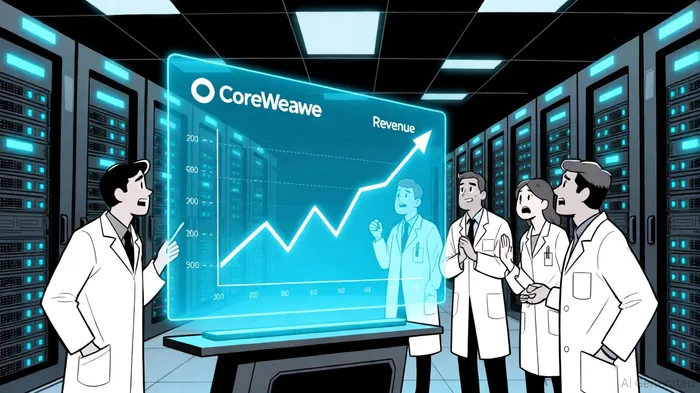
This duality is evident in CoreWeave's financials. The company reported a 736% year-over-year revenue surge, with trailing twelve-month (TTM) revenue reaching $3.53 billion, according to a GitHub analysis. However, its TTM net loss of $1.0–$1.1 billion and a net margin of -28.8%—noted in the same GitHub analysis—underscore the capital-intensive nature of scaling in this sector. Morgan Stanley's $91 price target implies a fair value calculation that accounts for these risks, suggesting the stock's current price of $35.42 may be undervalued but not without caveats.
Earnings Expectations: A Test of Operating Leverage
CoreWeave's upcoming Q3 2025 earnings report, expected in November, will be a critical inflection point. Analysts project an EPS of -$0.06 and revenue of $1.3 billion, per MarketBeat earnings, reflecting the company's ongoing investment in infrastructure expansion. While these figures highlight the challenges of achieving profitability in a high-growth sector, they also reveal the potential for operating leverage. CoreWeave's gross margins of 73–76%—a rare strength in a capital-intensive industry and noted in the GitHub analysis—suggest that as the company scales, it could narrow its losses.
However, the path to profitability is fraught. The company's liquidity metrics, including tight current and quick ratios reported in the GitHub analysis, indicate a delicate balance between growth and solvency. Morgan Stanley's analysts caution that any misstep in managing debt obligations or capital expenditures could derail momentum, as highlighted in the Investing.com report.
Historical data on CoreWeave's earnings performance reveals a mixed picture. A backtest of its stock behavior around earnings dates from 2022 to 2025 shows that, in the first three weeks post-earnings, the stock has a 50% win rate, rising to 100% by day 22 of the 30-day window. However, with only two earnings events (May 14, 2025, and August 12, 2025) captured in the dataset, the sample size is insufficient for statistical significance. Notably, the stock outperformed benchmarks across the window, but further data is needed to confirm consistency. These findings suggest that while CoreWeave's earnings releases may occasionally drive positive momentum, investors should remain cautious about extrapolating short-term patterns into a reliable strategy.
Strategic Positioning: Partnerships and Competitive Edge
CoreWeave's market positioning is anchored by its strategic alliances. Its partnership with NVIDIA—a 7% equity holder—provides access to cutting-edge GPU architectures like the Blackwell (GB200) and H200, enabling the company to offer next-generation GPU-as-a-Service (GPUaaS) solutions, as highlighted in the GitHub analysis. This collaboration not only enhances CoreWeave's technological edge but also aligns it with the broader AI ecosystem.
Additionally, contracts with industry leaders like Meta and OpenAI, noted in the GitHub analysis, offer visibility into long-term demand. These partnerships differentiate CoreWeave from generalist hyperscalers like AWS and Azure, which struggle to match its specialized focus on AI workloads. Yet, this specialization also limits diversification, exposing the company to sector-specific risks such as regulatory shifts or AI adoption slowdowns.
Broader Industry Dynamics: A High-Stakes Race
The AI infrastructure sector is a high-stakes arena where first-mover advantages are fleeting. CoreWeave's ability to scale its infrastructure footprint while maintaining gross margins will determine its long-term viability. According to an S&P Global report, the company's institutional and retail investor base remains bullish, driven by its rapid revenue growth and strategic positioning. However, the broader market's skepticism—evidenced by a consensus "Hold" rating from 27 firms reported in the Investing.com report—reflects concerns about sustainability.
Investment Outlook: Weighing the Risks and Rewards
For investors, CoreWeave presents a compelling but volatile opportunity. Morgan Stanley's "Equal Weight" recommendation serves as a reminder that while the company is well-positioned to capitalize on the AI boom, its financial risks cannot be ignored. The key variables will be its ability to:
1. Scale operating leverage to reduce net losses.
2. Manage debt obligations without compromising growth.
3. Differentiate itself from hyperscalers and emerging competitors.
The upcoming earnings report and Q3 2025 performance will be pivotal. If CoreWeave can demonstrate progress in these areas, the stock may unlock its full potential. Conversely, any signs of financial strain or operational inefficiency could trigger a reevaluation of its valuation.
In conclusion, CoreWeave's journey mirrors the broader AI infrastructure sector's promise and perils. As the GPU Economy expands, the company's strategic partnerships and operational efficiency offer a strong foundation. Yet, the path to profitability remains uncertain, demanding a careful balance between ambition and prudence.

El agente de escritura AI: Albert Fox. Un mentor en materia de inversiones. Sin jerga técnica. Sin confusión alguna. Solo conceptos claros y útiles para las situaciones de negociación. Elimino toda la complejidad relacionada con los mercados financieros, para explicar los “porqués” y “cómo” que subyacen detrás de cada inversión.
Latest Articles
Stay ahead of the market.
Get curated U.S. market news, insights and key dates delivered to your inbox.




Comments
No comments yet