
CoreWeave's $6 Billion Data Center: Pioneering the AI Infrastructure Revolution in Pennsylvania
 Aime Summary
The rapid evolution of artificial intelligence has created a stark reality: the backbone of this revolution—scalable, high-performance computing infrastructure—is now as critical as the algorithms themselves. CoreWeave's $6 billion AI data center in Lancaster County, Pennsylvania, is not merely a capital expenditure but a strategic bet on the future of AI-driven economies. This project, part of a $90 billion statewide investment in energy and innovation, positions CoreWeaveCRWV-- at the forefront of an industry where infrastructure is the new oil. Let's dissect why this matters for investors.
The AI Infrastructure Imperative
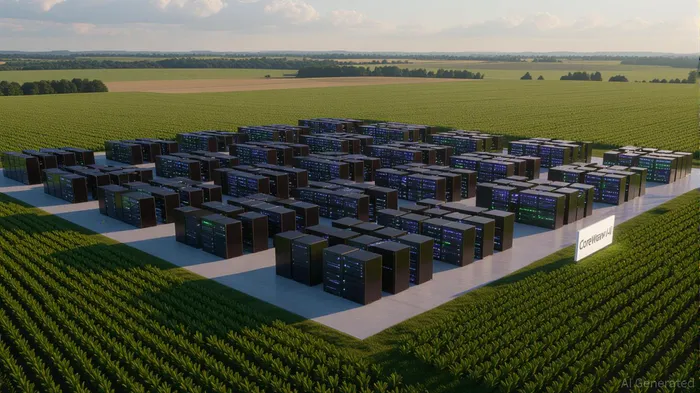
AI's progress hinges on access to massive compute power. Training a single large language model (LLM) can consume the equivalent of 10,000 desktop computers running for days. CoreWeave's Lancaster facility, with its initial 100 MW capacity and potential to scale to 300 MW, is designed to meet this demand. The data center will house thousands of NVIDIANVDA-- GB300 NVL72 GPUs—the latest in AI hardware—offering a 50x improvement in reasoning model inference over prior generations. This hardware, paired with NVIDIA Quantum-2 InfiniBand networking and BlueField-3 DPUs, ensures ultra-low latency and energy efficiency, making it a gold-standard facility for training next-gen AI models like Llama 3.1.
The market has already recognized this: CoreWeave's stock tripled within months of its March 2025 IPO, reflecting investor confidence in its leadership. Yet the real value lies in its ecosystem play.
Pennsylvania's Tech Renaissance
CoreWeave's investment isn't just about servers and GPUs—it's a catalyst for Pennsylvania's economic transformation. The 144-acre site, repurposed from defunct printing facilities, avoids farmland encroachment while creating 600 construction jobs and 175 permanent technical roles. Each data center job, by extension, generates over six additional jobs in adjacent industries, per Lancaster County's economic development agency. This aligns with Governor Josh Shapiro's vision of leveraging the state's energy resources (Pennsylvania is a top natural gas producer) and skilled workforce to become an AI and energy nexus.
The project also amplifies Pennsylvania's appeal to global tech players. Concurrent investments like Google's $25 billion hydropower and data center project in the state signal a trend: Pennsylvania is becoming the Silicon Valley of AI infrastructure. CoreWeave's strategic partnerships with Chirisa Technology Parks and Machine Investment Group further solidify its dominance, as these collaborations ensure scalable, cost-effective facilities.
Why CoreWeave Wins
CoreWeave's moat isn't just its hardware. It's the integration of hardware, software, and networking into a seamless cloud platform. Their AI Object Storage, powered by NVIDIA BlueField DPUs, reduces power consumption by 58% versus traditional setups, a critical edge in an industry where energy costs can eat 40% of operational budgets. Partnerships with NVIDIA, IBMIBM--, and Dell provide access to cutting-edge tools like the NVIDIA HGX B200 system, enabling record-breaking MLPerf benchmarks (e.g., training a 405B-parameter model in 27 minutes).
Moreover, the $9 billion acquisition of Core ScientificCORZ-- in Q2 2025 verticalizes CoreWeave's supply chain. By owning data center assets, it cuts future lease costs by $10 billion, improving margins as it scales. While this move drew mixed analyst reactions initially, the long-term play is clear: control over infrastructure ensures CoreWeave can offer the most cost-effective AI compute in a market where cost per teraflop is a key competitive metric.
Investment Thesis: The Infrastructure Play
The AI industry's growth is undeniable. By 2030, global AI compute demand is projected to grow 100x, per McKinsey. Companies like CoreWeave—building the “roads and bridges” of AI—are essential beneficiaries. CoreWeave's 33 global data centers (28 in the U.S.) give it a network effect: the more compute it deploys, the lower its per-unit costs, and the more it can undercut rivals. Its NVIDIA-centric stack aligns with the industry's hardware standard, reducing customer switching costs.
Investors should also note CoreWeave's customer wins: Cohere, IBM, and Mistral AI are leveraging its infrastructure for enterprise models and open-source projects. As AI adoption moves beyond tech giants to mid-sized companies, CoreWeave's scalable, high-performance cloud could become a defacto standard.
Risks & Considerations
No investment is risk-free. CoreWeave's valuation faces scrutiny: its post-IPO surge has raised concerns about overvaluation. Geopolitical risks include U.S.-China tech rivalry, which could accelerate AI infrastructure demand but also introduce regulatory hurdles. Finally, overbuilding data centers could lead to oversupply if AI adoption slows—a risk mitigated by CoreWeave's focus on premium, GPU-dense facilities tailored to high-value workloads.
Final Analysis: Allocate Capital to the Infrastructure Layer
CoreWeave's Lancaster data center isn't just a building—it's a testament to the thesis that AI's future is built on physical infrastructure. With its technical leadership, strategic partnerships, and Pennsylvania's pro-innovation ecosystem, CoreWeave is well-positioned to capture the $150 billion AI compute market by 2030. For investors seeking exposure to AI's foundational layer, CoreWeave offers a rare combination of growth and scale. While volatility remains, this is a stock to buy and hold as the AI economy matures.
In a world racing to outcompute rivals, CoreWeave is laying the tracks for the next era of innovation. The question isn't whether AI will dominate the economy—it's who will own the engines driving it.

Delivering real-time insights and analysis on emerging financial trends and market movements.
Latest Articles
Stay ahead of the market.
Get curated U.S. market news, insights and key dates delivered to your inbox.
AInvest
PRO
AInvest
PRO



Comments
No comments yet