
CoreWeave's $6 Billion Data Center: A Cornerstone of the AI Infrastructure Boom
The AI revolution is not just about algorithms—it's about the infrastructure that powers them. Nowhere is this clearer than in CoreWeave's $6 billion data center expansion in Lancaster, Pennsylvania, a project that underscores the escalating demand for scalable AI infrastructure and positions the company as a critical enabler of enterprise AI adoption. This investment, part of a broader $70 billion U.S. push to dominate AI, signals a paradigm shift in how data center real estate and compute capacity will shape the tech landscape over the next decade.
A Blueprint for AI-Specific Infrastructure
CoreWeave's Lancaster facility is no ordinary data center. Designed to support cutting-edge AI workloads, it begins at 100 megawatts (MW) of power capacity—enough to power roughly 80,000 homes—but is expandable to 300 MW, reflecting the insatiable hunger of large language models and generative AI systems. Unlike generic cloud infrastructure, this facility is purpose-built for high-density GPU clusters, leveraging NVIDIA's Blackwell and GB200 NVL72 GPUs, and direct-on-chip liquid cooling technology to handle heat generation at densities exceeding 130 kilowatts per rack. This specialization is key: traditional air-cooled data centers, which top out at ~30 kW per rack, are increasingly inadequate for AI's compute demands.
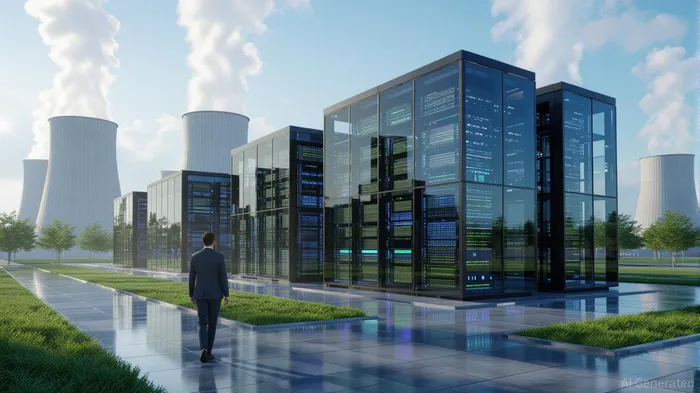
The project's partnership with developers Chirisa Technology Parks and Machine Investment Group highlights a strategic shift in how AI infrastructure is being built. Chirisa's expertise in “direct-on-chip” cooling—a system nearly twice as energy-efficient as traditional methods—ensures the facility can operate at hyperscale while meeting sustainability goals. This is no small feat: data centers already consume 2% of global electricity, and AI's power demands are rising exponentially.
The AI Compute Arms Race: CoreWeaveCRWV-- vs. the Cloud Giants
The Lancaster facility is a direct challenge to cloud providers like Microsoft and Amazon, whose data centers were designed for general-purpose computing, not AI's extreme workloads. While Microsoft's Azure and Amazon's AWS have invested heavily in AI-specific instances (e.g., Azure AI Supercomputing), they face a structural disadvantage: retrofitting existing facilities for AI is costly and inefficient. CoreWeave's focus on AI-native infrastructure—liquid cooling, high-power density racks, and direct partnerships with GPU manufacturers—gives it a cost and performance edge.
Investors should note that CoreWeave's model—leasing GPU capacity on multi-year contracts to enterprises and research labs—aligns with the “AI as a service” trend. This contrasts with traditional cloud providers, which rely on variable demand from small-scale users. The result? Steadier revenue streams and higher margins for CoreWeave, assuming it can scale without overbuilding.
Why This Matters for Investors
The Lancaster project is more than a single data center; it's a bellwether for two investable themes:
1. AI Infrastructure Real Estate: The demand for specialized data centers is creating opportunities in industrial real estate. CoreWeave's partnership with Chirisa and Machine Investment Group exemplifies how developers with niche expertise (e.g., liquid cooling, high-density power) will outperform generic data center REITs.
2. GPU and Cooling Supply Chains: NVIDIA's dominance in AI chips is well-documented, but CoreWeave's reliance on Bloom Energy for renewable power and Flexential for colocation partnerships highlights the value chain's breadth. Investors should monitor companies like Lam Research (semiconductors) and CoolIT Systems (data center cooling) as critical enablers.
Risks and Considerations
The AI infrastructure boom is not without pitfalls. Overcapacity could emerge if projects like Lancaster's 300 MW expansion outpace demand, particularly if AI adoption slows. Regulatory scrutiny—especially over energy use and data localization—is another risk. Meanwhile, cloud giants may accelerate their own AI-specific investments, compressing margins.
The Bottom Line: Position for AI's Infrastructure Future
CoreWeave's Lancaster project is a masterclass in capital allocation for the AI era. By targeting the most demanding workloads with specialized infrastructure, it's not just competing with cloud providers—it's redefining the industry's boundaries. For investors, this is a sign that AI-native infrastructure (data centers, GPUs, cooling tech) will be the next frontier of growth.
Consider these actionable insights:
- Long-term investors should allocate to CoreWeave (CWAV) as a direct play on AI compute demand, alongside NVIDIANVDA-- (NVDA) and specialized REITs like Digital Realty (DLR).
- Short-term traders might focus on volatility in GPU supply chains, using NVIDIA's stock as a proxy for AI's health.
- Avoid generic data center operators without AI-specific capabilities; they'll face margin pressure as hyperscalers like CoreWeave undercut them on price and performance.
The AI revolution is not just about smarter algorithms—it's about the iron, the watts, and the real estate that makes them possible. CoreWeave's $6 billion bet is proof that the next tech war will be fought in the data center.

Stay ahead of the market.
Get curated U.S. market news, insights and key dates delivered to your inbox.




Comments
No comments yet