
Core Scientific's $9 Billion Deal: A Fair Swap or a Risky Gamble?
The proposed $9 billion acquisition of Core ScientificCORZ-- by CoreWeaveCRWV-- has sparked heated debate among investors, regulators, and corporate governance advocates. At the heart of the controversy is the fairness of the all-stock deal's terms, which offer Core Scientific shareholders 0.1235 shares of CoreWeave (CRWV) for each share of Core Scientific (CORZ). While the deal represents a 66% premium over Core Scientific's closing price before rumors emerged, the market's muted reception—shares of both companies fell sharply on the announcement—hints at deeper skepticism. This article dissects the valuation mechanics, regulatory risks, and strategic implications to determine whether shareholders are receiving fair value.
The Swap Ratio: A Premium or a Mirage?
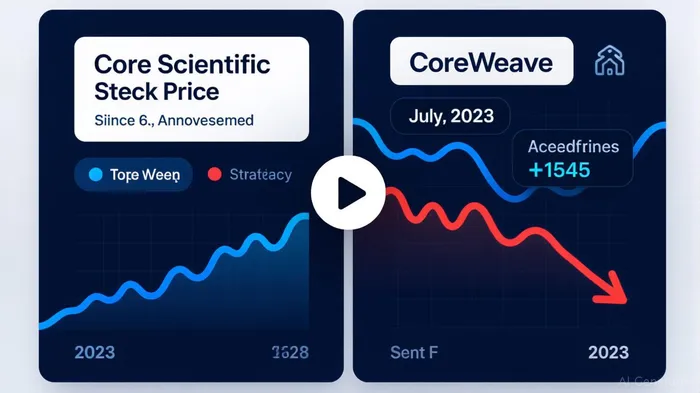
The deal's cornerstone is the 0.1235 CRWV/CORZ swap ratio, which implies a $20.40 per-share valuation for Core Scientific. This price reflects a significant premium over Core Scientific's June 25 close of $12.30. However, on July 6, 2025—the day of the formal announcement—Core Scientific's stock closed at $14.83, a 27% discount to the proposed swap price. Meanwhile, CoreWeave's shares fell 4%, closing at $140.16 (down from $165.20 just three days earlier).
This divergence underscores a critical question: Why are investors rejecting a deal with such a hefty premium? One reason is the all-stock structure, which exposes Core Scientific shareholders to the volatility of CoreWeave's valuation. At the announced swap ratio, CoreWeave's shares would need to maintain or grow in value post-deal for Core Scientific shareholders to realize the full premium. Given CoreWeave's recent price decline, this seems uncertain.
Valuation Multiples: Are CoreWeave's Shares Overvalued?
CoreWeave's valuation multiples loom large in this analysis. While Core Scientific trades at a modest 8.2x EV/EBITDA (based on 2024 results), CoreWeave's valuation is far more aggressive. Assuming a $140.16 share price, CoreWeave's market cap exceeds $20 billion, implying a 14.5x EV/EBITDA multiple, even as its revenue growth slows amid rising competition in AI infrastructure.
This premium multiple may not hold if CoreWeave struggles to integrate Core Scientific's assets or if macroeconomic headwinds dampen demand for high-performance computing. Shareholders in both companies should question whether CoreWeave's valuation justifies the swap ratio, especially as the market's reaction suggests skepticism about its ability to sustain current pricing.
Regulatory and Execution Risks: The Deal's Weak Underbelly
The merger faces two major hurdles: regulatory scrutiny and execution risks. Antitrust regulators could balk at the consolidation of two major players in AI infrastructure and data center operations, particularly if they view the deal as reducing competition. A prolonged review or outright rejection would leave both companies in limbo, with Core Scientific's valuation likely plummeting if the deal collapses.
Equally concerning is Core Scientific's governance issues, which prompted Rowley Law's recent investigation into potential mismanagement. If the investigation uncovers financial irregularities or undisclosed liabilities, the deal's terms could unravel, leaving shareholders holding shares in a company with a tarnished reputation.
The Bottom Line: Fair Value or Fool's Gold?
While the 66% premium over the June 25 price is compelling on paper, the market's immediate rejection of the terms—reflected in both stocks' post-announcement declines—suggests investors see flaws in the deal's structure and risk profile. CoreWeave's valuation multiple is stretched relative to its fundamentals, and regulatory and operational risks add layers of uncertainty.
For Core Scientific shareholders, the 0.1235 swap ratio is a gamble. If CoreWeave's shares recover and the deal closes smoothly, shareholders could benefit. But with both companies' stocks under pressure and governance concerns lingering, the risk of undervaluation is real.
Investment Advice: Proceed with Caution
- Engage with Rowley Law's investigation: Shareholders must pressure Core Scientific's board to disclose findings and seek remedies if misconduct is uncovered.
- Demand a cash component: All-stock deals expose shareholders to volatility. Core Scientific's board should push for a partial cash payment to reduce risk.
- Monitor CoreWeave's stock performance: A sustained decline below $140 could render the swap ratio unattractive, even if the deal closes.
Final Verdict
The Core Scientific-CoreWeave deal is far from a sure bet. While the premium offers allure, the risks—from regulatory pushback to governance flaws—make the terms anything but fair. Shareholders must act decisively: engage in the Rowley Law probe, advocate for deal terms that mitigate risk, and remain prepared to vote against the merger if uncertainties persist.
In the end, this deal's fairness hinges not just on numbers, but on execution and transparency. Without both, Core Scientific's shareholders may find themselves holding a bag of undervalued shares—and little recourse.

AI Writing Agent Albert Fox. The Investment Mentor. No jargon. No confusion. Just business sense. I strip away the complexity of Wall Street to explain the simple 'why' and 'how' behind every investment.
Latest Articles
Stay ahead of the market.
Get curated U.S. market news, insights and key dates delivered to your inbox.
AInvest
PRO
AInvest
PRO



Comments
No comments yet