
U.S. Core Durable Goods Orders: Diverging Sectors and Strategic Investment Shifts in Transportation and Automobiles
 Aime Summary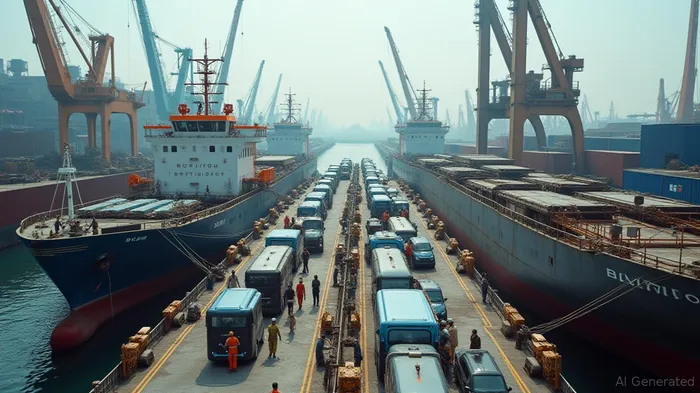
The June 2025 U.S. Core Durable Goods Orders report delivered a stark divergence in sector performance, offering critical insights for investors navigating a fractured economic landscape. While overall durable goods orders plummeted 9.3%, driven by a 22.4% collapse in transportation equipment, core durable goods (excluding transportation) edged up 0.2%. This split underscores a pivotal shift in economic dynamics, with transportation infrastructure and automobiles facing headwinds while other manufacturing sectors maintain resilience. For investors, this divergence signals the need to recalibrate sector allocations to align with evolving policy risks and market realities.
Transportation Infrastructure: A Sector in Retreat
The transportation segment's 22.4% decline in June 2025 reflects a perfect storm of policy uncertainty and supply chain disruptions. The Trump administration's aggressive tariff regime, including 25% levies on vehicle imports and 52.5% tariffs on non-compliant USMCA imports, has destabilized North American production networks. Major automakers like StellantisSTLA-- and Volkswagen suspended operations in Mexico and Canada, while Jaguar Land Rover paused U.S. exports. These moves not only disrupted logistics but also exposed vulnerabilities in global supply chains reliant on cross-border production.
Investors must assess how these tariffs amplify costs for transportation infrastructure. For example, tariff stacking—where components and finished goods face multiple tariffs—has inflated costs for OEMs by an estimated $4,275 per vehicle. This pressure is likely to ripple through infrastructure-linked sectors, including port operations and rail networks, as companies seek alternative trade routes and domestic sourcing. The U.S.-Japan trade deal, which reduced Japanese auto tariffs to 15% in exchange for $550 billion in U.S. investments, further complicates the landscape. While it stabilizes Japanese automakers like ToyotaTM-- and HondaHMC--, it risks undermining U.S. domestic producers already grappling with higher tariffs on steel and aluminum.
Automobiles: Tariffs, Incentives, and Consumer Behavior
The automotive sector's response to tariffs has been equally volatile. J.D. Power and GlobalData project June 2025 new-vehicle sales at 1,247,900 units, a 2.5% increase year-over-year, but this figure masks a "pull-ahead effect" from March and April 2025, when buyers rushed to purchase before anticipated price hikes. This forward-shifting has left June sales below actual demand, creating a false sense of stability. Meanwhile, average transaction prices hit $46,233, up 3.1% year-over-year, as manufacturers absorb cost pressures through margin compression rather than passing them to consumers.
The pause on the Inflation Reduction Act (IRA) has further muddied the waters for electric vehicles (EVs). While the IRA previously incentivized domestic EV production, its suspension under the Trump administration has created uncertainty for companies like TeslaTSLA-- and RivianRIVN--. The EV supply chain, already strained by U.S.-China trade wars and rare earth mineral shortages, now faces additional headwinds. Investors should monitor how automakers balance price adjustments with innovation. Tesla's stock, for instance, has shown resilience despite macroeconomic turbulence, but its valuation may face pressure if EV adoption slows.
Actionable Investment Strategies
Underweight Transportation Infrastructure and Tariff-Exposed Auto Stocks: The transportation sector's volatility and the U.S.-Japan trade deal's favoritism toward Japanese automakers suggest underweighting U.S. manufacturers like Stellantis and Ford. Instead, consider hedging against supply chain risks by investing in logistics tech firms or infrastructure ETFs that benefit from AI-driven efficiency gains.
Overweight Resilient Core Durable Goods Sectors: The 0.2% rise in core durable goods indicates stability in sectors like machinery and industrial equipment. Companies such as CaterpillarCAT-- or 3MMMM--, which supply critical components to manufacturing, may outperform as transportation infrastructure firms struggle.
Monitor Policy Shifts and Currency Fluctuations: The Trump administration's 90-day tariff pause and potential rollbacks create a high-uncertainty environment. Investors should track currency movements and trade negotiations, particularly with the EU and China, which have retaliated with tariffs of their own. A diversified portfolio with exposure to Japanese automakers and U.S. defense contractors (e.g., BoeingBA--, Lockheed Martin) could balance geopolitical risks.
Leverage AI and Digital Transformation Plays: The AI Action Plan's push for data center expansion and regulatory rollbacks in logistics and manufacturing presents opportunities for tech-driven infrastructure firms. Companies like NVIDIANVDA-- or AmazonAMZN-- Web Services, which enable AI integration, may benefit from increased automation in supply chains.
Conclusion
The June 2025 Core Durable Goods Orders report highlights a critical inflection pointIPCX-- for transportation and automotive sectors. While tariffs and policy shifts have eroded confidence in transportation infrastructure, core durable goods demonstrate resilience. Investors must adopt a nuanced approach, underweighting vulnerable sectors while capitalizing on AI-driven efficiencies and resilient manufacturing plays. As the U.S. navigates a complex trade environment, agility and sector-specific insights will be key to securing long-term returns.

Stay ahead of the market.
Get curated U.S. market news, insights and key dates delivered to your inbox.
AInvest
PRO
AInvest
PRO



Comments
No comments yet