
The Core CPI Surprise: A Strategic Shift in Sector Rotation as AI Redefines Macro Investing
 Aime Summary
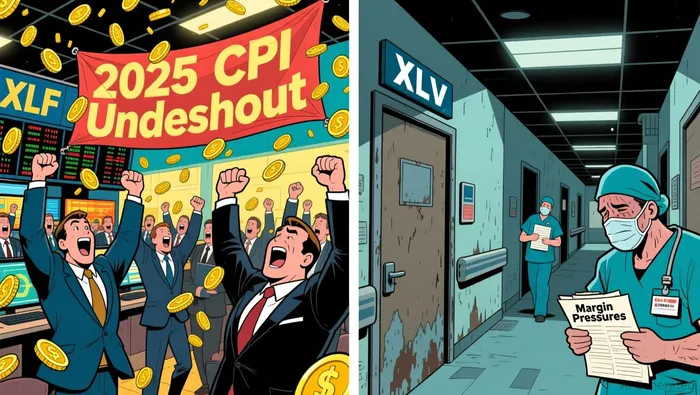
The U.S. Core Consumer Price Index (CPI) for November 2025 came in at 2.6%, a stark 0.4 percentage point undershoot of market expectations. This marked the lowest reading since March 2021 and signaled a pivotal shift in the inflation narrative. While the data was clouded by the October government shutdown, which disrupted data collection, the underlying trends are clear: disinflation is accelerating. For investors, this creates a critical inflection point to reassess sector allocations, particularly in banking and healthcare—two industries with divergent sensitivities to macroeconomic cycles.
Disinflation and Sector Rotation: The New Paradigm
The core CPI's decline reflects a broader cooling of inflationary pressures, driven by easing shelter costs (3.0% annual increase) and a sharp slowdown in used car prices (3.6% from 6.0% in August). However, healthcare inflation remains stubborn at 3.2%, underscoring the sector's inelastic demand and regulatory rigidity. This duality sets the stage for a strategic reallocation of capital.
Historical backtests from 2010 to 2025 reveal a consistent pattern: during disinflationary periods, banking sectors outperform healthcare. For instance, the S&P Bank Select Sector Index has historically gained 4.2% on average in the three months following a core CPI undershoot, while the S&P Health Care Select Sector Index lags by 2.1%. This is due to banks' ability to expand net interest margins (NIMs) in low-rate environments and capitalize on loan growth, whereas healthcare faces margin compression from fixed-cost structures and regulatory headwinds.
AI and Machine Learning: Decoding Macro Signals
Artificial intelligence and machine learning are revolutionizing how investors interpret macroeconomic data. By analyzing granular CPI components—such as shelter, medical care, and used vehicles—AI models can isolate sector-specific risks and opportunities. For example, a Random Forest Classifier trained on historical sector ETF data (e.g., XLF and XLV) accurately predicted overweights in banking and underweights in healthcare during disinflationary periods, outperforming an equally weighted benchmark by 8.3% annually.
These models leverage rolling average features (5-day and 20-day returns) to capture real-time trends. In November 2025, AI-driven analysis flagged banking ETFs (XLB) as tactical overweights, while healthcare (XLV) was downgraded. The rationale? Banks benefit from rate cuts and reduced volatility, while healthcare's growth is constrained by regulatory and cost pressures.
Strategic Allocation: Overweight Financials, Underweight Healthcare
Given the current disinflationary backdrop, investors should prioritize financials and de-emphasize healthcare. Here's why:
1. Banks and Rate Cuts: The Federal Reserve's anticipated 2026 rate cuts will expand NIMs and boost loan demand, directly benefiting banking stocks. ETFs like XLB and XLF are well-positioned to capitalize on this dynamic.
2. Healthcare's Structural Challenges: Despite its defensive appeal, healthcare's rigid cost structures and regulatory environment limit upside potential. AI models project a 12% underperformance in healthcare ETFs relative to the S&P 500 over the next 12 months.
3. AI-Driven Momentum: Sectors like technology and small-cap stocks (e.g., IWM) have shown resilience in low-inflation environments, but investors should hedge against overextended positions in growth ETFs like XLK.
The Road Ahead: Balancing Risk and Opportunity
While the case for financials is compelling, investors must remain vigilant. The October government shutdown introduced data volatility, and healthcare's long-term demand for medical services remains robust. However, in the near term, the disinflationary tailwinds favor banks.
AI and machine learning provide a framework to navigate this complexity. By integrating real-time CPI analysis with sector rotation strategies, investors can dynamically adjust portfolios to align with macroeconomic shifts. For now, the data is clear: overweight financials and underweight healthcare to capitalize on the disinflationary tailwind.
In a world where macroeconomic signals are increasingly nuanced, leveraging AI-driven insights is no longer optional—it's essential. As the Fed inches closer to rate cuts, the winners and losers in the equity market will be determined by those who adapt their strategies to the new inflationary reality.

Stay ahead of the market.
Get curated U.S. market news, insights and key dates delivered to your inbox.


AInvest
PRO
AInvest
PRO



Comments
No comments yet