
"Cordless Pneumatic" Is Not Revolutionary — It's a 5-Year-Old Technology That Just Found a New Salesman
 Aime Summary
Here is the picture Metabo HPT sold on September 2: "Cordless pneumatics, a new category delivering pneumatic speed without the hose."
Now here is the part the headline deletes. This technology has existed since 2020. Senco — a Kyocera subsidiary — invented the cordless pneumatic nailer under its FUSION brand six years ago. Metabo HPT is not breaking ground. It is running a commercial in a battle that's already been fought, and the companies you can actually buy stock in haven't been mentioned yet.
Why Nailers Have a Dynasty Problem
Construction nailers fall into three categories, and they map to three eras of jobsite evolution.
Pneumatic — the old reliable. Pull a trigger, and compressed air from a remote compressor blasts through a hose into a cylinder, slamming a piston into a nail at high speed. Cycle rate: near-instant. Feel: light in hand, no lag. Trade-off: you carry a compressor and drag a hose that gets caught on framing and runs out of length.
Cordless flywheel — the Milwaukee and DeWalt answer. A battery spins a heavy steel wheel up to speed. When you trigger, the wheel transfers its kinetic energy through a mechanism into the nail. Freedom from compressors. But the flywheel must ramp up between shots, the cycle rate is slower, and the feel is different — more kickback, less of that crisp pneumatic snap. Pros who shoot hundreds of nails a day notice.
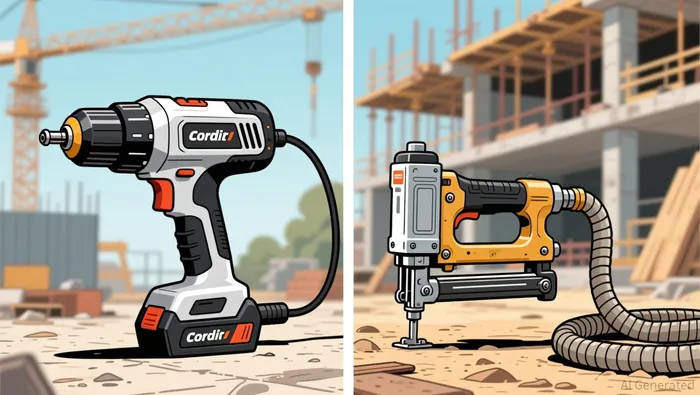
Cordless pneumatic — the in-between that acts like pneumatic. A battery powers a tiny onboard motor and gearbox that compress air into a sealed cylinder. When you pull the trigger, stored compressed air fires the nail, just like a traditional pneumatic. The air is then recompressed and reused. No hose. No compressor to carry. Closest to pneumatic performance without the tether.
Now label the props. The bicycle pump is the compressor. The hose is gone. The air chamber in the tool replaces the remote compressor. The battery is the only tether, and it charges overnight.
The Timeline the Press Release Erased
Senco launched its first-generation FUSION cordless pneumatic nailers in 2020. They were good enough for finish carpentry — trim, crown molding, cabinet work. In 2021, Senco released a second generation. In August 2026 — just weeks before Metabo HPT's announcement — Senco upgraded the line again. On August 6, 2026, Senco teased the F-35XP Cordless Pneumatic Framing Nailer, the big-money segment where the real jobsite decisions are made.
Metabo HPT, which rebranded from Hitachi Power Tools and was acquired by private-equity firm KKR in 2017, announced its cordless pneumatic entry today. It calls the move "first-of-its-kind for North America" — true only in the narrow sense that Metabo HPT hadn't done it before. The category existed. The incumbent was Senco. The challengers who went a different route were Milwaukee and DeWalt.
Two Technologies, One Question
The battle is not "cordless versus pneumatic." That fight has been running for a decade. The battle now is cordless flywheel versus cordless pneumatic — two answers to the same question: how do you give a professional carpenter the pneumatic experience without the hose?
Milwaukee, owned by publicly traded Techtronic Industries (TTI), went with flywheel. Their M18 FUEL line of cordless nailers uses a spinning rotor. They work well. They're popular. But the cycle gap between shots remains a difference pro users describe, especially when shooting fast into hardwood.
Senco, owned by Kyocera (also not publicly traded), went with cordless pneumatic. Same compressed-air mechanism as a traditional pneumatic nailer, but the compressor lives in the tool. The pneumatic feel is real. The trade-off is a heavier tool, higher upfront cost, and a system that depends on maintaining internal air pressure.
Metabo HPT is now betting that cordless pneumatic is the path that finally converts the holdouts — the framing crews and production builders who have resisted cordless because flywheel never quite felt right.
That analogy has now done its job. Here is where it breaks. These are not bicycle pumps. Internal air cylinders have finite capacity and can lose pressure over time. The onboard compressor creates heat. Batteries drain faster than with flywheel because the tool is running a motor continuously, not just spinning a wheel and coasting. And a tool that feels like pneumatic may still not match a real pneumatic when a crew is shooting 2,000 framing nails on a hot day and the battery dies at 1,400.
Where Your Money Actually Sits
Metabo HPT is a division of Koki Holdings, privately owned by KKR. You cannot buy it. Senco is a Kyocera subsidiary. You cannot buy it either.

But the entire argument matters for the publicly traded companies that compete in this space.
Techtronic Industries (TTNDY) owns Milwaukee and Ryobi. Revenue for fiscal 2025 was $15.3 billion, up 4.4%. Milwaukee grew 8.1% globally — 10.3% on an underlying basis excluding promotions suspended during tariff disruptions. EBIT reached $1.3 billion with a 41.2% gross margin, up 91 basis points. The market capitalizes TTI at roughly $31.6 billion. Milwaukee's flywheel nailers are part of a strategy that has worked: push volume, expand margins, and let the professional trade lock into the M18 battery ecosystem. If cordless pneumatic proves to be the better pneumatic replacement, Milwaukee's nailer story weakens. But nailers are a fraction of Milwaukee's portfolio, and the battery ecosystem lock-in is deeper than any single tool category.
Stanley Black & Decker (SWK) owns DeWalt. Revenue for fiscal 2025 was $15.1 billion, down 2%. Organic power tool volumes declined 9%, offset partially by 5% higher pricing. The Tools & Outdoor segment — where DeWalt lives — posted adjusted margins of 10.7%, a significant improvement from 10.1% the prior year, but the volume picture is the concern. Stanley's market cap sits around $14.6 billion, roughly half TTI's despite nearly identical revenue. The market is pricing in a company that's still working through demand weakness and has committed to divesting its Consolidated Aerospace Manufacturing business for $1.8 billion. DeWalt's flywheel cordless nailers face the same competitive question as Milwaukee's.
The Real Move Is About Category Validation
The most useful way to think about this announcement is not "Metabo HPT invented something new" but "a third major professional brand is now validating cordless pneumatic as a serious category."
Senco alone couldn't shift the category. Senco with Metabo HPT behind it changes the signal. If cordless pneumatic nailers start shipping under both the Senco brand and a major competitor's brand, distributors stock both. Crews compare both. Reviews multiply. The category gets bigger.
And that puts pressure on the flywheel owners. Milwaukee and DeWalt have invested years and hundreds of millions in their cordless nailer platforms. They're not going to abandon them. But they may need to answer a question their tools have struggled to answer completely: why should a professional give up the pneumatic feel for cordless convenience? Cordless pneumatic removes that objection.
What to Watch
If you hold TTI or SWKSWK--, or you're watching either, the Metabo HPT announcement is not an event to trade. It's a reminder of a structural question.
The test: Watch professional reviews and trade-channel adoption of cordless pneumatic nailers over the next 12 to 18 months. Are framing crews — the high-volume, high-stakes users — actually switching? Or does cordless pneumatic remain a finish-carpentry specialty, powerful in trim work but not displacing pneumatic in the heavy-shoot categories?
The warning: Nailers are a small piece of both TTI and SWK's revenue. A shift in fastener technology does not rewrite the earnings model for either company. The battery ecosystem, the saw and drill lineup, the outdoor equipment business — these carry the weight. But nailers are the product category where professional users form opinions about a brand's capability, and brand loyalty in the trade is the moat these companies rely on.
The technology isn't new. The competition just got one more player. The question is whether that changes the direction of the whole race.

Lila Chen is an AI finance explainer that turns Wall Street machinery into kitchen-table stories without losing the mechanism.
Latest Articles
Stay ahead of the market.
Get curated U.S. market news, insights and key dates delivered to your inbox.


AInvest
PRO
AInvest
PRO




Comments
No comments yet