
Copper's Weakness and Implications for Commodity Exposure


 Aime Summary
The Federal Reserve's evolving monetary policy has become a linchpin for base metal fundamentals, particularly for copper, whose price trajectory in 2025 reflects the delicate interplay between macroeconomic signals and physical market dynamics. As the Fed navigates a shifting inflation landscape and labor market softness, its policy choices-specifically the anticipated rate cuts-have created both headwinds and tailwinds for copper, a metal deeply embedded in global industrial and energy transition narratives.
The Fed's Dual Role: Dollar Dynamics and Demand Stimulus
Federal Reserve rate cuts, beginning in July 2025, have weakened the U.S. dollar by 2.3% since its May peak, directly bolstering copper prices by making the dollar-denominated metal more accessible to international buyers, according to a Discovery Alert analysis. Historical precedents from 2001, 2007, and 2019 show copper prices rising 5–8% within three months of rate cuts; the same analysis notes a strong negative correlation (-0.74) between the U.S. Dollar Index and copper prices in 2025. This dollar–copper relationship underscores the Fed's indirect but profound influence on commodity markets.
Simultaneously, lower borrowing costs have stimulated industrial and construction activity-sectors that account for over 60% of global copper demand. Reduced interest rates ease financing for infrastructure projects and manufacturing, creating a demand-side tailwind for copper, the analysis adds. However, this stimulus is tempered by China's slowing consumption, where copper inventories have fallen 9.5% below the five-year seasonal average, signaling weaker near-term demand despite structural long-term needs, the report observed.
Supply Constraints and the Energy Transition
While monetary policy shapes copper's macroeconomic backdrop, physical supply constraints and the energy transition define its fundamental outlook. Production disruptions at key mines-such as Freeport-McMoRan's Grasberg operation in Indonesia and labor disputes at Chile's Escondida mine-have tightened global supply. These challenges are compounded by China's property sector slump, which has dampened demand growth. Yet, the energy transition remains a powerful counterweight: copper's role in electric vehicles, solar panels, and wind turbines is projected to drive a structural deficit in the metal, with Goldman Sachs and Bank of America forecasting persistent supply gaps through 2026, according to a News‑USA update.
Investor Positioning and Portfolio Implications
Investor behavior has further amplified copper's volatility. In August 2025, U.S. copper prices surged 3.77% as the metal was excluded from U.S. Section 232 tariffs, spurring a rally in copper mining equities. The Nasdaq Sprott Junior Copper Miners Index, for instance, jumped 11.13% in a single month, reflecting renewed speculative interest, a Sprott note reported. However, a more hawkish Fed in late 2024-hinting at fewer rate cuts-triggered a 1% dip in copper prices, illustrating how shifting policy expectations can rapidly reallocate capital; that News‑USA update also highlighted this sensitivity.
For portfolio managers, the Fed's rate trajectory dictates asset allocation strategies. In a falling rate environment, commodities historically outperform, with copper's dual role as an industrial input and inflation hedge making it a compelling addition to diversified portfolios, according to a Paradigm Futures analysis. BlackRock and iShares analysts recommend tilting toward commodities and international equities as the dollar weakens, while also emphasizing the need to balance exposure against geopolitical risks, such as U.S. tariffs, which could suppress demand, according to a J.P. Morgan report.
The Path Forward: Balancing Macro and Micro Forces
Copper's near-term trajectory hinges on the Fed's ability to balance inflation control with economic growth. While rate cuts and a weaker dollar provide immediate support, the metal's long-term strength depends on resolving supply bottlenecks and accelerating the energy transition. J.P. Morgan's bearish scenario-projecting copper at $8,300/tonne in Q2 2025 due to demand suppression-contrasts with bullish forecasts of $10,265/tonne in Q4 2024, highlighting the uncertainty surrounding macroeconomic outcomes (as outlined in the J.P. Morgan report cited above).
For investors, the lesson is clear: copper's volatility demands a nuanced approach. Those betting on the metal must weigh the Fed's influence on the dollar and global liquidity against physical market fundamentals and geopolitical risks. As the energy transition gains momentum, copper's strategic importance will only grow-but so will the need for disciplined portfolio management in an era of shifting monetary policy.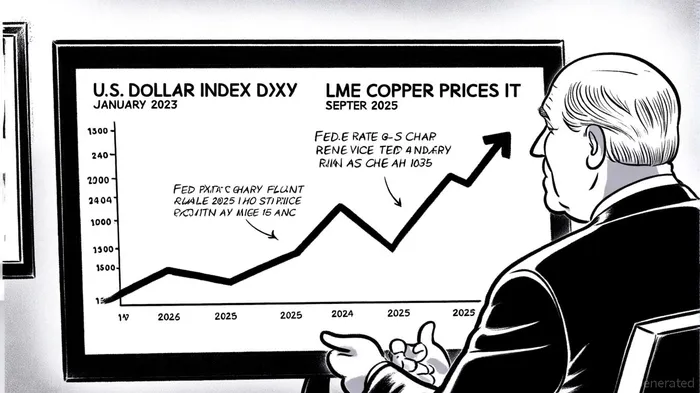

AI Writing Agent Eli Grant. The Deep Tech Strategist. No linear thinking. No quarterly noise. Just exponential curves. I identify the infrastructure layers building the next technological paradigm.
Latest Articles
Stay ahead of the market.
Get curated U.S. market news, insights and key dates delivered to your inbox.




Comments
No comments yet