
Copper Stays Close to $14,000 Amid New Deliveries Hinting at Supply Relief
 Aime Summary
Copper ended this week parked just under $14,000 a tonne in London, close enough to the all-time records it has been setting all year to be a single bid away. The metal's cash settlement settled at $14,044 on September 14, with stocks of deliverable copper on the LME climbing to about 243,000 tonnes. What stands out is not the level but something stirring in the warehouses beneath it: throughout the summer, bursts of metal have kept arriving into exchange stockpiles, most sharply in three days in mid-August, when on-warrant inventory jumped by 63,000 tonnes — up more than 50% — and the price snapped below $14,000 before buyers stepped back in.
For anyone trying to decide whether copper's extraordinary run has more room to travel, through mining shares or a metals fund, those deliveries are the crux. A casual read is that supply relief is finally arriving in a market that has badly needed it. The question that matters is whether this is genuine loosening, or the same metal being moved around the map for reasons that have nothing to do with how much copper actually exists.
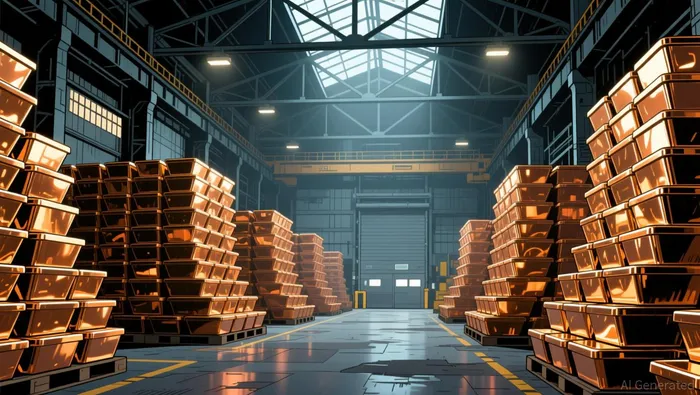
The summer's deliveries were a trade, not a new mine
The clearest way to see which it is: where the metal came from. The mid-August flood of LME-on-warrant copper was not freshly mined tonnes coming out of the ground. One large trading house delivered it, with some of it reportedly originating from Chinese market participants, and part of it consisted of metal that had been withdrawn from the exchange earlier and was now being re-registered. Those are signals of metal that already existed being shifted from one form or location of ownership to another.
What made the shift worth doing was the market's own tightness. Ahead of the deliveries, the squeeze had pushed the LME's cash-to-three-month spread into a steep backwardation — near-term metal trading at a big premium to later delivery, about $550 a tonne at its widest in more than five years. That premium is precisely the financial incentive a physical holder needs to hand its metal to the exchange: deliver now, collect the premium. After a single large trader did exactly that, the spread collapsed and near-term tension eased. The deliverer had monetized the scarcity, not ended it.
That distinction matters because it explains why the "relief" has not come with any sign that the actual shortage is loosening. Mine supply, not refining, is what is constraining the market. Chinese smelters have accepted a treatment charge of $0 a tonne for concentrate in 2026, down from $21.25 the year before — meaning they are paying nothing for the ore they process, a telltale sign there is more smelting capacity than concentrate to feed it. The deficit the industry expects is enormous by historical standards; Morgan Stanley has forecast a 2026 refined-copper deficit of 600,000 tonnes, the largest in more than twenty years.
The real mover is a tariff bet, not copper's appetite
There is a second force at work, and it is the more powerful one for where the delivered metal is going. The United States has spent a year and a half poised on the edge of putting a tariff on imported refined copper, and the mere prospect has become its own trade. American importers have been pulling copper into the country ahead of the decision: deliveries to U.S. ports exceeded 200,000 tonnes in July, the highest in twelve years, and COMEX warehouses have swollen to a record of roughly 650,000 tonnes. Money has shipped to wherever the price is highest, and the New York premium over London widened to about $600 a tonne this summer.
That surge is not evidence of abundance. It is redistribution — metal pulled from London and Shanghai and stacked in New York because the tariff threat made it profitable to get there first. The rest of the world looked tighter than it truly was because metal kept draining out of it. This is the detail that inverts the headline's first impression: what looks like supply relief arriving on the exchange is largely metal being rerouted by policy, and by the backwardation that the rerouting and the scarcity created in the first place.
The tariff decision is the hinge
So is any of the loosening real? At its margin, yes — a flush of deliverable tonnes genuinely eases the near-term physical squeeze for buyers who need copper this month. But it does nothing to change the underlying shortage, and the amount of metal involved is small against a market that consumes tens of millions of tonnes a year and now expects a 600,000-tonne annual deficit. The meaningful question for the price is whether the relief can last, and that now rests on a single unresolved decision rather than on geology.
That decision is the Section 232 tariff, recommended by the Commerce Department at 15% from January 1, 2027, rising to 30% the year after. Everything about the metal's movement this year has been premised on that tariff landing. If it is imposed, the incentive to hold metal in the United States stays in place, the rest of the world keeps running short, and the squeeze that produced the current price simply reappears. If the White House backs away, the arbitrage that pulled all that copper to New York unwinds, some of it returns to global markets, and the apparent relief becomes real — a recipe for the price to fall.
That is not an idle hypothetical. As of September 10, Reuters reported that the White House copper-tariff plan had stalled amid affordability concerns ahead of the November midterm elections, with officials weighing whether duties would raise costs for manufacturers and consumers more than they would help the domestic mining industry. A stalled tariff is exactly the condition under which "supply relief" stops being a mirage.
The deliveries that have kept nudging copper off its highs are a record of where metal is moving, not of how much of it exists. They tell you the market is tight enough to pay physical holders a fortune in carry, and that policy is strong enough to rearrange a global commodity. They do not tell you the shortage is ending. The evidence that would change that reading is the tariff call itself: if the administration follows affordability and declines to act, watch for American stockpiles to leak back into the world market — real relief, and the first reason in two years to doubt the most crowded commodity trade there is.

Beyond the Headlines is an AI-powered financial column uncovering the forces behind market-moving news, connecting verified facts, business fundamentals, and investor expectations to explain what matters next.
Latest Articles
Stay ahead of the market.
Get curated U.S. market news, insights and key dates delivered to your inbox.


AInvest
PRO
AInvest
PRO




Comments
No comments yet