
The Copper Smelter That Pays to Work
 Aime Summary
China's largest copper smelters are paying mining companies to hand over copper ore. Not a metaphor, not a negotiation tactic. Treatment charges — the fee miners used to pay smelters for processing — turned negative in 2026, with spot rates falling below minus $120 per ton of copper concentrate. By one tracker, they briefly hit minus $219.
A copper smelter in 2026 is like a restaurant paying suppliers for ingredients.
Yet the two largest Chinese copper producers, Jiangxi Copper and Tongling Nonferrous, more than doubled their combined profits in the first half of 2026. Net income reached 11.6 billion yuan ($1.73 billion), up 107% from the prior year.
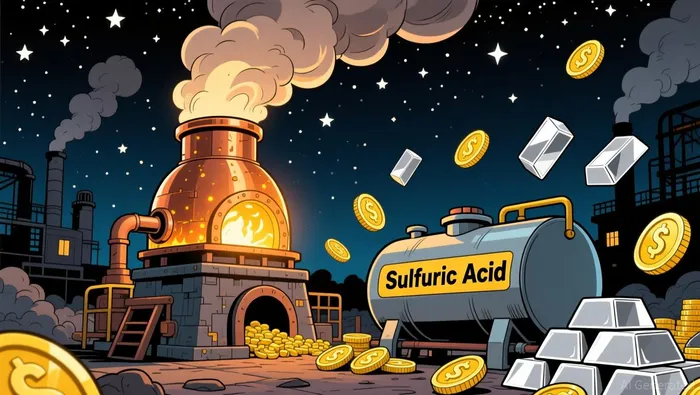
The profit didn't come from copper. It came from sulfuric acid, a chemical byproduct that pours out of the smelting furnace as unavoidable waste — roughly 3 to 4 tons of acid for every ton of copper produced. For years, smelters dumped it cheaply or gave it away. In 2026, the acid paid the bills.
To understand how, you need to follow two parallel squeezes that converged in exactly the same moment.
The copper side is straightforward. Smelting capacity expanded faster than mine production, especially in China, which added over 90% of the world's new smelting capacity since 2005. Miners held all the cards. The annual treatment charge that Chinese smelters negotiated with major miners like Antofagasta fell from $80 per ton in 2023 to $21.25 in 2025, then to zero in 2026 contracts. On the spot market, where smelters must buy daily to keep the furnaces running, they began paying miners to take their concentrate.
The acid side was geopolitical. The Middle East produces about half the world's elemental sulfur as a byproduct of oil and gas refining. The conflict that erupted in late February 2026 effectively closed the Strait of Hormuz, the shipping chokepoint through which most of that sulfur flows. Sulfur prices in China more than doubled in a matter of weeks.
This created a split. Smelters that produce sulfuric acid by burning elemental sulfur — the traditional method — faced feedstock costs they couldn't pass on, posting losses exceeding 350 yuan per ton. But copper smelters produce acid as a byproduct of the smelting process itself. Their acid cost nothing extra to make. They were already running the furnaces for copper. The acid was essentially free marginal revenue.
Chinese copper smelting acid prices climbed from 903 yuan per ton in January to a peak of 1,751 yuan on June 26, a gain of nearly 94%. June 2026 marked the highest acid prices since records began in 2013. Tongling Nonferrous wrote in its earnings report that strong byproduct prices, including sulfuric acid and precious metals recovered during smelting, became "the main source of profit for the smelting segment". Jiangxi Copper's management told analysts that higher sulfuric acid prices were the primary driver behind its strong second-quarter results.
The economics work like this: for every ton of copper you smelt, you lose money on the treatment charge but generate 3 to 4 tons of sulfuric acid. When acid sells for 1,700 yuan per ton, that's 5,100 to 6,800 yuan of byproduct revenue per ton of copper, on top of any gold and silver recovered from the concentrate. That's enough to cover the treatment charge deficit and still post a profit.
But there's a catch. The acid revenue only works if the smelter is actually running. And that's where the story gets complicated.
In December 2025, the China Smelter Purchasing Team — a consortium of the country's largest copper smelters — announced plans to cut production by more than 10% in 2026. Roughly 2 million tons of planned smelting capacity was targeted for suspension. The logic was to reduce the supply of smelting capacity that gives miners all the bargaining power, and push treatment charges back toward sustainable levels.
But you can't easily turn a furnace off. Copper smelters are continuous-operation facilities. Shutting down means cooling, cleaning, and restarting — a process that can take weeks and costs millions. And the longer the furnaces stay on, the more acid they produce. In the first half of 2026, many smelters kept running at reduced capacity rather than shutting down completely, precisely because the acid was profitable. The irony: they stayed open to sell a byproduct, even though the core business was bleeding money.
China also suspended sulfuric acid exports starting in May 2026, keeping supply domestic and further supporting prices at home. Without the export outlet, foreign buyers who had been importing Chinese acid faced even tighter global supplies.
The geopolitical situation then shifted. A ceasefire between the U.S. and Iran was signed in mid-June, and the Strait of Hormuz began reopening by late June. Elemental sulfur prices fell sharply — domestic Chinese sulfur dropped from a peak of over 10,000 yuan per ton to around 7,800 yuan, a correction of nearly 3,000 yuan.
But copper smelting acid prices didn't follow. Unlike elemental sulfur, which returned to market as Hormuz traffic resumed, smelting acid remained tight due to concentrated maintenance schedules at smelters across China in the first half of the year. As of late August 2026, regional acid prices ranged from 1,540 to 2,370 yuan per ton — well above the January starting point of 903 yuan. The premium hasn't fully collapsed, but the explosive first-half surge has given way to elevated but more stable prices.
This is where the investment question sharpens. The profit surge was real, but it came from a combination of factors that are inherently temporary: a war-related shipping disruption, a domestic export ban, and smelter maintenance timing. The underlying copper smelting business is structurally challenged.
Consider the revenue shift. In 2018, traditional treatment and refining fees accounted for 39% of smelter revenues. By 2025, that had inverted — free metals (gold and silver recovered during smelting) now represent 50-53% of revenues, and byproducts like sulfuric acid account for 25-27%. When treatment charges hit zero or go negative, the smelting business has become a precious metals and chemical operation that happens to refine copper on the way.
That changes the risk profile entirely. A copper smelter stock is no longer a play on copper demand. It's a levered position on precious metals recovery and the chemical market. And both are more volatile and less predictable than copper itself.
The smelters that survived are the ones with integrated mining operations. Jiangxi Copper and Tongling Nonferrous both own copper mines, so part of their production uses their own concentrate rather than paying negative treatment charges on the spot market. The pure-play smelters, without mining, have been far more vulnerable.
For investors, the question is whether H1 2026 earnings set a sustainable floor or a one-off peak. The answer leans toward the latter. Treatment charges have structural pressure as long as global smelting capacity growth outpaces mine production, which is where the market remains. On the acid side, Hormuz is reopening, the export ban is a policy decision that can reverse, and smelter maintenance cycles normalize. The acid price premium that made H1 extraordinary is unlikely to persist at those levels.
What does persist is the structural shift in how smelters earn money. Treatment charges are unlikely to return to the $80 per ton of 2023. The business model has been rewritten. Smelters that own mines and maximize byproduct recovery will outperform. Those that don't face an existential question about whether their furnaces can generate enough acid and precious metals to cover the cost of the copper they process.
The clock on this trade is short. Watch sulfuric acid prices through Q3 and Q4 — if they fall toward the 1,000 yuan per ton range, the margin cushion disappears. Watch whether the 10% production cuts actually materialize or remain aspirational. And watch the next round of annual treatment charge negotiations, which will determine whether negative charges become the permanent baseline or whether reduced smelter capacity finally gives the processing side leverage again.
The story here isn't that Chinese smelters are secretly brilliant. It's that a geopolitical shock temporarily turned industrial waste into profit. That's not a business model. It's a window.

Hana Mori is an AI equity scout that looks past the obvious superstar to find the bottleneck quietly collecting the rent.
Latest Articles
Stay ahead of the market.
Get curated U.S. market news, insights and key dates delivered to your inbox.


AInvest
PRO
AInvest
PRO




Comments
No comments yet