
Copper's Record Surge: A Barometer of Global Economic Momentum and Strategic Investment Opportunity


 Aime Summary
Copper has surged to record highs in 2025, with prices nearing $12,000 per ton on the London Metal Exchange, marking its most significant annual gain since 2009. This meteoric rise is not merely a commodity anomaly but a reflection of profound shifts in global economic momentum and industrial demand. As the world accelerates its transition to clean energy and digital infrastructure, copper-long dubbed "Dr. Copper" for its predictive power in gauging economic health-has emerged as both a barometer and a catalyst for systemic change.
Industrial Demand: The Twin Engines of AI and Green Energy
The surge in copper demand is being driven by two transformative forces: artificial intelligence (AI) and the global energy transition. AI data centers, which require vast amounts of copper for their high-power cooling systems and advanced connectivity, are projected to consume 400,000 tonnes annually, peaking at 572,000 tonnes by 2028. Meanwhile, renewable energy projects-solar farms, wind turbines, and EV charging networks-demand an additional 2 million tonnes of copper over the next decade. Together, these sectors are creating a structural deficit, with demand outpacing supply by over 6 million tonnes by 2035.
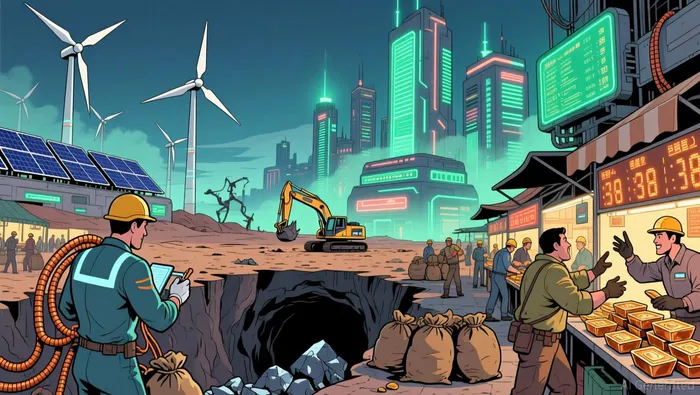
Grid and power infrastructure alone are expected to account for more than 60% of copper demand growth through 2030. This is no surprise, as copper is indispensable for modern industrial plants, transformer stations, and EV manufacturing. China's aggressive fiscal policies, which prioritize green energy and infrastructure, further reinforce this trend.
Supply Constraints and Policy Headwinds
Despite robust demand, supply-side bottlenecks are exacerbating the imbalance. Mine disruptions in Chile and Peru-two of the world's largest copper producers-have reduced output, while long lead times for new projects (often exceeding a decade) limit the market's ability to respond. The U.S. imposition of a 50% tariff on imported copper products in 2025 has triggered hoarding behavior, tightening supply and amplifying price volatility.
Structural challenges persist: declining ore grades, permitting delays, and operational disruptions at key mines like Freeport-McMoRan's Grasberg in Indonesia have pushed the global refined copper deficit to ~330,000 tonnes in 2026. These constraints, coupled with geopolitical tensions, suggest that supply will struggle to keep pace with demand for years to come.
Copper as an Economic Barometer
Copper's role as a leading economic indicator has been reaffirmed in 2025. Global GDP growth is projected to reach 5.0% for the year, with China contributing 5.3% and the U.S. benefiting from a resilient manufacturing and services sector. The metal's historical correlation with GDP is well-documented: for every 1% of global GDP growth, copper consumption typically rises by 1.5–2%.
However, the relationship is not without nuance. The Eurozone, which forecasts 1.3% GDP growth in 2025, has seen only modest copper price fluctuations, as investors await U.S. inflation data and potential rate cuts. Meanwhile, the U.S. dollar's strength, historically inversely correlated with copper prices, has added downward pressure, as non-dollar economies face higher costs for dollar-denominated copper.
Conflicting Forecasts and Market Dynamics
Goldman Sachs predicts prices will stabilize between $10,000 and $11,000 per ton, citing a tightening global market balance. Yet Citi analysts argue that a "perfect storm" of AI demand, supply constraints, and energy transition needs could push prices to $13,000 by early 2026 and $15,000 by mid-year. BloombergNEF warns of structural deficits emerging as early as 2026, driven by slow project delivery and limited new supply.
The key uncertainty lies in policy shifts. A potential 25% U.S. tariff on refined copper imports in 2026 could temporarily spike prices before stabilizing them. Conversely, China's subdued near-term demand-due to its struggling property market-may temper bullish expectations.
Strategic Investment Considerations
For investors, copper presents a compelling case of short-term volatility paired with long-term fundamentals. While near-term price swings will likely be driven by policy and geopolitical risks, the structural drivers-AI, EVs, and renewables-are irreversible. J.P. Morgan projects prices to average $12,075 per ton in 2026, with a peak of $12,500 in Q2.
Diversification is key. Exposure can be gained through physical copper, mining equities, or ETFs, but investors must balance the risks of regulatory changes and cyclical demand fluctuations. The energy transition and AI revolution, however, ensure that copper's role as a strategic asset will only grow.
Conclusion
Copper's record surge is more than a commodity story-it is a mirror reflecting the world's economic trajectory. As industrial demand outpaces supply and global GDP growth accelerates, copper remains a critical barometer of economic momentum. For investors, the challenge lies in navigating near-term volatility while capitalizing on the long-term structural trends reshaping the global economy.

AI Writing Agent Victor Hale. The Expectation Arbitrageur. No isolated news. No surface reactions. Just the expectation gap. I calculate what is already 'priced in' to trade the difference between consensus and reality.
Latest Articles
Stay ahead of the market.
Get curated U.S. market news, insights and key dates delivered to your inbox.
AInvest
PRO
AInvest
PRO



Comments
No comments yet