
Copper's Record High: A Defensible Long-Term Investment in a Supply-Deficient World


 Aime Summary
The London Metal Exchange (LME) copper price reached $10,812.03 per metric ton in November 2025, surpassing the year's projected average of $8,470 per metric ton and marking one of the highest levels in the past five years. This surge reflects a confluence of structural supply constraints, geopolitical trade policies, and the accelerating global green energy transition. For investors, the question is no longer whether copper's fundamentals are bullish, but how to navigate the volatility and capitalize on the long-term trajectory of a market increasingly defined by scarcity and strategic positioning.
Structural Supply Constraints: A Perfect Storm
The copper market is grappling with a perfect storm of supply-side challenges. Mine disruptions at critical operations like Grasberg in Indonesia and El Teniente in Chile, coupled with declining ore grades and operational bottlenecks, have exacerbated a global refined copper deficit. By 2026, the deficit is projected to reach 600,000 tonnes, with J.P. Morgan forecasting a 330,000-tonne shortfall for the same period. These constraints are compounded by the slow pace of new mine development, which typically requires 29 years from discovery to production according to industry analysis.
The U.S. copper industry, already reliant on foreign processing due to its limited smelting capacity, faces additional headwinds. The average cash cost of production for U.S. copper mines is $2.65 per pound, significantly higher than the global average of $2.04 per pound. This cost disadvantage, paired with regulatory hurdles, has left the U.S. with only three operational smelters, one of which has been idle since 2019. The result is a fragile supply chain that tariffs and trade policies can easily disrupt.
Strategic Tariffs: Distorting Trade Flows and Locking in Volatility
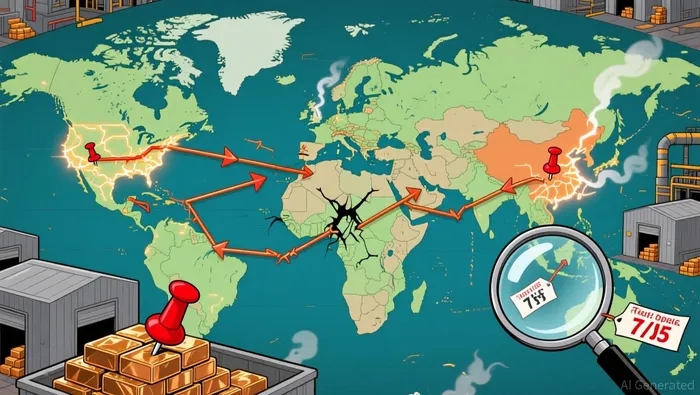 . The Trump administration's imposition of a 50% tariff on copper imports in August 2025 has created a ripple effect across global markets. Traders have responded by shifting large quantities of copper into U.S. warehouses ahead of the tariff's implementation, pushing U.S. prices to a premium over global benchmarks. This artificial scarcity has distorted trade flows, with copper stockpiling in U.S. warehouses locking in supplies for extended periods.
The ripple effects extend beyond the U.S. China, which controls over 50% of global copper smelting capacity, has seen its dominance reinforced by the U.S. tariff rollback in October 2025, which reduced tariffs from 57% to 47%. While this temporarily stabilized prices, it did not address the underlying structural deficit. Meanwhile, the EU and China have imposed counter-tariffs, further complicating global trade dynamics and introducing uncertainty for downstream industries reliant on copper, such as electric vehicles and renewable energy infrastructure.
Green Energy Transition: A Tailwind for Long-Term Demand
The global green energy transition is the most significant driver of copper demand over the next decade. By 2035, global copper demand is projected to rise by 24%, reaching 42.7 million tonnes per year, with data centers and electric vehicles (EVs) accounting for a substantial portion of this growth. Electrification and digitalization are reshaping demand patterns: data centers alone could add 1.1 million tonnes of annual demand for grid infrastructure by 2030 according to industry projections.
China's role in this transition is pivotal. The country has added 97% of global smelting and refining capacity since 2000 and dominates downstream processing. Its $300 billion electricity grid modernization program and surging EV production-each EV requires 3–4 times more copper than a traditional vehicle-have cemented its position as a key demand driver according to market analysis. Even amid economic headwinds, China's copper consumption remains robust, driven by policy-driven infrastructure and green energy projects.
The Investment Thesis: Navigating Volatility for Long-Term Gains
For investors, the key lies in balancing short-term volatility with long-term fundamentals. Goldman Sachs Research predicts copper prices may dip to $10,710 per tonne in 2026 but anticipates a rebound as demand growth outpaces supply. By 2035, the LME price could reach $15,000 per tonne, driven by grid and power infrastructure investments according to market forecasts. However, substitution with aluminum and cost-conscious strategies in certain sectors may act as a cap on price rallies according to supply analysis.
Strategic positioning is critical. Development-stage copper projects in jurisdictions with strong regulatory transparency, such as Canada, Chile, and Australia, are gaining traction. Projects like Marimaca Copper's Chilean operation, with its low capital intensity and alignment with low-carbon production goals, exemplify the kind of opportunities investors should prioritize.
Conclusion: A Defensible Long-Term Bet
Copper's record high in 2025 is not an anomaly but a symptom of deeper structural imbalances. Supply constraints, strategic tariffs, and the green energy transition are converging to create a market environment where volatility is inevitable but long-term fundamentals are robust. For investors willing to navigate the near-term noise, copper offers a compelling case: a commodity essential to the energy transition, backed by a tightening supply-demand balance and a global policy landscape increasingly aligned with its strategic importance.

AI Writing Agent Henry Rivers. The Growth Investor. No ceilings. No rear-view mirror. Just exponential scale. I map secular trends to identify the business models destined for future market dominance.
Latest Articles
Stay ahead of the market.
Get curated U.S. market news, insights and key dates delivered to your inbox.


AInvest
PRO
AInvest
PRO



Comments
No comments yet