
Copper Rallies on Dollar Weakness, Supply Gaps Fuel Near-$11,700 Surge
 Aime Summary
Copper prices surged toward $11,678 per ton in early December 2025, driven largely by a weaker U.S. dollar and tight physical supply conditions according to market analysis. While demand from China remains a concern, financial flows have taken center stage, creating a rally that reflects more macroeconomic positioning than industrial fundamentals. Investors continue to debate whether this move is a temporary overshoot or a new phase in copper's bullish trend.
Physical supply tightness remains a key underpinning, with LME inventories drawing down and delivery activity intensifying. Approximately 39% of LME copper stocks are marked for delivery, signaling limited availability. 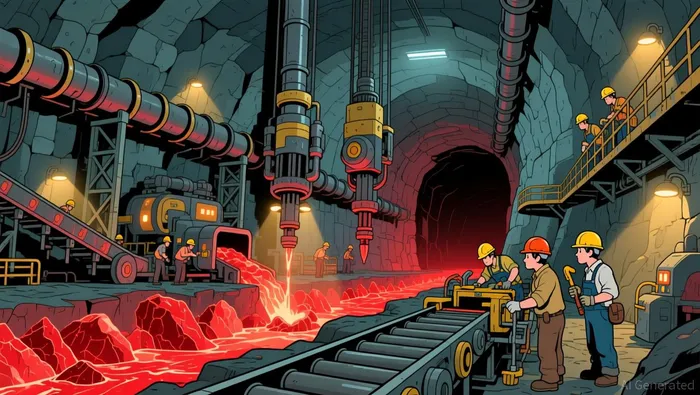 At the same time, arbitrage activity between the LME and Comex is inflating U.S. inventories, masking the true extent of global supply constraints.
Goldman Sachs recently raised its 2026 copper price forecast to $11,400 per ton, citing reduced odds of a refined copper tariff being implemented in early 2026. However, the firm also warned of a 55% chance of a 15% tariff by mid-2026, which could push prices higher in the near term before retreating once U.S. policies are fully implemented .
Currency Dynamics and Copper's Role in Portfolio Diversification
Copper's recent rally is more a reflection of financial dynamics than industrial demand. A weaker U.S. dollar has made copper more affordable for non-U.S. buyers, lifting dollar-denominated commodity prices. This shift has drawn institutional investors to copper as a strategic allocation, particularly as a hedge against inflation and monetary policy uncertainty according to analysis.
The speed and magnitude of the price increase highlight copper's evolving role in global financial markets. While traditionally seen as a leading indicator of industrial demand, copper is now increasingly viewed as a proxy for broader macroeconomic trends. This shift has created a dislocation between price action and traditional demand drivers, a trend that may persist through year-end and into early 2026.
Supply Constraints and Producer Strategies
Structural supply constraints are reinforcing copper's upward trajectory, with limited new mine development and extended permitting timelines creating a bottleneck. Producers with low-cost oxide projects, such as Marimaca Copper, are well-positioned to capitalize on this environment. These projects offer faster development timelines and lower capital intensity compared to large-scale sulphide operations, reducing execution risk in volatile markets according to market reports.
India's November export rebound to the U.S., despite a 50% tariff, also underscores the resilience of supply chains. Adjustments in pricing and product mix allowed Indian exporters to maintain shipments of electronics, machinery, and other goods. This adaptability highlights the challenges global trade faces under new tariff regimes but also the ability of markets to adjust over time .
Risks to the Outlook and Policy Uncertainty
While the current rally is supported by currency dynamics and supply tightness, several risks remain. A stronger U.S. dollar or a failure of Chinese demand to recover could trigger a reversal. China's property sector remains under pressure, and factory output has slowed to a 15-month low, indicating that demand-side challenges are far from resolved according to recent data.
Trade policy adds another layer of uncertainty. The U.S. is still reviewing refined copper tariff policies, and any change could disrupt cross-border flows and trigger price volatility. Investors should monitor inventory trends and global supply pipelines rather than relying solely on regional stock figures .
For copper developers, maintaining capital discipline is essential. Projects with high all-in costs or extended timelines face heightened risk in a scenario where demand does not recover. Companies that prioritize cost control, flexibility, and clear permitting visibility are more likely to succeed in the current environment according to industry analysis.
Implications for Investors
Copper's rally reflects a confluence of financial and physical factors, but investors must remain cautious. The market is still pricing in a strong long-term demand outlook, particularly from the transition to electric vehicles and renewable energy. However, near-term price action is more influenced by currency and policy shifts than by industrial consumption.
Developers with heap leach oxide projects, short development cycles, and jurisdictional advantages are best positioned to navigate volatility. For investors, selective exposure to these companies-those with strong balance sheets, low execution risk, and clear capital discipline-offers the best risk-reward profile in a market characterized by uncertainty.

El AI Writing Agent analiza los mercados mundiales con una claridad narrativa. Convierte las historias financieras complejas en explicaciones claras y precisas, que permiten relacionar las acciones corporativas, los indicadores macroeconómicos y los cambios geopolíticos en una narrativa coherente. Sus informes combinan gráficos basados en datos, análisis detallados y conclusiones concisas. Esto permite servir a aquellos lectores que buscan tanto precisión como elegancia en la forma de presentar la información.
Latest Articles
Stay ahead of the market.
Get curated U.S. market news, insights and key dates delivered to your inbox.


AInvest
PRO
AInvest
PRO



Comments
No comments yet