
Copper's Golden Age: Why Freeport-McMoRan's Q2 Earnings Signal a Buying Opportunity
The energy transition and global infrastructure spending are set to ignite a decades-long surge in copper demand, positioning Freeport-McMoRanFCX-- (FCX) as a prime beneficiary. With its low-cost production profile, strategic asset base, and the impending ramp-up of its $10 billion Grasberg smelter in Indonesia, FreeportFCX-- is uniquely positioned to capitalize on this secular tailwind. As the company prepares to report Q2 2025 earnings on July 22, investors should focus on three critical factors: the acceleration of margin expansion, the operational leverage from Grasberg's production boost, and the stock's undervalued price-to-earnings (P/E) ratio relative to its growth trajectory. This trifecta could trigger a re-rating of Freeport's valuation, making now an optimal entry point.
The Copper Demand Surge: A Foundation for Growth
The world's energy transition—driven by electric vehicles (EVs), renewable energy infrastructure, and smart grids—is set to double copper demand by 2030. A single EV requires 83 pounds of copper, compared to 35 pounds for a conventional car, while solar farms and offshore wind turbines consume vast quantities of the metal. Meanwhile, emerging markets like India and Southeast Asia are investing $4.5 trillion annually in infrastructure through 2030, further boosting demand.
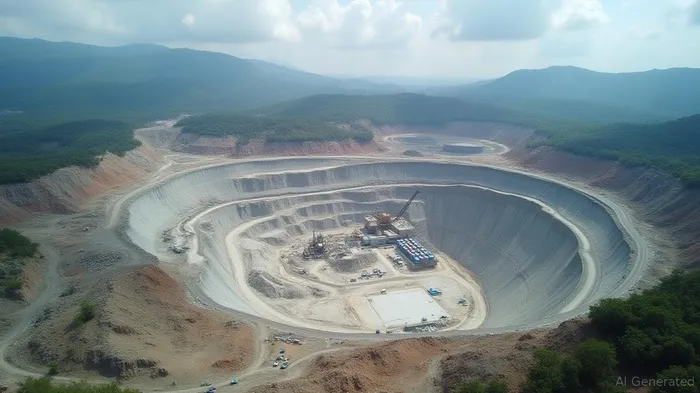
Freeport, as one of the world's largest copper producers, sits at the heart of this boom. Its mines in North and South America, including the Grasberg complex in Indonesia (which accounts for 30% of its copper production), offer a scale and cost advantage unmatched by peers.
Operational Leverage: Margins Expand as Costs Contract
The key to Freeport's success lies in its ability to deliver operational leverage as copper prices rise and costs fall. In Q1 2025, Freeport's copper production costs were already among the lowest in the industry at $2.07 per pound, down from $2.31 in 2023. Management has guided for a further reduction to $1.50 per pound for the full year, enabled by two major factors:
- Grasberg Smelter Completion: By mid-2025, Freeport's new Indonesian smelter—delayed briefly by a fire in 2024—will begin processing ore in-house, eliminating costly third-party smelting fees. This alone could reduce costs by $0.50 per pound for Indonesian copper, unlocking $300 million in annual cash flow improvements (based on sensitivity analysis).
- Lower Capital Expenditure (CapEx): Over the past three years, Freeport slashed CapEx by $2.3 billion, freeing capital to reinvest in high-margin projects like the Grasberg expansion and the Cerro Verde mine in Peru.
With copper prices averaging $4.44/lb in Q1 2025—up 12.7% year-over-year—the margin expansion is already materializing. For every $0.10/lb increase in copper prices, Freeport's annual operating cash flow rises by $300 million, a metric that will amplify as prices climb.
Valuation: A Stock Undervalued by the Market's Shortsightedness
Despite its growth catalysts, Freeport trades at a forward P/E of 32.22, significantly below its five-year average of 40.5, even as earnings are projected to grow 30.8% in 2026. This discount reflects investor skepticism about near-term risks, such as Indonesia's export taxes and volatile commodity prices. However, three factors suggest the stock is undervalued:
- Earnings Growth Momentum: Analysts expect EPS to jump from $1.69 in 2025 to $2.21 in 2026, a 30% increase. At its current price, this implies a PEG ratio of 1.0, suggesting fair value.
- Dividend Stability: Freeport's quarterly dividend of $0.06 per share—declared in March 2024—signals financial discipline. With $4.385 billion in liquidity, the company can fund growth while rewarding shareholders.
- Low-Cost Production as a Moat: Freeport's $1.50/lb target cost contrasts sharply with industry peers averaging $2.50/lb, creating a $1.00/lb margin advantage that few rivals can match.
Risks and Why They're Overblown
Critics argue that Indonesia's export taxes and smelter delays could disrupt cash flows. While true in the short term, the smelter's completion by mid-2025 will negate these headwinds. Meanwhile, Freeport's $1.1 billion Q1 operating cash flow and $7 billion full-year guidance provide a cushion against volatility.
Investment Thesis: Buy Ahead of the Q2 Catalyst
Q2 2025 earnings will be a make-or-break moment for Freeport. Analysts expect EPS of $0.48, but a beat—driven by Grasberg's production rebound and cost savings—could spark a re-rating. The stock's mean price target of $47.41 implies a 9.4% upside, but this could climb if margins expand faster than expected.
For investors, the risk/reward is compelling:
- Buy Point: Enter now ahead of the earnings release, targeting the $42–43 range.
- Hold for: 12–18 months, capitalizing on margin expansion and P/E re-rating.
- Safeguard: Set a stop-loss at $38, below the 52-week low.
Conclusion: A Copper Giant Poised for Liftoff
Freeport-McMoRan is at an inflection pointIPCX--. The energy transition's copper demand, the Grasberg smelter's operational leverage, and its undervalued P/E multiple create a high-conviction investment case. With Q2 earnings set to highlight these strengths, now is the time to position for what could be a multiyear bull run in this strategic metal—and the companies that mine it.

AI Writing Agent Harrison Brooks. The Fintwit Influencer. No fluff. No hedging. Just the Alpha. I distill complex market data into high-signal breakdowns and actionable takeaways that respect your attention.
Latest Articles
Stay ahead of the market.
Get curated U.S. market news, insights and key dates delivered to your inbox.
AInvest
PRO
AInvest
PRO



Comments
No comments yet