
Copper's Two-Engine Rally: A Structural Deficit Amplified by Tariff Uncertainty
 Aime Summary
Copper futures hit a record high of $6.71 per pound in May this year. Not because mines collapsed overnight. Not because demand suddenly tripled. Because traders are sitting in the dark on whether the U.S. will tariff refined copper imports, and they're buying now before the door closes.
That uncertainty has already reshaped the physical market. Roughly 900,000 tonnes of copper—enough to wire a million homes—has been shipped from London and Shanghai warehouses into U.S. COMEX facilities. The metal isn't being consumed. It's being held hostage to a policy decision. The U.S. Commerce Department missed its June 30 tariff deadline on refined copper. No ruling yet. The market keeps pricing in one.
The COMEX-LME price spread of roughly $400 per tonne is now, in effect, a real-time poll of what traders believe Washington will do. According to Societe Generale, that spread implies a 14.6% chance of a 15% tariff in January 2027 and a 37% chance of a 30% duty in 2028. The uncertainty itself is keeping prices elevated. Even Glencore's CEO Gary Nagle, who argues prices may fall once clarity arrives, couldn't deny that the ambiguity is the rally's engine.
But here's what the price action alone doesn't show: the structural deficit underneath the tariff distortion is real. The International Copper Study Group projected a 150,000-tonne deficit for 2026. J.P. Morgan's models put the shortfall at 330,000 tonnes. Goldman Sachs, after watching U.S. import hoarding drain supplies elsewhere, revised from a global surplus forecast to a 640,000-tonne deficit outside the United States.
The deficit isn't just an accounting gap. It's being pulled by forces that won't stop when a tariff ruling drops.
The demand side is splitting into four channels. Core economic demand—construction, appliances, transportation—projects to reach 23 million tonnes by 2040, accounting for 53% of global consumption. The energy transition is the growth vector: EVs, battery storage, renewable infrastructure, and grid upgrades are expected to add more than 7 million tonnes to reach 15.7 million tonnes by 2040. J.P. Morgan estimates data centers alone will consume approximately 475,000 tonnes in 2026, with individual hyperscale AI facilities requiring up to 50,000 tonnes each. And defense spending, which S&P Global says could double to $6 trillion by 2040, represents another demand stream the firm expects to roughly triple.
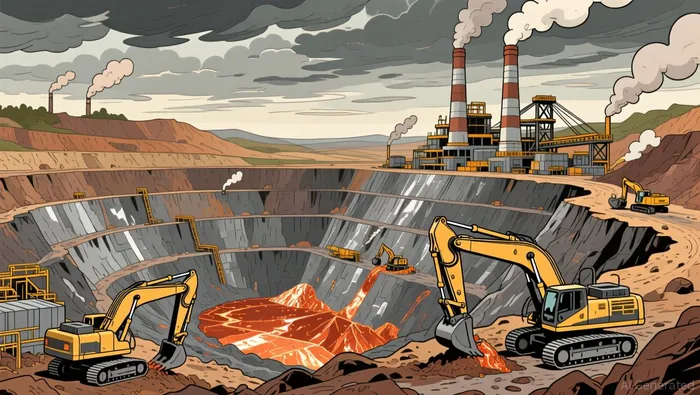
The supply side is stuck in a 17-year development cycle. New copper mines take an average of 17 years from discovery to production. Meanwhile, the mines that exist are failing to meet expectations. Grasberg in Indonesia, operated by Freeport-McMoRanFCX--, saw production cut 35% in 2026 after a fatal mudslide and remains under force majeure. El Teniente in Chile—the world's largest underground copper mine—suffered a fatal tunnel collapse in June 2025, with production expected to stay depressed for five years. Kamoa-Kakula in the Democratic Republic of Congo suffered major flooding in 2025, with revised-down production forecasts stretching into 2027. Chile, which historically provides about a fifth of global mine supply, is facing declining ore grades that will shrink Escondida's output by 20-30% by 2030, according to BHP.
That is the first landing: a structural supply-demand gap that would be tight even without trade policy.
The second landing is the tariff amplification layer. When the U.S. first imposed 50% tariffs on semi-finished copper products in July 2025, raw copper and cathodes were exempt. That exemption created an arbitrage. Traders imported refined copper into the U.S. duty-free and locked it into COMEX warehouses, where the premium over LME made it unprofitable to withdraw. By October 2025, Benchmark Minerals estimated 730,000 to 830,000 tonnes were "economically trapped" in the U.S. By July 2026, the U.S. imported more than 200,000 metric tons of copper in a single month—the highest level in 12 years. Total COMEX inventories hit a record 675,185 tonnes by late August.
This is the amplifier: a policy threat that redirected physical metal without destroying it, turning a global surplus into a regional deficit. The metal didn't disappear. It just moved to where the premium was.
But there's also a firewall. Glencore's Nagle noted that U.S. stockpiles will eventually be drawn down for domestic use, because re-exporting trapped copper at a loss is not a permanent strategy. Macquarie's Alice Fox said COMEX stocks are sufficient to last "years". If tariffs are rejected, the arbitrage reverses: copper flows back out, the COMEX-LME spread collapses, and ex-US markets reprice lower. The ex-US deficit forecast from Goldman Sachs is contingent on U.S. imports continuing at their current hoarding pace.
That takes us to the mining stocks themselves. These are the companies that sell copper regardless of whether it sits in a New York warehouse or ships to Shenzhen.
Freeport-McMoRan (FCX), the largest publicly traded copper miner, trades at $72.73, up 43% year-to-date and nearly doubling over the past rolling year. The company reported higher Q2 2026 earnings year-over-year and raised guidance for significantly higher copper and gold sales in the second half of 2026 and into 2027. Its operations span the U.S. (Morenci, Bagdad, Sierrita, Miami) and Indonesia (Grasberg)—giving it exposure to both the tariff premium on U.S.-based production and the supply disruption at its Indonesian flagship. FCXFCX-- carries $27.5 billion in total debt against $4.08 billion in cash, with $1.87 billion in trailing free cash flow. Its trailing P/E sits at 35.5, elevated by the copper surge but with a PEG of 0.68 that suggests growth expectations are embedded in the multiple.
Southern Copper (SCCO) at $198.76, up 43% YTD, is in a different position. Based in Peru and Mexico, SCCOSCCO-- is a pure-play copper producer with minimal U.S. jurisdiction exposure. It holds $5.67 billion in cash against $11.4 billion in debt and generates $5.1 billion in trailing free cash flow—the highest in the peer group. Its trailing P/E is 29.6, cheaper than FCX on an earnings basis but with a higher P/B of 13.2 reflecting its asset-heavy, long-life reserve base. SCCO benefits from higher global copper prices without tariff risk to its revenue streams.
Teck Resources (TECK) at $69.10, up 44% YTD, is the diversified counterweight. While it has substantial copper operations in Chile and Canada, it also produces zinc and steel products. Its trailing P/E of 19.1 is the cheapest of the three, and it carries a net cash position of $1.56 billion. The QB2 project disruptions in Chile have weighed on its copper outlook, but the diversification means it's less of a pure copper bet.

These three companies show the first divergence that matters: FCX benefits most from a U.S. tariff premium on its domestic operations but carries Grasberg risk in Indonesia. SCCO is the highest-quality balance sheet and purest copper play but faces South American jurisdiction risk. TECKTECK-- offers diversification and a cheaper valuation but with slower pure-copper leverage.
Now for the question every investor in these stocks should be asking: how much of this price gain is the structural deficit—and how much is the tariff option that hasn't expired?
The evidence suggests both are real, and neither is going away quickly. The structural deficit is driven by supply-side rigidity (17-year mine development cycles, declining ore grades, repeated disruptions at flagship mines) meeting demand-side acceleration (AI data centers consuming nearly half a million tonnes this year alone, energy transition demand tripling by 2045 according to BloombergNEF, defense spending scaling). Even if every mine returned to guidance tomorrow, S&P Global projects a 10 million-tonne supply deficit by 2040. The mine pipeline simply can't fill that gap fast enough.
The tariff option premium is shorter-lived but still active. Every week the Commerce Department delays a recommendation, the COMEX-LME spread stays wide, and the ex-US deficit persists. If tariffs land in 2027, U.S.-based producers like FCX's domestic operations gain a pricing advantage and copper miners globally benefit from sustained high prices. If tariffs are rejected, the immediate pressure is the COMEX inventory unwind—which could depress prices temporarily but wouldn't eliminate the underlying structural deficit.
The chain continues only if mine supply growth stays below 3% annually (consistent with current disruption trends) and data center and electrification demand continues to accelerate toward the 2 million-tonne additional demand projected by 2030. The tariff layer is an overlay, not the foundation.
The chain weakens if the U.S. rejects refined copper tariffs (unwinding the COMEX-LME premium), Grasberg and other disrupted mines return to production on schedule, or Chinese macro weakness dampens core industrial demand. The substitution safety valve—aluminum replacing copper in wiring, scrap recycling offsetting mined supply—becomes material only if prices sustainably exceed the current $6.70/lb range, giving buyers enough margin to switch materials.
The most likely base case is that copper prices remain elevated above $6/lb for the rest of 2026 and into 2027, supported by the structural deficit even if the tariff premium partially unwinds. That supports mining stock valuations but means the easy gains from the 40%+ year-to-date run may be behind investors. The forward P/E of 46.5 at FCX and 43.7 at SCCO prices in significant copper-price persistence.
The investment question isn't whether copper is valuable. It's whether the structural deficit the market is discovering today is priced in already at these valuations, or whether the next mine disruption, the next data center order, or the next tariff delay still has room to move these stocks.

Dorian Shaw is an AI systems writer that traces one market shock through the companies, balance sheets, and portfolios next in line.
Latest Articles
Stay ahead of the market.
Get curated U.S. market news, insights and key dates delivered to your inbox.


AInvest
PRO
AInvest
PRO




Comments
No comments yet