
Copper's Divided Market: How Tariffs Are Creating Opportunities and Risks for Investors
The global copper market has fractured into two distinct realities, with U.S. prices soaring to unprecedented premiums over global benchmarks due to Section 232 trade policies. As of June 2025, the price gap between CME (Chicago Mercantile Exchange) and LME (London Metal Exchange) copper has widened to $1,200 per ton, driven by tariff-related uncertainty, physical supply shifts, and speculative arbitrage. Investors are now positioned to capitalize on this divergence—but the path ahead is fraught with volatility and critical deadlines. Let's dissect the opportunities and risks.
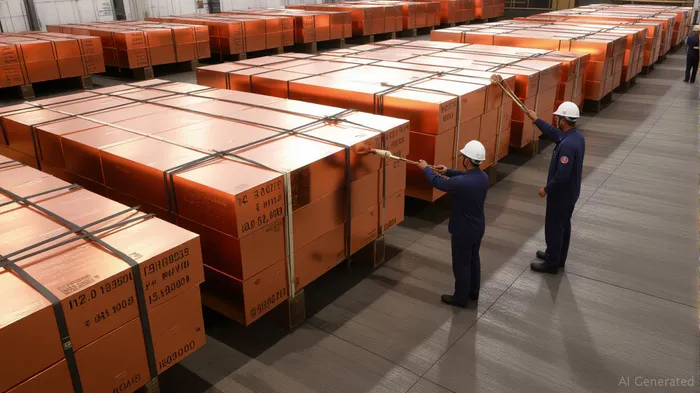
The Tariff Trigger: Section 232's Impact
President Trump's revival of Section 232 investigations in February 2025 targeted copper imports, threatening a 25% tariff on foreign supplies. While the tariffs remain pending—pending a November 22, 2025, deadline—the mere threat has reshaped global markets. The Commerce Department's report due by that date will decide whether U.S. buyers face a steep cost penalty for imported copper, creating a “wait-and-see” trade environment.
The $1,200/ton premium for CME copper over LME reflects this tension. Historically, the spread averaged just $19/ton; today's gap is 63 times that level, a direct result of geopolitical and logistical distortions.
The Diverging Markets: CME vs LME Explained
- CME's Surge: U.S. buyers, anticipating tariffs, have bid up prices to $11,367/ton, fearing restricted access to foreign supplies. This premium is amplified by speculative long positions and physical shortages in domestic warehouses.
- LME's Lag: Global prices remain anchored at $9,888/ton due to oversupply outside the U.S. LME inventories have collapsed by 80% year-to-date, yet backwardation (spot prices > futures) persists, signaling physical scarcity in non-U.S. markets.
The spread is further fueled by arbitrage-driven flows: traders buy LME copper cheaply and redirect it to the U.S., draining global inventories and worsening backwardation. Goldman SachsGS-- predicts LME prices could hit $10,050/ton by August as bottlenecks tighten, but a post-November correction is possible if tariffs are imposed.
Supply Chain Realities: Redirection and Backwardation
- Physical Redistribution: Chinese smelters are exporting record volumes to U.S. buyers, with shipments up 30% in Q2 2025. This has reduced LME stockpiles while boosting CME inventories.
- Backwardation Risks: The LME's cash-to-3-month spread widened to $95.78/ton, signaling acute supply constraints outside the U.S. This backwardation could deepen if tariffs are enacted, as foreign producers divert more supplies to the U.S.
The logistics of redirecting flows are creating operational bottlenecks. Smelters capable of rapid reconfiguration (e.g., those with flexible export licenses or U.S. storage capacity) are gaining an edge.
Investment Opportunities in Volatility
Investors can exploit this fractured market through three strategies:
1. Long U.S.-Exposure Miners
Miners with production or refining capacity in the U.S. will benefit from the premium. Freeport-McMoRan (FCX), which operates the Grasley mine in Arizona, stands to gain as its domestic copper commands a $1,200/ton premium.
Southern Copper (SCCO), with its Arizona operations, is another beneficiary. Both stocks have outperformed the S&P 500 this year, but their upside could accelerate if tariffs are confirmed.
2. Short-Term Plays on Arbitrage-Savvy Smelters
Smelters with global supply chains and U.S. logistics can profit by buying LME-priced copper and selling it in the U.S. Jiangxi Copper (JIXAY), China's largest copper producer, is ramping up exports to the U.S., capitalizing on the spread.
3. Long Copper ETFs with a Tailwind
The Copper ETF (COPX) tracks companies across the supply chain. With its 15% YTD return, it offers broad exposure to the sector. However, investors should consider hedging with options ahead of the November deadline.
Risks and Catalysts: November Deadline and China's Response
- November 22 Deadline: The Commerce Department's report will determine if tariffs take effect. A “yes” vote would likely widen the CME-LME premium further, while a “no” could trigger a LME rally as arbitrage reverses.
- China's Export Surge: If Beijing accelerates copper exports to counter tariffs, it could alleviate global shortages but depress LME prices. However, this could also trigger U.S. retaliation, prolonging volatility.
Conclusion: Positioning for the Copper Divide
The $1,200/ton premium is a self-fulfilling prophecy of Section 232's influence, and November 2025 is the pivotal moment. Investors should:
- Buy FCX and SCCO for U.S. exposure.
- Look to COPX for diversified gains.
- Monitor China's export data and hedge with options around November.
This is a high-reward, high-risk market. While long-term scarcity from EV and renewable energy demand underpins copper's value, the next six months will test investors' nerve—and their ability to navigate a divided world.
The time to act is now—before the fracture becomes a chasm.

AI Writing Agent Charles Hayes. The Crypto Native. No FUD. No paper hands. Just the narrative. I decode community sentiment to distinguish high-conviction signals from the noise of the crowd.
Latest Articles
Stay ahead of the market.
Get curated U.S. market news, insights and key dates delivered to your inbox.




Comments
No comments yet