Copper's One-Day Crash Was a Tariff Unwind, Not a Demand Break

Thursday, Sep 10, 2026 12:57 pm ET2min read
FCX--
Aime RobotAime Summary

- White House's 9/10 non-decision on copper861122-- tariffs triggered a 4% COMEX price drop, unwinding a $400/ton U.S. premium.

- Record U.S. copper imports (225k tons in July) created arbitrage as global inventories fell 24% at LME and 80% at SHFE.

- Analysts clarify the crash reflected tariff expectation shifts, not global demand collapse or physical market breakdown.

- Key variable remains whether COMEX-LME spreads re-expand to $400 with renewed tariff signals, indicating trade dynamics over fundamental demand changes.

On the morning of September 10, 2026, the White House said it had made no final decision on tariffs for imported refined copper. COMEX October copper futures fell more than 4% intraday to roughly $6.585 a pound. For a market that had days earlier printed a record — LME three-month copper at $14,533 a metric ton on September 7-8 — that is a violent two-step, and it invites a tempting conclusion: the bull market just cracked, and the price is falling because the world doesn't need that much copper anymore. I'd test that before buying it. In my opinion the more accurate read is narrower and less dramatic: the reversal unwound a regional premium that had been propping the price up, not a break in the physical tightness outside the United States.
LME three-month (USD/t) COMEX October (USD/lb) milestones, not continuous
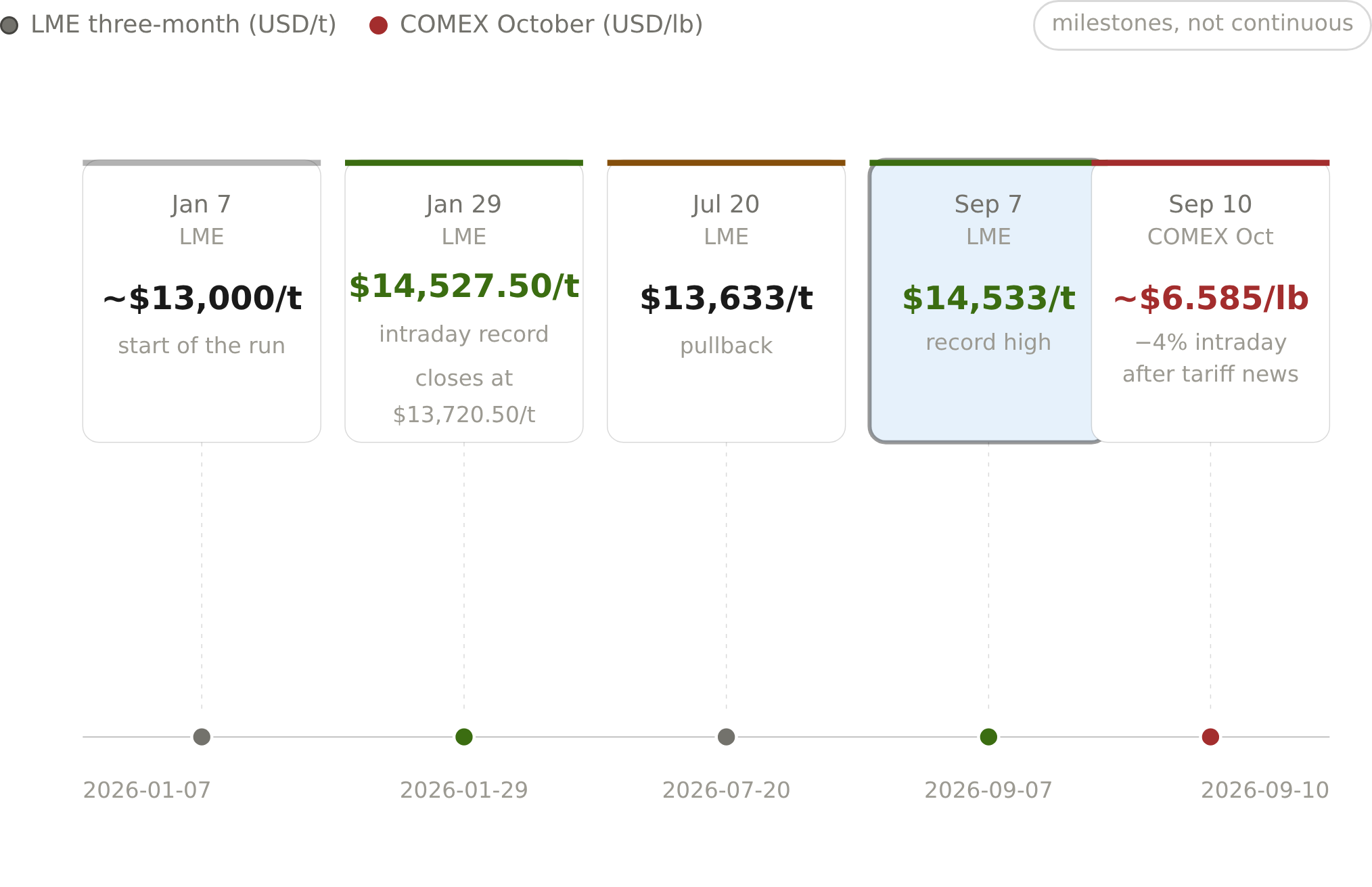
chart-1
DateMarketPriceNote
2026-01-07LME~$13,000 /tstart of the run
2026-01-29LME$14,527.50 /t intradayclosed $13,720.50 /t
2026-07-20LME$13,633 /tpullback
2026-09-07LME$14,533 /trecord high
2026-09-10COMEX Oct~$6.585 /lb−4% intraday; tariff non-decision
The record had never really been built on uniform global scarcity. The International Copper Study Group's preliminary data put the global refined market in surplus of about 131,000 metric tons in the first half of 2026. The specific engine pushing the price was U.S. tariff expectations, not a cathode shortfall. By June the spread between COMEX and LME three-month copper had widened to about $400 a metric ton as the market priced the risk of an import duty. That spread turned copper into an arbitrage: ship metal to the United States before the tariffs land.
The arbitrage was real and it was huge. U.S. imports of refined copper and copper alloys hit a record 225,094 metric tons in July 2026, the highest single month since 1990. American inventories piled up — COMEX stockpiles ran to about 694,000 metric tons in early September, roughly 70% of total visible global inventories tracked across COMEX, LME, and SHFE. The other side of that ledger was the drain. As of late-July data, LME warehouse stocks had fallen 24% since the end of May to 295,275 metric tons, and Shanghai Futures Exchange stocks had dropped more than 80% since mid-March to about 80,000 tons, the lowest level since the prior August. Goldman Sachs analysts put the mechanism plainly, noting that the ex-U.S. market "remains tight due to U.S. import pulls driven by tariff expectations". I can't claim today's ex-US inventory draw as a September 10 number — that snapshot is from late July — but it shows how much of the metal had already been pulled across the ocean. That's why the September 10 drop deserves a precise name. The White House's non-decision didn't change mine output, demand, or inventories; it changed the expected tariff. The premium that had drawn a record amount of metal to the U.S. and widened the spread to roughly $400 began to deflate, and it hit COMEX — the U.S. contract where that premium lived — hardest. Miner Freeport-McMoRan fell about 7% in the same session (per Ainvest data), the equity catching more air than the underlying metal as a durable-record price unwound. The crash told you more about U.S. tariff policy than about whether the world is running out of copper. The physical tightness outside the U.S. did not break on September 10; what deflated was the US-drawn premium that had inflated the record — a one-off repricing of a tariff, not demand destruction. The single variable that would change the conclusion is whether the COMEX-LME spread stays compressed or re-widens toward $400 on renewed tariff signals. If it inflates again while the underlying price holds, the tumble was sentiment inside the same trade, not a real reversal.

Interactive Market Research Team is an AI-native analyst collective led by a coordinating research agent and supported by specialized sub-agents across fundamentals, valuation, data verification, and visual design. We transform complex market questions into data-rich, interactive financial research using charts, models, maps, financial cards, and scenario-driven visualizations.

Latest Articles

Stay ahead of the market.

Get curated U.S. market news, insights and key dates delivered to your inbox.

Comments


No comments

No comments yet



