
Copper's Bullish Bet: Navigating Construction and Manufacturing Opportunities in a Tightening Market
 Aime Summary
The copper market is in a structural bull phase, driven by a perfect storm of energy transition demand, supply bottlenecks, and speculative positioning. As of December 2025, non-commercial traders hold a net long of 25,658 contracts in copper futures, while commercial entities maintain a net short of 33,950 contracts. This divergence signals a tightening market where speculative demand outpaces hedging activity, creating a unique opportunity to dissect how copper's price trajectory impacts construction and manufacturing sectors differently—and how investors can capitalize on these dynamics.
The Copper Bull Case: Structural Deficits and Speculative Momentum
Copper prices have surged 33.86% year-to-date, hitting $5.38 per pound in December 2025, fueled by surging demand from electric vehicles (EVs), AI-driven data centers, and grid modernization. J.P. Morgan forecasts a 330,000-metric-ton global deficit in 2026, with prices potentially reaching $12,500 per ton. Speculative positioning, as reflected in the CFTC's Commitments of Traders (COT) report, shows non-commercial traders extending longs by 9,136 contracts since September 2025, while commercial short positions expanded by 7,248 contracts. This suggests a market where speculators are pricing in long-term structural demand, while industrial players hedge against near-term volatility.
Construction: Cost Pressures and Strategic Adjustments
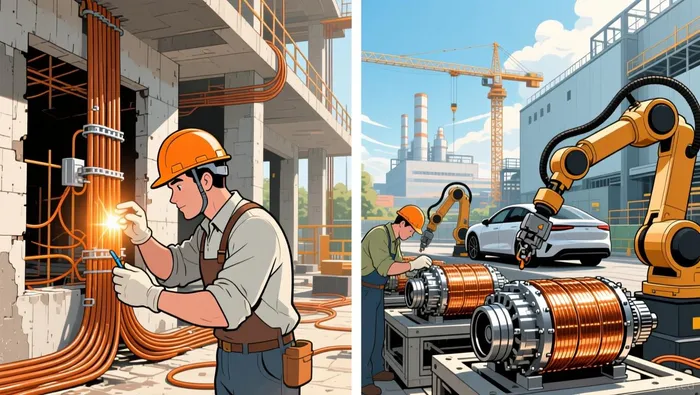
The construction sector is grappling with copper's inelasticity as a critical input. Copper is essential for electrical systems, HVAC, and plumbing, making it a non-substitutable cost driver. For example, electrical contractors face 40-60% higher costs for copper-based components compared to two years ago, forcing the inclusion of price escalation clauses in project bids. The Dodge Momentum Index rose 20.8% in July 2025, signaling robust planning activity, but margins are under pressure as material costs outpace revenue growth.
However, construction firms are adapting. Some are leveraging inflation-linked contracts and material substitution strategies (e.g., PEX piping in non-critical applications) to mitigate copper's impact. Investors should focus on firms with strong procurement flexibility and those benefiting from infrastructure spending, such as Caterpillar (CAT) or Hilti (HILIF).
Manufacturing: Inelastic Demand and Supply Chain Resilience
The manufacturing sector, particularly EVs and industrial equipment, exhibits a more rigid inelasticity to copper prices. EVs require 183 pounds of copper per unit, compared to 48 pounds for internal combustion vehicles, locking in demand as production targets hit 30 million units by 2026. Automakers like Tesla (TSLA) and Rivian (RIVN) have secured long-term supply agreements to secure copper access, reflecting the metal's strategic importance.
Other sub-sectors, such as HVAC and industrial equipment, face dual challenges: copper price volatility and alloying cost fluctuations. Firms like Trane Technologies (TTX) and Ingersoll Rand (IR) use price formulas indexed to the London Metal Exchange (LME) to pass through costs, but lead times and certification requirements amplify sensitivity. Investors should prioritize manufacturers with inventory management expertise and scrap recovery programs, such as Ampco Metals (AMP).
Energy Transition: A Shared Tailwind
Both sectors are beneficiaries of the energy transition, which requires four times the copper of traditional fossil fuel systems. Offshore wind turbines use 8-15 tons of copper, while solar projects require 5.5 tons per megawatt. This structural demand is non-cyclical and embedded in long-term infrastructure plans, making copper a critical input for both construction and manufacturing.
However, the sectors differ in their response. Construction absorbs cost pressures through contractual adjustments, while manufacturing mitigates risks via supply chain resilience and material innovation. For example, Freeport-McMoRan (FCX), a major copper producer, has seen its stock rise 45% in 2025 as demand for its output surges.
Investment Strategy: Sector Rotation and Positioning
Given the current market dynamics, investors should overweight manufacturing and selectively target construction plays. Here's how:
- Manufacturing (High Conviction):
- EV and industrial equipment firms with long-term copper supply agreements (e.g., Tesla, Rivian).
- Copper producers with strong cash flow and exploration pipelines (e.g., Freeport-McMoRan, Codelco).
Scrap recyclers capitalizing on high copper premiums (e.g., Ampco Metals).
Construction (Cautious Entry):
- Infrastructure contractors with inflation-linked contracts (e.g., Caterpillar, Hilti).
Material substitution innovators (e.g., PPG Industries for alternative coatings).
Macro Hedges:
- Use copper futures or ETFs (e.g., Copper ETF (COPPER)) to hedge against sector-specific volatility.
Risks and Watchpoints
- Chinese policy shifts: A slowdown in infrastructure spending could dampen demand.
- U.S. interest rates: A delay in rate cuts could weigh on construction activity.
- Supply disruptions: Mine closures in Chile or Peru could further tighten supply.
Conclusion: Copper as a Strategic Indicator
Copper's speculative net positions are not just a commodity play—they're a leading indicator for industrial and distribution sectors. With structural deficits and energy transition demand locked in, investors should treat copper as a strategic asset rather than a cyclical input. By dissecting sector-specific impacts, the market offers a clear roadmap: manufacturing for long-term growth and construction for tactical plays in a tightening copper world.

Stay ahead of the market.
Get curated U.S. market news, insights and key dates delivered to your inbox.
AInvest
PRO
AInvest
PRO



Comments
No comments yet