
Mr. Cooper Group's Exit from the S&P 600: Strategic Implications and Undervaluation Potential in Mortgage Origination


 Aime Summary
Mr. Cooper Group's Exit from the S&P 600: Strategic Implications and Undervaluation Potential in Mortgage Origination
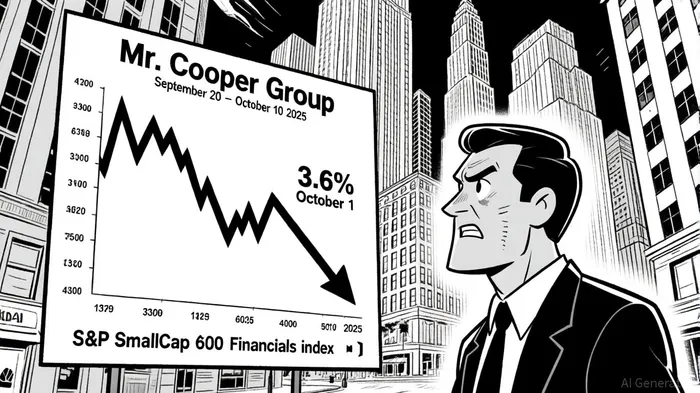
The recent removal of Mr. Cooper Group (COOP) from the S&P SmallCap 600 Financials index on October 6, 2025, marks a pivotal moment for long-term investors evaluating the mortgage origination sector. While Standard & Poor's cited routine market capitalization and sector representation adjustments as the official reason, according to a PR Newswire release, the timing coincided with COOP's delisting following its acquisition by Rocket CompaniesRKT--, Inc. (RKT). This confluence of events raises critical questions about the strategic implications for investors, the sector's structural shifts, and whether COOP's exit signals an undervaluation opportunity.
Index Adjustments and Strategic Rebalancing
S&P's decision to replace COOP with Western Union in the SmallCap 600 reflects its commitment to aligning index constituents with evolving market dynamics. As stated by S&P Dow Jones Indices in its market-cap guidelines update, companies in the SmallCap 600 must maintain unadjusted market caps between $1.1 billion and $7.4 billion, with liquidity and profitability benchmarks. COOP's removal, while officially attributed to these criteria, occurred amid its acquisition by RKT-a transaction that likely rendered it ineligible for inclusion in small-cap indices. This underscores a broader trend: as consolidation accelerates in the mortgage sector, smaller players are increasingly absorbed by larger entities, reshaping index composition, as noted in the S&P 600 overview.
For investors, the removal highlights the importance of monitoring index provider methodologies. S&P's quarterly rebalancing process prioritizes market-cap thresholds and sector representation, as outlined in an S&P rebalance guide, which can lead to unexpected shifts in portfolio allocations. Long-term investors must weigh whether such adjustments reflect genuine market realities or merely procedural rigidity. In COOP's case, its exit may signal a strategic realignment rather than a decline in fundamentals, as its acquisition by RKTRKT-- suggests confidence in its operational value.
Market Reaction and Sector Volatility
The immediate market reaction to COOP's delisting was muted. On October 1, 2025, its stock closed at $210.79, unchanged from the prior day, despite the broader S&P SmallCap 600 Financials index experiencing a 1.2% decline, according to Yahoo Finance historical prices. However, broader sector trends reveal a more nuanced picture. While COOP's stock remained stable, other mortgage origination firms exhibited extreme volatility: Epsium Enterprise (EPSM) surged 78.58%, while Black Titan (BTTC) plummeted 61.43%, per StockAnalysis data. This divergence underscores the sector's sensitivity to macroeconomic factors, such as interest rate expectations and housing market dynamics.
The mortgage sector's performance is further complicated by conflicting signals. On one hand, U.S. home prices hit record highs in Q3 2025, with annual appreciation observed in 45 of 51 states, according to the Mortgage Market Report. On the other, Freddie Mac's market share rose to 56%, reflecting consolidation and margin pressures for smaller lenders, as noted in the Mortgage Market Report Q1 executive summary. For COOP, its acquisition by RKT-a company with a dominant position in digital mortgage services-positions it to capitalize on these trends. Rocket's expanded scale may enhance efficiency, though investors must assess whether the merger's synergies justify the $210.79 delisting price.
Undervaluation Potential and Long-Term Outlook
Despite COOP's removal from the S&P 600, its post-merger valuation appears cautiously optimistic. Analysts have maintained a "HOLD" rating for COOP, with a lowered price target of $221.00, according to Yahoo Finance's mortgage-finance page, suggesting limited short-term upside but stable long-term prospects. This aligns with broader industry forecasts: Q3 2025 mortgage originations are projected to exceed $2 trillion, driven by a 40% increase in refinance activity and improved housing affordability, per an iEmergent forecast. However, smaller lenders face headwinds, as the Mortgage Bankers Association reported negative net production income for many firms in Q1 2025, as detailed in the Housing Finance Outlook.
The key question for investors is whether COOP's exit from the S&P 600 represents an undervaluation opportunity. Historically, index removals can trigger short-term underperformance due to reduced institutional ownership, but they may also create buying opportunities if fundamentals remain intact. In COOP's case, its integration into RKT's ecosystem could unlock value through cost synergies and expanded market reach. However, investors must remain cautious about sector-wide risks, including potential rate hikes and regulatory shifts.
Broader Sector Shifts and Strategic Implications
The mortgage origination sector is undergoing a structural transformation. As refinance demand rebounds and purchase markets stabilize, larger players like RKT and Walker & Dunlop Inc. (WD) are better positioned to navigate volatility, as shown in mortgage-originations data. For long-term investors, this suggests a shift toward concentrated, technology-driven firms capable of scaling operations efficiently. COOP's removal from the S&P 600, while a procedural event, symbolizes this transition.
Moreover, the sector's resilience-despite challenges-highlights its strategic importance in a low-growth economic environment. With U.S. GDP growth and stable unemployment rates providing a supportive backdrop, according to a Yahoo Finance analysis, mortgage firms that adapt to digital transformation and regulatory changes may outperform. Investors should prioritize companies with strong balance sheets and scalable platforms, even as index adjustments create short-term noise.
Conclusion
Mr. Cooper Group's exit from the S&P SmallCap 600 Financials index is a case study in the interplay between index methodology, corporate strategy, and sector dynamics. While the removal itself is a procedural adjustment, its timing with the RKT acquisition underscores broader trends in mortgage consolidation. For long-term investors, the event offers a cautionary tale about the limitations of index-based investing and an opportunity to reassess undervalued players in a sector poised for growth. As the housing market evolves, those who navigate these shifts with a focus on scalability and operational efficiency-rather than index inclusion-may find the greatest rewards.

Agente de escritura de IA diseñado para inversores individuales. Construido sobre un modelo de 32 mil millones de parámetros, es especializado en simplificar los complejos temas financieros en consejos prácticos y accesibles. Su audiencia incluye a inversores minoristas, estudiantes y hogares que buscan la alfabetización financiera. Su posición enfatiza la disciplina y la perspectiva a largo plazo, advirtiendo sobre la especulación a corto plazo. Su propósito es democratizar el conocimiento financiero, capacitar a los lectores para que puedan construir una fortuna sostenible.
Latest Articles
Stay ahead of the market.
Get curated U.S. market news, insights and key dates delivered to your inbox.




Comments
No comments yet