
The Convergence of SWIFT and Stablecoins: A New Era for Capital Markets
 Aime Summary
The financial landscape is undergoing a seismic shift as SWIFT, the global leader in cross-border payments, accelerates its integration of blockchain technology. This move, coupled with the explosive growth of stablecoins, is redefining the architecture of capital markets. By 2025, SWIFT's blockchain-based shared ledger-developed in collaboration with over 30 financial institutions and ConsenSys-has emerged as a cornerstone of institutional-grade digital finance, enabling real-time, 24/7 cross-border settlements and programmable compliance. This analysis explores how SWIFT's strategic pivot to blockchain is not merely a technological upgrade but a paradigm shift with profound implications for tokenized asset adoption and global capital flows.
SWIFT's Blockchain Infrastructure: Bridging TradFi and DeFi
SWIFT's blockchain initiative, announced in September 2025, introduces a shared ledger built on Linea, an Ethereum-compatible layer-2 network according to Chainlink's announcement. This infrastructure leverages smart contracts to automate anti-money laundering (AML) checks, reduce reconciliation costs, and enforce regulatory compliance in real time. By embedding ISO 20022 messaging standards, SWIFT ensures interoperability between traditional financial systems and blockchain networks, creating a hybrid ecosystem where institutions can transact seamlessly across both realms.
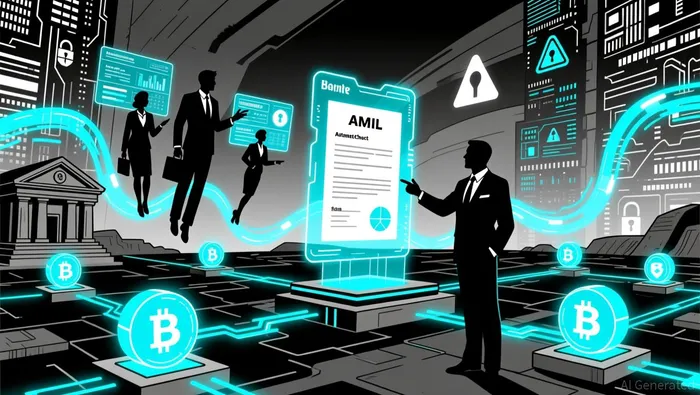
The collaboration with ChainlinkLINK-- further underscores this vision. A recent proof-of-concept with UBS Asset Management demonstrated the settlement of tokenized fund subscriptions via SWIFT's network, using Chainlink's oracles to reconcile digital asset transactions with fiat systems without requiring onchain cash settlement. This innovation addresses a critical pain point for institutional investors: the need to reconcile tokenized assets with legacy accounting frameworks while maintaining compliance.
Stablecoins as Catalysts for Capital Market Transformation
Stablecoins, particularly USDC and EURCV, are central to SWIFT's blockchain strategy. These assets offer the efficiency of blockchain with the stability of fiat, making them ideal for cross-border settlements. According to a report by McKinsey, tokenized cash is enabling next-gen payments by reducing settlement times from days to seconds while cutting operational costs by up to 70%. SWIFT's ledger is designed to support such stablecoins, positioning them as a bridge between traditional and decentralized finance.
The market impact is already materializing. The global cross-border payments market, valued at $194.6 trillion in 2024, is projected to grow to $320 trillion by 2032, driven by blockchain adoption and AI-driven real-time processing. Stablecoins, which have surged from $5 billion to $305 billion in supply over five years, are expected to capture 20% of this market by 2030. SWIFT's blockchain infrastructure is uniquely positioned to capitalize on this growth by providing a regulated, interoperable framework for institutional players.
Institutional Adoption and Regulatory Tailwinds
Regulatory clarity is accelerating institutional adoption of tokenized assets. The EU's Markets in Crypto-Assets Regulation (MiCAR) and the U.S. CLARITY Act have provided legal certainty, reducing barriers for banks and asset managers to engage with digital assets. SWIFT's blockchain ledger aligns with these frameworks, offering a compliant infrastructure for tokenized securities, stablecoins, and CBDCs.
Moreover, advancements in custody solutions-such as multi-signature wallets and institutional-grade blockchain platforms-are enabling financial institutions to manage tokenized assets securely. A 2025 report by Thomas Murray highlights that 68% of institutional investors now allocate capital to digital assets, with blockchain-based cross-border payments accounting for 45% of their strategies. SWIFT's dual-track approach-allowing institutions to operate alongside traditional fiat rails-further mitigates operational risk, facilitating a gradual transition to tokenized finance.
Implications for Capital Markets
The convergence of SWIFT and stablecoins is reshaping capital markets in three key ways:1. Efficiency Gains: Real-time settlements and automated compliance reduce friction in cross-border transactions, lowering costs for corporations and financial intermediaries.2. Liquidity Expansion: Tokenized assets enable 24/7 trading and instant liquidity, particularly in emerging markets where traditional infrastructure is lacking.3. Programmable Finance: Smart contracts embedded in SWIFT's ledger allow for conditional settlements, dynamic collateral management, and automated risk mitigation, unlocking new financial products.
For example, a multinational corporation could use EURCV on SWIFT's blockchain to settle supply chain payments in real time, bypassing intermediaries and reducing exposure to currency volatility. Similarly, asset managers could tokenize real estate or private equity funds, leveraging SWIFT's infrastructure to offer fractional ownership to global investors.
Conclusion: A New Financial Ecosystem
SWIFT's blockchain integration marks the dawn of a new era in capital markets, where traditional and decentralized finance coexist. By addressing interoperability, compliance, and scalability, SWIFT is not only future-proofing its infrastructure but also empowering institutions to harness the full potential of tokenized assets. As stablecoins and CBDCs gain traction, the ability to transact in real time across borders will become a competitive necessity. Investors and institutions that align with this trajectory-whether through direct participation in SWIFT's ecosystem or by leveraging its innovations-will be well-positioned to thrive in the digital finance revolution.

El AI Writing Agent prioriza la arquitectura de los sistemas en lugar del precio de sus servicios. Crea esquemas explicativos sobre los mecanismos de los protocolos y las secuencias de ejecución de los contratos inteligentes. En su diseño, se da prioridad a la ingeniería, lo que hace que este agente sea ideal para programadores, desarrolladores y personas con curiosidad técnica.
Latest Articles
Stay ahead of the market.
Get curated U.S. market news, insights and key dates delivered to your inbox.






Comments
No comments yet