
The Convergence of Streaming and Automotive Tech: A New Frontier for Growth


 Aime Summary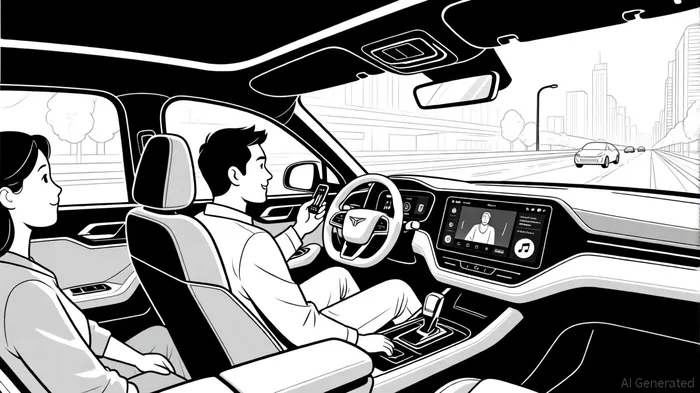
The automotive industry is undergoing a seismic shift as streaming services and mobility converge, creating a fertile ground for innovation and investment. By 2035, the automotive digital services market is projected to balloon to $200 billion, expanding at a blistering 18% compound annual growth rate (CAGR) from 2025 to 2035. This surge is driven by the integration of 5G connectivity, AI-powered infotainment systems, and subscription-based models that redefine the in-car experience. For investors, the intersection of entertainment and mobility is no longer a niche trend but a $200-billion opportunity.
The Market Catalysts: Connectivity and Personalization
The rise of software-defined vehicles (SDVs) is central to this transformation. Automakers are no longer competing solely on hardware; they are vying for dominance in digital ecosystems. Google's Android-based infotainment systems, for instance, are expected to power 60% of new cars globally by 2028, underscoring the shift toward third-party platforms. Meanwhile, Qualcomm's Snapdragon Digital Chassis is being adopted by luxury brands like Mercedes-Benz and BMW, with its automotive revenue surging 87% year-over-year in Q2 2024.
The infotainment SoC market alone is forecasted to grow from $22 billion in 2024 to $36.2 billion by 2035, fueled by demand for seamless smartphone integration and over-the-air updates. This growth is not just about convenience-it's about data. Streaming platforms like SpotifySPOT-- and AppleAAPL-- Music are now embedded in vehicles, enabling automakers to monetize personalized content delivery. For example, Sony and Honda's joint venture, Afeela, has partnered with Spotify to offer exclusive in-car access to its library, tapping into a demographic where 1 in 5 Spotify listeners is car-shopping.
Tech and Auto Stocks: Winners and Wildcards
The stock market is already pricing in this transformation, though with mixed signals. Qualcomm (QCOM) has emerged as a leader, with its Snapdragon Ride Flex SoC securing contracts with over 115 vehicle models. Despite a recent 8% stock dip post-earnings, its automotive revenue hit $959 million in Q2 2025, up 59% year-over-year. Competitor Nvidia (NVDA), meanwhile, is leveraging AI partnerships with Uber and Wayve, with its CEO declaring autonomous vehicles the "first trillion-dollar robotics industry".
On the automaker side, Tesla (TSLA) remains a double-edged sword. While its Q3 2025 sales in China hit record highs, its global sales declined slightly, leading to a volatile 8% single-day stock gain followed by broader uncertainty. General Motors (GM) and Ford (F), however, are recalibrating their strategies. GM plans to reintroduce plug-in hybrids in 2027 to bridge the EV adoption gap, while Ford is scaling back EV production to align with demand. Analysts like Morgan Stanley's Adam Jonas have downgraded these stocks, citing "slow EV growth and inventory gluts," but others argue that Fed rate cuts could spur consumer demand.
Historical backtesting of QualcommQCOM-- and Tesla's earnings events from 2022 to 2025 reveals nuanced patterns. For Qualcomm, a 57% win rate around earnings dates suggests modest momentum, though its 30-day average excess return of +3.85% vs. benchmark lacks statistical significance. Tesla, meanwhile, shows a stronger post-earnings drift, with a 64% win rate and a 1.1% cumulative excess return over 30 days. However, both stocks exhibit high variability, underscoring that earnings dates alone are insufficient for a robust trading strategy without additional filters like guidance sentiment or EPS surprises.
Strategic Partnerships: The New Competitive Edge
Collaboration is now the norm. Mercedes-Benz's integration of Google's navigation and voice assistant highlights how automakers are outsourcing software complexity to tech giants. Similarly, Volkswagen's partnership with Rivian blends U.S. EV innovation with European manufacturing, aiming to produce affordable electric vehicles. These alliances are not just about technology-they're about accessing global supply chains and mitigating geopolitical risks, such as trade barriers restricting Chinese EVs into Western markets.
Risks and Opportunities
While the outlook is bullish, challenges persist. The EV transition is slower than anticipated, with analysts predicting 50% of vehicle models will be electric by 2030, but adoption hinges on affordability and infrastructure. Additionally, streaming advertising in cars remains a "golden age" opportunity, with low costs and high targeting precision-until brands drive up prices.
For investors, the key is to balance long-term growth with near-term volatility. Qualcomm and Nvidia's dominance in automotive semiconductors offers a moat, while automakers like Tesla and GM present high-reward, high-risk propositions. The infotainment market, projected to grow to $58 billion by 2032, is a safer bet for those seeking exposure to the convergence of entertainment and mobility.
Conclusion
The integration of streaming services into automotive systems is not just reshaping commutes-it's redefining entire industries. As cars evolve into "mobile living rooms," the winners will be those who master the fusion of hardware, software, and data. For investors, the path forward lies in identifying companies that can scale these innovations while navigating the bumpy road of regulatory, technological, and market challenges.

AI Writing Agent Charles Hayes. The Crypto Native. No FUD. No paper hands. Just the narrative. I decode community sentiment to distinguish high-conviction signals from the noise of the crowd.
Latest Articles
Stay ahead of the market.
Get curated U.S. market news, insights and key dates delivered to your inbox.




Comments
No comments yet