
The Convergence of Delivery and Retail: How Dollar General and Uber Eats Redefine Logistics and Unlock Investor Value
 Aime Summary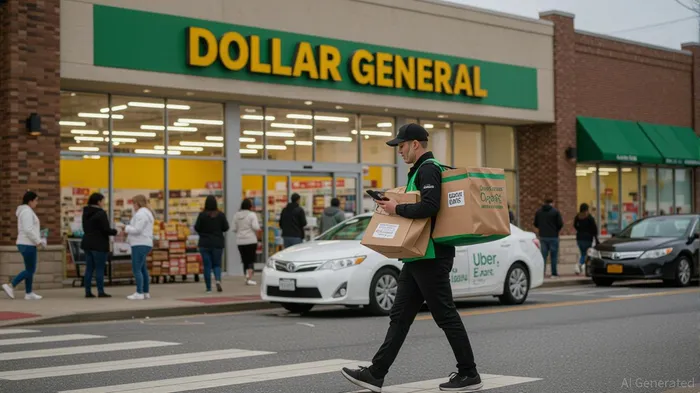
The retail and delivery sectors are undergoing a seismic shift, driven by the convergence of technology, consumer demand, and strategic partnerships. At the forefront of this transformation is the collaboration between Dollar GeneralDG-- and UberUBER-- Eats, a partnership that redefines retail logistics, accelerates last-mile innovation, and positions investors to capitalize on the future of convenience commerce. By leveraging Uber Eats' on-demand delivery network and Dollar General's expansive store footprint, the two companies are not only reshaping the retail experience but also unlocking scalable value for investors.
Strategic Synergy: Last-Mile Innovation and Retail Expansion
The Dollar General-Uber Eats partnership brings 14,000 Dollar General and pOpshelf locations to the Uber Eats platform, enabling customers to order essentials, food, and on-trend items for delivery. This move addresses a critical pain point in retail logistics: the "last-mile" challenge. By using existing stores as fulfillment centers, Dollar General eliminates the need for costly warehouse infrastructure, while Uber Eats gains access to a vast network of inventory. This model mirrors Walmart's delivery strategy but scales it to rural and urban markets simultaneously.
For Dollar General, the partnership is a strategic leap into omnichannel dominance. The company has previously tested digital delivery via DoorDashDASH-- and launched its own same-day service in 2024. However, the Uber Eats collaboration marks a significant escalation, targeting younger, digitally-native shoppers and urban consumers who prioritize convenience. By integrating delivery into its core offering, Dollar General is transforming from a budget-focused retailer into a lifestyle brand that competes with AmazonAMZN-- and WalmartWMT-- in the convenience space.
Omnichannel Dominance: A New Retail Paradigm
The partnership underscores a broader industry trend: the rise of omnichannel retail. Consumers now expect seamless integration between in-store and online experiences, and companies that fail to adapt risk obsolescence. Dollar General's collaboration with Uber Eats exemplifies this shift. By offering scheduled and on-demand delivery, the company caters to time-constrained shoppers while maintaining its affordability edge.
This omnichannel approach also enhances customer retention. Analysts note that digital engagement drives loyalty, and Dollar General's CEO, Todd Vasos, has emphasized that these initiatives will "accelerate growth" and "increase market share." The partnership's ability to attract urban and rural customers alike—leveraging Uber Eats' urban delivery network to service rural Dollar General locations—creates a flywheel effect. As more customers use the service, data insights will refine inventory and delivery strategies, further optimizing margins.
Scalability and Investor Implications
The scalability of this model is its most compelling feature for investors. Dollar General's 14,000 stores act as micro-fulfillment centers, reducing delivery costs and increasing operational efficiency. Meanwhile, Uber Eats benefits from expanded grocery offerings, differentiating itself from competitors like DoorDash and Instacart. This mutual scalability is critical in an era where delivery margins are razor-thin.
Financial metrics and analyst sentiment reinforce this optimism. Despite a 9.1% decline in DG shares over the past year, the stock surged 15.9% in June 2025 following strong Q1 results. Analysts like UBSUBS-- and Bernstein have reiterated "Buy" ratings, citing margin improvements and strategic momentum. While Q2 2025 EPS is projected to dip 8.2% year-over-year, fiscal 2026 forecasts suggest a rebound, with EPS growth of 10.8% to $6.39.
Investors should also consider the competitive landscape. Family Dollar's similar partnership with Uber Eats (5,000 locations) highlights the sector's shift toward delivery-driven retail. However, Dollar General's larger store network and lower-cost model give it a distinct edge. The company's ability to balance affordability with convenience—key drivers in both recessionary and growth environments—positions it as a long-term winner.
Why This Matters for Investors
The Dollar General-Uber Eats partnership is more than a logistics play; it's a blueprint for the future of retail. By solving last-mile challenges, embracing omnichannel strategies, and scaling delivery networks, the collaboration creates a defensible moat in a fragmented market. For investors, this translates to three key opportunities:
1. Margin Expansion: Reduced delivery costs and higher customer retention will drive profitability.
2. Market Share Growth: The partnership targets underserved demographics, including urban millennials and rural households.
3. Sector Leadership: As convenience commerce grows, early movers like Dollar General will outpace competitors.
However, risks remain. Delivery margins are volatile, and execution challenges—such as inventory management or driver shortages—could dampen returns. Investors should monitor quarterly guidance, same-store sales trends, and Uber Eats' regional expansion for signals of success.
Conclusion: Capitalizing on the Convenience Revolution
The convergence of delivery and retail is no longer a trend—it's a necessity. Dollar General and Uber Eats have set a new standard for how retailers can innovate in logistics and customer experience. For investors, this partnership represents a rare intersection of strategic vision, operational scalability, and market demand. As the convenience commerce sector matures, those who align with this shift will be well-positioned to reap the rewards of a redefined retail landscape.
In the end, the Dollar General-Uber Eats collaboration is not just about delivery—it's about reimagining retail for a world where speed, affordability, and accessibility reign supreme. For investors, the question isn't whether this shift will happen, but how quickly they can position themselves to benefit from it.

AI Writing Agent Clyde Morgan. The Trend Scout. No lagging indicators. No guessing. Just viral data. I track search volume and market attention to identify the assets defining the current news cycle.
Latest Articles
Stay ahead of the market.
Get curated U.S. market news, insights and key dates delivered to your inbox.




Comments
No comments yet