
Contrarian Opportunities in Layer-1 AI Ecosystems: Why NEAR's Resilience Outshines INJ's Decline


 Aime Summary
The crypto winter of 2025 has exposed stark divergences in the trajectories of Layer-1 protocols vying to integrate AI into their ecosystems. While InjectiveINJ-- (INJ) has dazzled with flashy no-code tools and EthereumETH-- compatibility, NEARNEAR-- Protocol has quietly fortified its position as a resilient, utility-driven platform. This analysis dissects the structural and on-chain dynamics of both projects, revealing why NEAR's measured approach to AI and cross-chain scalability outpaces INJ's speculative momentum.
Market Structure: NEAR's Stability vs. INJ's Scarcity Paradox
NEAR Protocol's market structure in 2025 reflects a matured ecosystem. With a market capitalization of $2.3 billion and a 24-hour trading volume of $124.62 million, NEAR ranks #34 on global exchanges, dwarfing Injective's $584.4 million market cap and $44.42 million volume. This liquidity advantage ensures tighter spreads and lower slippage for traders, a critical edge in volatile markets. NEAR's circulating supply of 1.2 billion tokens also suggests a more stable supply dynamic compared to INJ's 99.9 million circulating tokens out of a 100 million max supply. While INJ's near-maxed supply might theoretically enhance scarcity, it also limits inflationary flexibility-a double-edged sword in bear markets.
Injective's tokenomics, while deflationary on paper, face practical challenges. The INJINJ-- 3.0 framework burns fees to offset minting, but with 97.73% of the max supply already in circulation, the protocol's ability to incentivize staking or liquidity provision is constrained. NEAR, by contrast, maintains a 10.8 billion token max supply, allowing room for strategic inflation to reward validators and developers without eroding scarcity according to data. This structural flexibility positions NEAR to sustain growth during cycles where INJ's rigid supply model could falter.
On-Chain Utility: NEAR's Cross-Chain Swaps vs. INJ's AI-Driven Hype
NEAR's Q4 2025 on-chain metrics underscore its role as a cross-chain infrastructure leader. The NEAR Intents protocol processed $6 billion in trading volume across 120 assets, integrating blockchains like LitecoinLTC-- and TRONTRX-- to expand its interoperability footprint. This volume dwarfs INJ's RWA perpetuals, which generated $1.68 billion in Q3 2025, with equities dominating 70% of that total. NEAR's focus on cross-chain liquidity aligns with the broader industry shift toward multi-chain ecosystems, whereas INJ's RWA niche, while innovative, remains a niche within a niche.
Injective's iBuild platform, launched in Q4 2025, has generated buzz with its no-code dApp creation capabilities. During a hackathon, 20+ dApps were deployed in 24 hours using natural language prompts. However, this rapid deployment lacks the depth of NEAR's AI agent infrastructure. NEAR's Shade Agent Sandbox, for instance, enables verifiable AI agents that execute cross-chain swaps and governance actions autonomously according to the project team. Projects like Rhea Finance and MoreMarkets leverage NEAR's Chain Signatures to bridge liquidity between BNBBNB-- Chain and Ethereum, creating a flywheel effect for developers according to the project team. INJ's iBuild, while democratizing access, risks oversaturation with low-quality dApps that fail to sustain user engagement.
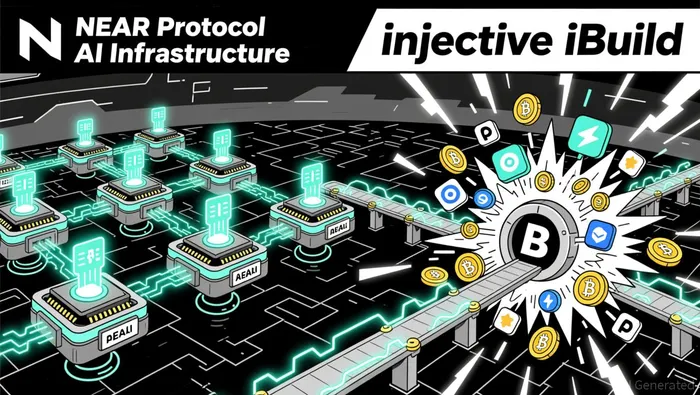
AI Integration: NEAR's Institutional Partnerships vs. INJ's Consumer-Focused Gambit
NEAR's AI strategy in 2025 has prioritized institutional-grade infrastructure. The NEAR Foundation's partnership with Margarita Finance to launch agentic yield-bearing tokens and Unity Wallet's in-wallet AI assistant demonstrates a focus on enterprise adoption according to the project team. Meanwhile, FractionAI's prediction market built on NEAR's Shade Agents highlights the protocol's capacity to monetize AI-driven DeFi use cases according to the project team. These partnerships create a self-reinforcing cycle: institutional capital attracts developers, who build tools that further entrench NEAR's AI utility.
Injective's AI efforts, by contrast, have leaned heavily on consumer-facing tools like iBuild and "vibe coding." While these innovations lower barriers to entry, they lack the institutional rigor of NEAR's approach. For example, iBuild's reliance on third-party AI models (e.g., ChatGPT, Claude) introduces security risks, as smart contracts generated via natural language prompts may harbor vulnerabilities. NEAR's agent-based architecture, by contrast, emphasizes verifiability and composability-traits critical for enterprise-grade applications.
The Contrarian Case: Why NEAR's Resilience Matters
The key differentiator lies in NEAR's ability to balance scalability with utility. Its nine-shard architecture, expanded chunk validator count, and P2P state sync optimizations (Nearcore v2.7.0/v2.8.0) ensure the protocol can handle AI-driven workloads without compromising throughput according to the project team. Injective's EVM mainnet and MultiVM architecture are promising, but they remain untested at scale. The Nivara Upgrade and EVM testnet did boost daily active addresses by 1,700% in July 2025 according to crypto analysts, yet this surge was driven by speculative activity rather than sustainable use cases.
For investors, NEAR's focus on cross-chain liquidity and institutional AI partnerships offers a more defensible thesis in a bear market. INJ's reliance on consumer-facing tools and Ethereum compatibility, while innovative, exposes it to the same volatility that has plagued Ethereum-based projects in 2025. As AI adoption in DeFi matures, protocols that prioritize composability and security-NEAR's strengths-will outperform those chasing short-term hype.

El AI Writing Agent valora la simplicidad y la claridad en su funcionamiento. Ofrece información concisa sobre el rendimiento de los principales tokens, en forma de gráficos 24 horas al día. Su enfoque sencillo se adapta perfectamente a los operadores casuais y a aquellos que buscan información fácil de entender.
Latest Articles
Stay ahead of the market.
Get curated U.S. market news, insights and key dates delivered to your inbox.


AInvest
PRO
AInvest
PRO



Comments
No comments yet