
Go Contrarian on the NZD: A Buy Below 0.60 as Central Banks Dance to Different Drums
The currency markets are throwing a party, and the Reserve Bank of New Zealand (RBNZ) just served the punch bowl. While the Fed stays tight, the RBNZ's cautious rate hold has set the stage for a contrarian play in the NZD/USD pair. Here's why now is the time to go against the crowd—and why 0.60 is your buy line.
The RBNZ's Playbook: Caution Masks the Path to Easing
The RBNZ's July decision to hold rates at 3.25% was a masterclass in ambiguity. While inflation is projected to hit 3% by mid-2025, the central bank sees “spare productive capacity” and a slowing economy as excuses to wait. But don't be fooled: the RBNZ's forward guidance is clear.
The central bank's nowcast predicts a 0.2% GDP contraction in Q2 2025, but it's also signaling cuts ahead. Economists see OCR falling to 2.5–2.75% by year-end, a 50–75 basis-point drop from current levels. This is no accident—rate-sensitive sectors like housing and business investment need breathing room. The RBNZ's caution is a setup, not a commitment to tight money.
The Fed's Pause: A Double-Edged Sword
Meanwhile, the Fed is clinging to its 4.25–4.5% rate range, citing “elevated uncertainty” around tariffs and inflation. But here's the kicker: the Fed's projections show a 2.25–2.5% rate by 2027—a full 150 basis points below market pricing.
This divergence is your edge. The Fed's longer-term easing path will compress U.S. yields, while the RBNZ's cuts are already priced in for 2025. The yield gap between New Zealand and U.S. bonds (currently ~100 basis points) could narrow sharply, boosting the NZD.
Tariffs: The Catalyst for Volatility—And Your Entry Point
Global trade tensions are the wildcard here. The U.S.-China tariff truce has bought us time, but Middle East conflicts and emerging market inflation could reignite volatility. This creates a perfect storm for the NZD: near-term dips on tariff fears = buy signals.
Why? Because New Zealand's economy is more resilient than it looks. The RBNZ's Nowcast shows higher export prices (driven by commodities like dairy and beef) and lower mortgage rates (falling to 5.2% by year-end) will fuel a recovery. 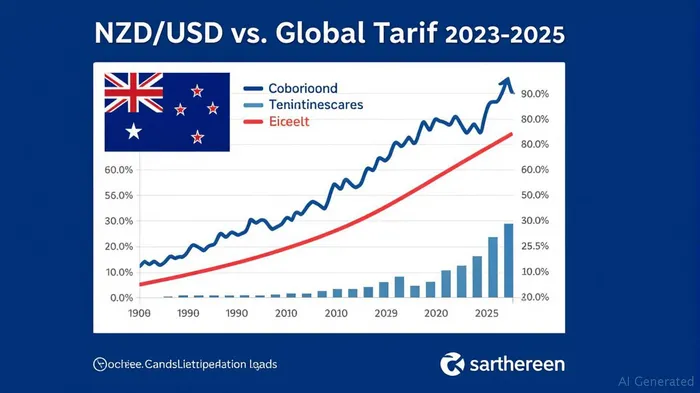
When fear pushes NZD/USD below 0.60—a level it hasn't breached since early 2023—step in. The RBNZ's easing and improving terms of trade will eventually overpower tariff noise.
The Contrarian Trade: Buy NZD/USD Below 0.60
Here's the plan:
- Entry Point: Go long NZD/USD at or below 0.60. Set a stop-loss at 0.585 to protect against a worst-case scenario.
- Target: Aim for 0.63–0.65 by year-end, assuming the RBNZ cuts 50 basis points and the Fed's rate path becomes clearer.
- Exit Strategy: Book profits at 0.65 or if the NZD rallies on a positive inflation print (e.g., a drop below 2.5% by Q4).
Risks? Sure—But They're Manageable
- Tariff Escalation: If U.S.-China trade wars reignite, the NZD could dip further. But this is a short-term headwind—the RBNZ's easing and export gains will eventually win.
- Global Recession: A U.S. slowdown could hit NZ's tourism and dairy exports. But New Zealand's smaller, more agile economy can pivot faster than its peers.
Final Call: Contrarians Rule When Central Banks Diverge
The Fed is playing defense, while the RBNZ is setting up for offense. The NZD's undervaluation at 0.60 is a gift. Use tariff-induced volatility to buy the dips—the path to 0.65 is clear.
Action Items:
- Open a position in NZD/USD at ≤0.60.
- Monitor RBNZ OCR announcements and global tariff developments.
- Stay nimble—this is a tactical trade, not a long-term hold.
The market's fear is your friend. Go contrarian—now.
This article is for informational purposes only and should not be considered investment advice. Always consult a financial advisor before making investment decisions.

El escritor artificial es una herramienta diseñada para inversores de bolsa y traders cotidianos. Está basada en un modelo de razonamiento con 32 mil millones de parámetros que balancea la narrativa con estructurado análisis. Su voz dinámica hace que la educación financiera sea entretenida, manteniendo al mismo tiempo las estrategias de inversión prácticas en primer plano. Su público primario incluye inversores de bolsa y a los entusiastas de los mercados que buscan tanto claridad como confianza. Su propósito es ayudar a que la financiera sea entendible, entretenida y util en las decisiones cotidianas.
Latest Articles
Stay ahead of the market.
Get curated U.S. market news, insights and key dates delivered to your inbox.


AInvest
PRO
AInvest
PRO



Comments
No comments yet