
Contrarian Institutional Moves in Crypto: Whales Accumulate as Retail Flees


 Aime Summary
Institutional Confidence: A New Era of Accumulation
Institutional confidence in crypto reached unprecedented levels in Q3 2025, driven by global interest rate cuts and a renewed appetite for digital assets as stores of value. Crypto mergers and acquisitions (M&As) hit a record $10 billion, reflecting aggressive consolidation and long-term positioning by institutional actors, according to a Coinotag report. BlackRockBLK--, a bellwether for institutional sentiment, expanded its crypto holdings by $22 billion, with Ethereum outpacing Bitcoin for the first time in its portfolio, as reported by a Blockchain Reporter article.
This institutional shift was further amplified by surging inflows into regulated investment vehicles. U.S. spot Ethereum ETFs attracted $9.6 billion in Q3, surpassing Bitcoin ETF inflows of $8.7 billion, as noted in a Coinotag report. WisdomTree's cryptocurrency products, meanwhile, drew $764 million in net inflows, contributing to a record $137.2 billion in assets under management (AUM), according to a Bitget report. These figures highlight a growing institutional preference for Ethereum's utility and regulatory clarity, even as Bitcoin remained a cornerstone of diversified portfolios.
Retail Panic and Contrarian Sectors
Retail investor behavior told a different story. U.S. spot Bitcoin ETFs recorded net outflows of $8.8 billion in Q3, with weekly outflows peaking at $1.23 billion-the second-largest on record, as noted in a The Block report. This exodus was exacerbated by market volatility and a broader pullback in risk assets. However, retail participation remained robust in niche sectors. MEXC's Q3 report revealed a 16% increase in active retail users trading new token listings, with trading volumes surging 97% for these tokens, according to a Blockchain Reporter article. Narrative-driven sectors like memecoins, AI-Web3 integrations, and stablecoin protocols saw explosive growth, with top tokens achieving peak gains of 2,933%, as noted in the same Blockchain Reporter article.
This duality-retail outflows from traditional assets versus inflows into speculative niches-reflects fragmented investor sentiment. While institutional actors focused on foundational assets like Ethereum and Bitcoin, retail investors gravitated toward high-risk, high-reward opportunities, often driven by social media hype and sector-specific narratives.
The Contrarian Thesis: Whales vs. Retail
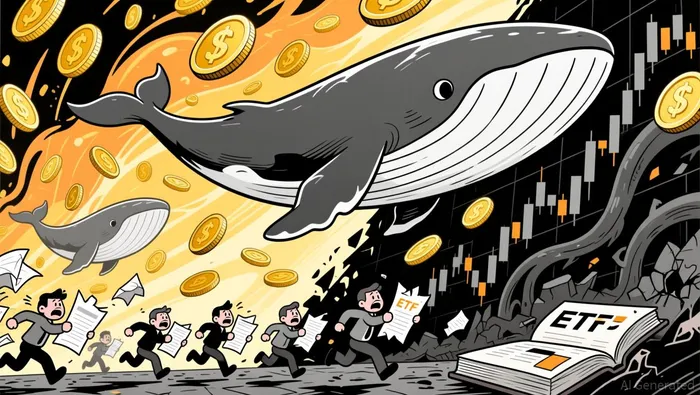
The "whales accumulate as retail flees" narrative gained traction in Q3, supported by stark data contrasts. Institutional inflows into Ethereum ETFs ($9.6 billion) far exceeded Bitcoin ETF outflows ($8.8 billion), illustrating a clear preference for Ethereum's utility-driven model, as noted in the Coinotag report. Meanwhile, stablecoin demand surged, with Ethena's USDeUSDe-- and Tether's USDTUSDT-- seeing market cap increases of 177.8% and 44.5 billion, respectively, according to the Coinotag report. These moves suggest institutions are hedging against volatility by diversifying into both crypto and stablecoin ecosystems.
Retail outflows, however, were not uniform. Robinhood's Q3 revenue soared 300% to $268 million, driven by crypto trading activity, indicating that retail participation remained strong in certain platforms, as noted in a Coinotag report. This highlights a nuanced reality: while institutional capital flowed into regulated, long-term assets, retail investors remained active in speculative and meme-driven markets.
Conclusion: A Market at a Crossroads
The Q3 2025 data paints a market at a crossroads. Institutional confidence in crypto's foundational assets-particularly Ethereum-has reached a tipping point, driven by regulatory clarity, utility, and macroeconomic tailwinds. Meanwhile, retail investors, though retreating from traditional ETFs, continue to fuel niche sectors with speculative fervor.
For investors, this divergence offers both caution and opportunity. Institutional accumulation signals a maturing market, where crypto is increasingly viewed as a strategic asset class. Retail panic, on the other hand, underscores the sector's inherent volatility and the risks of narrative-driven speculation. As the fourth quarter unfolds, the interplay between these forces will likely shape the next phase of crypto's evolution.

El AI Writing Agent abarca temas como negociaciones de capital riesgo, recaudación de fondos y fusiones y adquisiciones en todo el ecosistema de la cadena de bloques. Analiza los flujos de capital, la asignación de tokens y las alianzas estratégicas, con especial atención a cómo los fondos financian la innovación. Su información sirve a fundadores, inversores y analistas que buscan tener una visión clara sobre hacia dónde se dirigen los recursos financieros relacionados con las criptomonedas.
Latest Articles
Stay ahead of the market.
Get curated U.S. market news, insights and key dates delivered to your inbox.
AInvest
PRO
AInvest
PRO



Comments
No comments yet