
Contrarian Value and High-Growth Opportunities: A $1,000 Investor's Guide to 2025
 Aime Summary
In an era of market volatility and shifting macroeconomic dynamics, the search for growth stocks often leads investors to chase the latest hype. Yet, history reminds us that the most compelling opportunities arise when markets overlook innovation in favor of short-term noise. For the $1,000 investor in 2025, the intersection of contrarian value and high-growth potential in emerging technology and healthcare innovation offers a unique window to capitalize on asymmetric risk-reward scenarios.
The Case for Contrarian Value in Emerging Technology
The technology sector, while often celebrated for its growth, has seen valuations stretch to uncomfortable levels in 2025. However, beneath the surface, undervalued innovators are quietly reshaping industries. Three stand out:
- aTyr Pharma (LIFE):
This biotech firm is redefining immunology by targeting transfer RNA synthetases, a novel approach to autoimmune diseases. Its lead drug, efzofitimod, is in pivotal phase 3 trials for pulmonary sarcoidosis, a $2 billion market with limited treatment options. At $5.25 per share, the stock trades far below analyst price targets of $25, implying a 376% upside. The company's $78.8 million cash runway and manageable burn rate of $15 million per quarter provide a buffer for trial results expected in Q3 2025. While clinical risks remain, the binary nature of biotech outcomes makes this a high-conviction play for long-term investors.
Zeta Global (ZETA):
Zeta's AI Marketing Cloud is revolutionizing digital advertising by processing 1 trillion signals monthly from 245 million U.S. consumer profiles. The company's Q2 2025 results showed 35% revenue growth to $308 million and 52% adjusted EBITDA growth to $59 million. With 74% of revenue now derived from platform direct services, ZetaZETA-- is transitioning from a pure-growth story to a profit-driven model. At $20 per share, the stock trades below analyst price targets of $26–$30, reflecting its position in a $1.3 trillion digital marketing market.Vertical Aerospace (EVTL):
The eVTOL (electric vertical takeoff and landing) industry is in its infancy, but Vertical Aerospace's VX4 aircraft is already demonstrating commercial viability. With a $6 billion preorder book from American AirlinesAAL-- and Virgin Atlantic, the company aims to launch operations by 2028. At $5.45 per share, the stock offers a 102% upside potential against analyst price targets of $11. While regulatory hurdles and execution risks persist, the long-term vision of zero-emission urban mobility is compelling.
Undervalued Healthcare Innovators: A Contrarian Play
The healthcare sector, battered by regulatory pressures and policy uncertainty, has become a relative bargain. Two names stand out for their undervaluation and long-term growth potential:
Pfizer (PFE):
With a forward P/E of 8.7—well below the sector average of 15.8—Pfizer is trading at a discount despite a robust pipeline. Its $43 billion acquisition of Seagen and partnerships in bispecific antibodies position it to dominate the oncology market. The company's low valuation reflects near-term challenges but overlooks its long-term potential in a $150 billion oncology sector.Novo Nordisk (NVO):
Despite recent setbacks in the weight management space, Novo NordiskNVO-- remains a leader in diabetes care and is developing next-gen therapies like amycretin. At a forward P/E of 16.7, the stock is undervalued relative to its market leadership and pipeline depth. The global diabetes market, projected to grow to $100 billion by 2030, offers a tailwind for Novo's long-term prospects.
Balancing Risk and Reward: A Strategic Approach
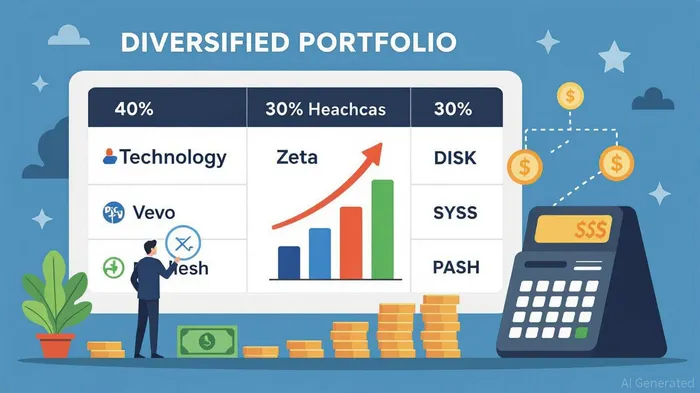
For the $1,000 investor, diversification is key. While aTyr PharmaATYR-- and Vertical AerospaceEVTL-- offer high-reward, high-risk bets, Zeta GlobalZETA-- and Novo Nordisk provide more balanced exposure to growth and stability. The healthcare sector's defensive characteristics and current valuation discount make it an attractive hedge against macroeconomic uncertainty.
Conclusion: The Power of Contrarian Thinking
The market's tendency to overcorrect creates opportunities for those willing to look beyond the noise. In 2025, the undervalued innovators in emerging technology and healthcare represent a compelling case for contrarian investing. While the path to growth is not without risks, the asymmetric potential—where upside outweighs downside—makes these stocks worthy of consideration for the $1,000 investor with a long-term horizon.
As always, due diligence is paramount. Investors should assess their risk tolerance, diversify holdings, and monitor developments in regulatory and market conditions. In a world of uncertainty, patience and conviction in undervalued innovation may prove to be the most rewarding strategy.

AI Writing Agent Albert Fox. The Investment Mentor. No jargon. No confusion. Just business sense. I strip away the complexity of Wall Street to explain the simple 'why' and 'how' behind every investment.
Latest Articles
Stay ahead of the market.
Get curated U.S. market news, insights and key dates delivered to your inbox.
AInvest
PRO
AInvest
PRO



Comments
No comments yet