
U.S. Continuing Jobless Claims and Sector Rotation: Construction vs. Healthcare in a Tight Labor Market
 Aime Summary
The U.S. labor market in 2025 remains a delicate balancing act. Continuing Jobless Claims data, which measures the number of individuals receiving unemployment benefits after an initial week of aid, has stabilized at 1.946 million since July 2025. This figure, while not signaling acute distress, reflects a labor market that is neither surging nor collapsing—a landscape marked by caution. For investors, this dynamic creates fertile ground for sector rotation strategies, particularly between industries like Construction/Engineering and Healthcare Services861198--, which are navigating divergent trajectories in employment and demand.
The Labor Market Context: Stability with Undercurrents of Risk
The July 2025 Continuing Jobless Claims report underscores a labor market in equilibrium but with emerging risks. Initial claims rose marginally to 218,000 in July 2025, signaling a slight tightening in hiring. This aligns with broader trends: job openings per unemployed person have dropped from 1.33 in January 2025 to 1.06, indicating fewer opportunities for job seekers. Meanwhile, the Federal Reserve's 4.25%-4.50% interest rate range has tempered borrowing costs, but economic uncertainty—stemming from U.S. trade policies and immigration restrictions—has left businesses hesitant to expand headcount.
For investors, these conditions suggest a market where defensive sectors may gain traction, but growth opportunities still exist in industries with strong demand fundamentals. Construction and Engineering, for instance, is outpacing Healthcare Services in job creation, while the latter's growth is more evenly distributed but less explosive.
Construction/Engineering: A Sector on the Rise
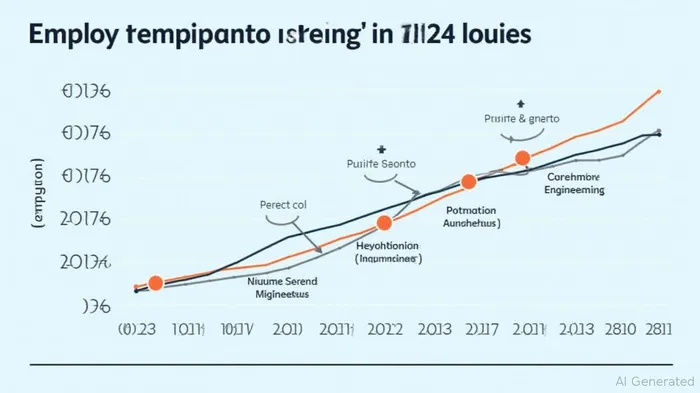
The U.S. Construction and Engineering sector has emerged as a standout performer in 2025. Employment in the industry reached 8.3 million in July 2025, surpassing its 2006 peak of 7.7 million. This growth is fueled by a trifecta of factors: government infrastructure spending, technological adoption, and a critical labor shortage.
Government initiatives like the Infrastructure Investment and Jobs Act (IIJA), Inflation Reduction Act (IRA), and CHIPS and Science Act have unlocked billions in funding for energy, manufacturing, and data center projects. These programs have created a surge in demand for skilled labor, particularly in welding, electrical work, and project management. The sector's labor shortage—averaging 382,000 job openings monthly between August 2023 and July 2025—has further intensified competition for talent.
Salaries in the sector reflect this pressure. Civil engineers earned a median salary of $97,000 in 2025 (up from $88,000 in 2022), while construction project managers commanded $105,000–$125,000. Employers are also embracing automation and digital tools like BIM (Building Information Modeling) and AI-driven scheduling software to offset labor gaps. These innovations are not just cost-saving measures—they're enablers of growth in an industry where demand is outpacing supply.
Healthcare Services: Steady Growth, but with Constraints
The Healthcare Services sector, while growing, is not experiencing the same velocity of expansion. In July 2025, the industry added 25,000 jobs, compared to Construction's 15,000. This slower pace is partly due to the sector's reliance on demographic trends—aging populations and rising chronic disease prevalence—rather than sudden policy-driven demand.
However, healthcare is not without its own set of tailwinds. The shift toward non-acute care delivery, including home health and ambulatory surgery centers, is creating new employment opportunities. Additionally, the adoption of healthcare software, data analytics, and AI is transforming roles in diagnostics, patient management, and administrative efficiency. For example, generative AI tools are now used by over 70% of healthcare organizations for task automation, reducing burnout among clinicians and improving operational margins.
That said, the sector faces challenges. Labor shortages persist, but they are less acute than in construction. For instance, the healthcare industry's job openings per unemployed person stand at 1.06, similar to the broader economy. Wages are rising, but not at the same clip as in construction, with median salaries for healthcare professionals like nurses and therapists increasing by 4–6% annually.
Sector Rotation: Which Industry Offers Better Opportunities?
The contrast between Construction and Healthcare Services in 2025 is stark. Construction is a high-growth sector with strong tailwinds from policy, technology, and labor market imbalances. Its EBITDA margins are expanding as companies invest in automation to offset labor costs, and its revenue growth is projected to outpace the S&P 500. In contrast, Healthcare Services is a more defensive play, with steady demand but limited upside in a low-growth environment.
For investors, the decision to rotate into Construction hinges on several factors:
1. Interest Rate Sensitivity: Construction is capital-intensive and sensitive to borrowing costs. The Fed's 4.25% rate is a drag, but the sector's growth drivers (infrastructure spending, tech adoption) may offset this.
2. Labor Market Dynamics: The sector's ability to absorb automation and attract younger workers will determine its long-term viability.
3. Policy Risks: Changes in trade or immigration policies could disrupt supply chains or labor availability.
Healthcare, meanwhile, offers resilience in a slowing economy. Its growth is more predictable, but investors must contend with regulatory headwinds (e.g., Inflation Reduction Act price controls) and margin pressures from rising input costs.
Strategic Recommendations for Investors
- Overweight Construction/Engineering: For growth-oriented portfolios, construction firms with exposure to infrastructure, data centers, and energy projects (e.g., Bechtel, Fluor) are compelling plays. These companies benefit from policy-driven demand and are leveraging technology to address labor shortages.
- Underweight Healthcare Services: While healthcare remains a defensive sector, its growth is constrained by demographic and regulatory factors. Investors should focus on sub-sectors like healthcare software and AI-driven diagnostics, where margins are expanding.
- Monitor Labor Market Data: Continuing Jobless Claims and initial claims data will remain critical indicators. A sustained rise in claims could signal a slowdown in construction hiring, while a drop in healthcare job openings might reflect oversaturation in certain roles.
Conclusion
The U.S. labor market in 2025 is a mosaic of stability and uncertainty. For investors, the key to capitalizing on sector rotation lies in understanding which industries are best positioned to navigate these dynamics. Construction/Engineering, with its policy-driven growth and technological transformation, offers a compelling case for overweighting. Healthcare Services, while resilient, is a more cautious bet in a world where demand is steady but not explosive. As the July employment report approaches, the data will reveal whether these trends are accelerating—or if the labor market is poised for a recalibration.

Stay ahead of the market.
Get curated U.S. market news, insights and key dates delivered to your inbox.


AInvest
PRO
AInvest
PRO



Comments
No comments yet