
U.S. Continuing Jobless Claims Fall to 1.974M: Navigating Sectoral Divergence and Fed Policy Uncertainty Through Strategic Rotation
 Aime Summary
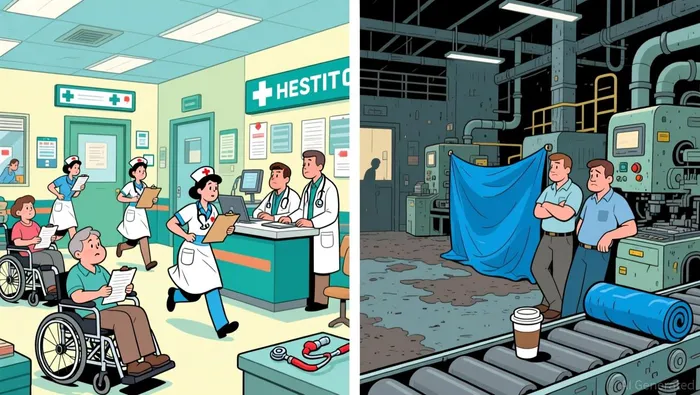
The recent drop in U.S. . This decline, however, masks a critical structural shift: the U.S. economy is increasingly bifurcated between a thriving services sector and a struggling manufacturing base. For investors, this divergence demands a recalibration of sector rotation strategies, particularly in equities and capital markets, as Federal Reserve policy uncertainty looms large.
The : A Pillar of Resilience
The Philadelphia Federal Reserve's Q2 2025 Employment Report reveals that the services sector—encompassing healthcare, professional services, and utilities—has become the backbone of U.S. economic growth. ; , driven by aging demographics, telemedicine adoption, and sustained wage growth. These sectors now account for over 80% of U.S. economic output, .
The Nasdaq Composite, heavily weighted toward tech and healthcare, , reflecting the market's appetite for high-growth, services-oriented equities. Investors should overweight capital markets tied to these sectors, particularly those with exposure to AI-driven diagnostics, telehealth platforms, and renewable energy infrastructure.
and the Fed's Dilemma
In stark contrast, . , exacerbated by tariffs, energy costs, and global supply chain disruptions. , signaling a capital-intensive industry in structural decline.
The Federal Reserve's 25-basis-point rate cut in September 2025 has further tilted the playing field. While this dovish pivot supports long-duration assets, it has disproportionately benefited services sectors with stable demand. Industrial and materials equities, however, , reflecting investor caution.
: Overweight Capital Markets, Cautious on Banks
The Federal Reserve's recent policy actions and the BTFP's successful closure in March 2024 highlight the central bank's ability to stabilize financial markets. However, the same tools that averted a 2023 banking crisis now pose risks for underperforming sectors. Banks, particularly those with exposure to industrial lending, face margin compression as loan demand wanes. Investors should adopt a cautious stance on regional banks and instead focus on capital markets that channel funds into high-productivity services sectors.
Deep learning-based predictive models can refine tactical asset allocation by identifying early signals of sectoral shifts. For instance, wage growth disparities between Professional & .
and the Path Forward
The Fed's ongoing research into generative AI's impact on financial stability underscores the evolving nature of systemic risk. While AI can mitigate asset bubbles driven by herd behavior, its implementation requires careful design to avoid unintended consequences. Investors should integrate macroeconomic signals—such as the Philadelphia Fed's employment index and wage growth trends—into their decision-making frameworks.
Conclusion: Aligning Portfolios with Structural Change
The Q2 2025 data confirms a pivotal inflection point in the U.S. economy. Investors must reallocate capital toward services, tech, and defensive sectors while underweighting manufacturing and industrial equities. By leveraging macroeconomic signals and deep learning models, tactical allocations can better navigate policy-driven volatility and sectoral divergence. In this environment, agility—not just in asset selection but in strategy execution—will define long-term success.


Stay ahead of the market.
Get curated U.S. market news, insights and key dates delivered to your inbox.


AInvest
PRO
AInvest
PRO



Comments
No comments yet