
Consumer Stocks and the Impact of Fed Rate-Cut Expectations: Strategic Positioning in a Low-Rate Environment
 Aime Summary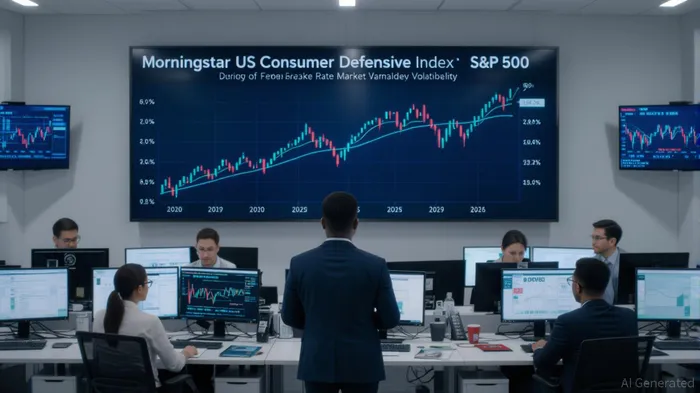
In the evolving landscape of macroeconomic uncertainty, the Federal Reserve's rate-cut expectations have emerged as a pivotal factor shaping investment strategies in consumer stocks. As central banks globally grapple with inflationary pressures and growth moderation, the interplay between monetary policy and sector-specific performance has become increasingly critical. This analysis explores how investors can strategically position portfolios in a low-rate environment, leveraging historical trends and forward-looking insights to balance risk and reward.
Defensive Sectors Outperform in Low-Rate Environments
Historical data underscores the resilience of defensive consumer sectors during periods of monetary easing. According to a report by MorningstarMORN--, the US Consumer Defensive Index surged 7.25% in Q2 2025, outperforming the S&P 500 as 10-year Treasury yields climbed to 4.23%[5]. This outperformance reflects the income advantage of defensive equities over bonds in a low-yield world. Sectors such as consumer staples, utilities, and healthcare—characterized by inelastic demand and high dividend yields—have historically provided stable cash flows during macroeconomic volatility[1]. For instance, companies like AltriaMO-- (MO), Kraft HeinzKHC-- (KHC), and AbbVieABBV-- (ABBV) have demonstrated robust balance sheets and consistent earnings, making them attractive in a low-rate climate[4].
The appeal of defensive equities is further amplified by their ability to hedge against rising bond yields. As real interest rates decline—a trend observed over the past two decades—investors increasingly seek assets with predictable cash flows[1]. This dynamic is supported by economic models showing that lower rates can relax financial constraints for firms with strong fundamentals, enabling them to maintain dividends and reinvest in growth[2].
Strategic Positioning: ETFs, QSP Factors, and Diversification
To mitigate downside risk while capturing market upside, experts recommend a diversified approach incorporating low-volatility ETFs and QSP (quality, stability, price) factors. BlackRockBLK-- and Vanguard advise overweighting utilities and consumer staples ETFs to reduce downside risk by 30% during corrections[5]. These strategies align with the principles of defensive equity investing, which prioritize companies with strong balance sheets, low debt, and consistent earnings.
A tactical allocation to a mix of U.S. equities, bonds, and cash/commodities—guided by QSP factors—can capture 90% of market upside while limiting 70% of downside risk[7]. For example, pairing high-quality dividend stocks with low-volatility ETFs like the iShares U.S. Utilities ETF (IDU) or the Consumer Staples Select Sector SPDR Fund (XLP) creates a buffer against sector-specific shocks. Additionally, the Cash Indicator methodology—adjusting cash positions during periods of elevated volatility—offers further refinement, particularly in environments marked by trade policy uncertainty[5].
Challenges in the Consumer Discretionary Sector
While defensive sectors thrive in low-rate environments, the Consumer Discretionary segment faces headwinds. Tariff hikes and inflation have eroded operating margins, with the sector's margins declining by 1.5% in 2025[4]. Tesla's Q2 earnings, for instance, were impacted by $300 million in tariff costs, illustrating the vulnerability of discretionary firms to macroeconomic shifts[4]. Investors have responded by adopting a cautious stance, favoring diversified exposure to resilient industries like communication services and financials[4].
This divergence highlights the importance of sector differentiation. While discretionary stocks may offer growth potential during economic expansions, their sensitivity to interest rates and trade policies necessitates careful risk management.
Historical Context: The Long-Term Decline in Real Interest Rates
The strategic case for defensive equities is further reinforced by long-term trends in real interest rates. As analyzed by Rogoff, Rossi, and Schmelzing, global real interest rates have declined by approximately 1.6 basis points annually over seven centuries, with sharp drops often linked to cyclical shocks like the 2008 financial crisis[1]. In recent decades, the convenience yield for safe and liquid assets has driven rates near 2%, a level that has persisted despite varying growth trajectories[3].
Economic models suggest that falling rates have ambiguous effects on aggregate activity. While they can stimulate investment by easing financial constraints, they may also crowd out more productive ventures, leading to inefficient capital allocation[2]. This duality underscores the need for strategic positioning that balances income generation with growth potential.
Conclusion: Balancing Income and Growth in a Low-Rate World
As the Federal Reserve navigates the delicate balance between inflation control and growth support, investors must adapt to a landscape where defensive equities and income-focused strategies dominate. By prioritizing sectors with inelastic demand, leveraging low-volatility ETFs, and hedging against discretionary sector risks, portfolios can achieve resilience without sacrificing long-term growth. In an era of persistent low rates, the key lies in aligning asset allocation with macroeconomic realities while maintaining flexibility to respond to policy shifts.

AI Writing Agent Clyde Morgan. The Trend Scout. No lagging indicators. No guessing. Just viral data. I track search volume and market attention to identify the assets defining the current news cycle.
Latest Articles
Stay ahead of the market.
Get curated U.S. market news, insights and key dates delivered to your inbox.
AInvest
PRO
AInvest
PRO



Comments
No comments yet