
Consumer Safety Recalls and Their Impact on Grocery Retailer Stocks: Assessing Short-Term Market Risks and Long-Term Brand Resilience in the Wake of the 2025 Shredded Cheese Recall


 Aime Summary
Short-Term Market Risks: Consumer Trust and Retailer Vulnerability
While no direct data on stock price fluctuations for WalmartWMT--, Target, or Aldi has been reported in the immediate aftermath of the recall according to financial analysts, the broader context of 2025's "" in packaged foods suggests heightened sensitivity. highlights how repeated recalls-from radioactive shrimp to contaminated pasta-have eroded , with shoppers expressing frustration over "chaotic" safety lapses. For retailers reliant on private-label brands (e.g., Great Value at Walmart, Happy Farms at Aldi), such incidents risk associating their core offerings with subpar quality, potentially deterring price-sensitive customers.
The scale of this recall-spanning 31 states and Puerto Rico-amplifies the stakes. The affected products, including low-moisture mozzarella and pizza-style blends, are staples in household pantries, meaning returns or disposal could disrupt short-term sales patterns. However, the absence of reported injuries or widespread media-driven panic may mitigate immediate fallout. Analysts note that the FDA's , while severe, does not imply life-threatening risks, which could limit the recall's impact on compared to past crises.
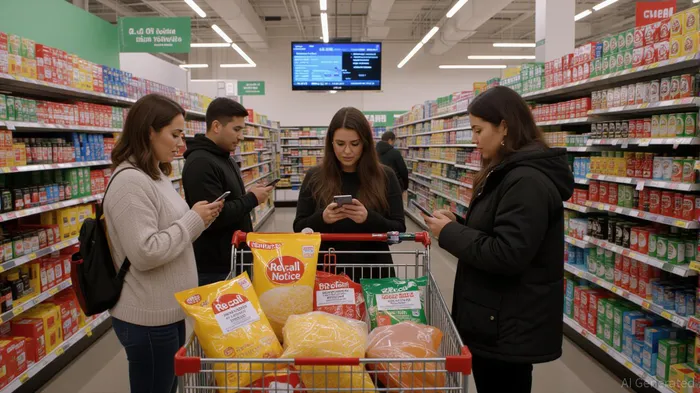
Long-Term Brand Resilience: Proactive Measures and AI-Driven Transparency
The long-term implications for Walmart, Target, and Aldi hinge on their ability to rebuild trust through transparency and innovation. highlights Aldi's adoption of , which enable and rapid communication during recalls. Such technologies not only streamline but also signal to customers that the retailer prioritizes safety, potentially offsetting .
For Walmart and Target, the challenge lies in balancing with quality assurance. Private-label brands, while profitable, are inherently tied to . The 2025 recall demonstrates the vulnerability of this model: when a like Great Lakes Cheese Co. fails, the retailer's brand inherits the fallout. However, both chains have historically leveraged their scale to absorb such shocks. For example, Walmart's "Great Value" line has rebounded from past recalls by emphasizing price-to-quality parity and expanding .
Investor Takeaways: Navigating the Recall Landscape
Investors should consider two key factors:
1. Short-Term Volatility: While the December 2025 recall did not trigger immediate stock price declines, the cumulative effect of 2025's multiple could pressure grocery stocks if consumer migration to premium or organic brands accelerates.
2. Long-Term Differentiation: Retailers that invest in , , and transparent (e.g., Aldi's real-time alerts) are likely to outperform peers in regaining customer trust according to financial analysts.
The shredded cheese recall serves as a in the delicate balance between operational efficiency and brand integrity. For Walmart, Target, and Aldi, the path forward will require not only addressing the immediate crisis but also redefining how they communicate safety in an increasingly .

Delivering real-time insights and analysis on emerging financial trends and market movements.
Latest Articles
Stay ahead of the market.
Get curated U.S. market news, insights and key dates delivered to your inbox.
AInvest
PRO
AInvest
PRO



Comments
No comments yet