
Consumer Retail Resilience: How Regional Grocery Chains Like ShopRite Are Navigating Holiday Seasons and Stock Valuation Opportunities


 Aime Summary
The Shift in Consumer Priorities: Value Over Convenience
The 2025 Thanksgiving season reveals a clear trend: consumers are prioritizing affordability over convenience. Data from Deloitte shows that 62% of shoppers are trading down to more affordable brands or retailers, while 75% are hunting for October and November promotions to stretch their budgets. This shift is not limited to lower-income households-high-income consumers are also flocking to big-box retailers and thrift stores to find value. For regional chains like ShopRite, this means rethinking inventory strategies and store hours to cater to a cost-conscious audience.
ShopRite, for instance, has adopted a flexible approach to store hours, with locations varying their Thanksgiving Day availability to accommodate last-minute shoppers according to a local business report. While some stores remain open, others close early, reflecting a balance between operational costs and customer demand. This adaptability is critical in a market where 44% of consumers have already begun holiday shopping earlier than usual. By aligning store hours with consumer schedules, ShopRite minimizes labor expenses while maximizing foot traffic during peak shopping windows.
Inventory Management: Balancing Staple Prices and Profit Margins
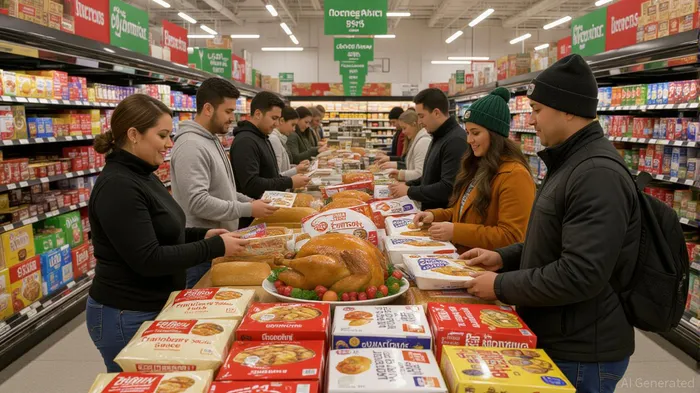 One of the most striking aspects of the 2025 Thanksgiving season is the divergence in grocery inflation. While overall food prices have risen 30% compared to 2019, staple items like turkey, stuffing, and cranberries have seen price declines or stability. Retailers like WalmartWMT--, Aldi, and TargetTGT-- have capitalized on this by offering budget-friendly meal kits, with Walmart's $4-per-person package becoming a standout according to a market analysis. ShopRite, too, has leveraged this trend, maintaining low inflation in its core banners-Shoprite and Usave-with selling price inflation dropping to 0% and -0.4%, respectively, in September 2025 according to a company update.
This strategic pricing not only attracts budget-conscious shoppers but also protects gross margins. ShopRite's ability to pass on cost savings to consumers-despite rising wholesale turkey prices due to avian flu-demonstrates its operational agility. By pre-positioning inventory and focusing on private-label products, the company mitigates supply chain risks while maintaining competitive pricing.
Stock Valuation: A Tale of Growth and Caution
For investors, the key question is whether these operational strategies translate into sustainable stock performance. ShopRite's Q3 2025 results suggest they are on the right track. The company reported an 8.0% sales increase for the quarter, driven by its core South African supermarkets segment, which saw a 7.9% sales growth. Analysts have taken notice, with a "Buy" consensus rating and an average 12-month price target of $32,662.50, implying an 18.52% upside-consensus-estimates).
However, the stock is not without risks. ShopRite's shares are currently in a weak rising trend, and a break below the $27,020.58 support level could signal a reversal. Additionally, the broader retail sector faces challenges, including compressed holiday shopping windows and reduced liquidity during Thanksgiving week according to market analysis. Yet, ShopRite's focus on omnichannel growth-such as its 47.7% sales increase in the Sixty60 e-commerce platform-positions it to weather these headwinds.
The Bigger Picture: Why Regional Chains Matter
The success of regional chains like ShopRite underscores a broader trend: in an era of economic uncertainty, consumers and investors are gravitating toward companies that combine affordability with operational flexibility. Unlike national chains, regional players can tailor their strategies to local market conditions, whether that means adjusting store hours, optimizing inventory for staple goods, or leveraging digital platforms to reach price-sensitive shoppers.
For investors, this means looking beyond traditional metrics like same-store sales and focusing on adaptability. ShopRite's 16.6% increase in trading profit for the year ending June 2025, coupled with its 11.9% projected annual earnings growth, highlights the rewards of such a strategy. While the stock may experience short-term volatility, its long-term fundamentals-driven by cost discipline, strategic expansion, and a focus on value-make it an attractive play for those betting on retail resilience.
Conclusion: A Season of Opportunity
The 2025 Thanksgiving season is a microcosm of the broader retail landscape: consumers are cautious but not deterred, and companies that adapt to their needs will thrive. ShopRite's operational strategies-flexible store hours, competitive pricing, and omnichannel innovation-position it as a prime example of how regional chains can navigate economic headwinds. For investors, the message is clear: resilience in retail is not about resisting change but embracing it.
As the holiday season unfolds, keep a close eye on how companies like ShopRite balance affordability with profitability. In a market where every penny counts, the ability to adapt is the ultimate competitive advantage-and the stock market is taking notice.

Delivering real-time insights and analysis on emerging financial trends and market movements.
Latest Articles
Stay ahead of the market.
Get curated U.S. market news, insights and key dates delivered to your inbox.
AInvest
PRO
AInvest
PRO



Comments
No comments yet