
Consumer Retail Resilience During U.S. Holiday Seasons: Operational Strategies and Shifting Consumer Behavior


 Aime Summary
Operational Flexibility: A Strategic Edge
ShopRite's 2023 Thanksgiving strategy exemplifies the importance of localized decision-making in retail. Unlike national chains with standardized store hours, ShopRite's decentralized model allowed individual locations to adjust operating hours based on regional demand. While some stores remained open 24/7, others operated on reduced schedules or closed entirely, with customers directed to an online store locator for real-time updates according to ShopRite's internal strategy. This adaptability ensured that ShopRite could meet last-minute shopping needs without overextending resources-a critical advantage in a market where 197 million consumers shopped during the Thanksgiving to Cyber Monday period.
The chain also leveraged its Price Plus® club card to drive sales, offering a free or discounted turkey or ham for members who spent $400 between October 26 and November 27. Such loyalty-driven incentives not only boosted basket sizes but also reinforced customer retention in a competitive sector. While specific sales figures for ShopRite during Thanksgiving 2023 remain undisclosed, its first-half 2023 sales grew by 13.9% year-over-year, underscoring the effectiveness of its customer-centric approach.
Consumer Behavior: Value-Seeking and Omnichannel Shifts
The 2023 holiday season saw consumers prioritize affordability over convenience, with 58% of shoppers expressing extreme concern about grocery prices. This trend benefited discount chains like Aldi and Lidl, which offered Thanksgiving meal bundles for as low as $36 for 10 people. In contrast, traditional grocers like Kroger and WalmartWMT-- focused on store-brand products to maintain margins while appealing to budget-conscious buyers. For example, Kroger's $47.50 meal bundle for 10 emphasized private-label items like Campbell's gravy and yams, while Walmart's $39.88 bundle included a smaller turkey to reduce costs.
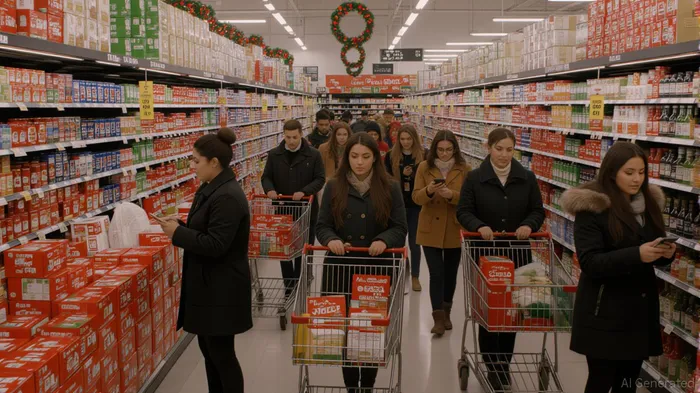
ShopRite's localized promotions and loyalty program positioned it to compete with these national and discount rivals. By offering plant-based and vegetarian alternatives alongside traditional options, the chain catered to diverse dietary preferences while maintaining price competitiveness. Meanwhile, the broader retail sector saw a 52% consolidation of purchases to one or two stores, reflecting a shift toward omnichannel convenience. Online sales surged, with $6.1 billion spent on Thanksgiving Day alone, driven by mobile purchases accounting for 59.5% of total online spending.
Comparative Resilience: Regional Chains vs. National Giants
While Kroger maintained its position as the most-visited grocery banner in 2023, regional chains like ShopRite demonstrated resilience through localized strategies. Kroger's third-quarter 2023 sales rose by 5.5%, outpacing Target's flat performance and a 1.9% decline in comp store revenue. However, discounters like Aldi and Lidl gained traction by undercutting prices on essential items, with Aldi's $40 Thanksgiving bundle $7 cheaper than its 2022 offering.
ShopRite's success in the Northeast-where many locations remained open on Thanksgiving Day-highlights the importance of regional relevance. Unlike national chains, which often face uniform operational constraints, regional players can tailor hours and promotions to local demand. This adaptability is particularly valuable in a market where 64% of shoppers spent more time seeking deals and 70% engaged in value-seeking behaviors such as loyalty programs.
Investment Implications
For investors, the 2023 holiday season underscores three key themes:
1. Operational Agility: Retailers that balance localized decision-making with centralized efficiency-like ShopRite-are better positioned to meet fluctuating demand.
2. Loyalty-Driven Sales: Promotions tied to loyalty programs (e.g., ShopRite's Price Plus card) not only drive immediate revenue but also foster long-term customer retention.
3. Discount Retail Resilience: As inflation persists, discount chains like Aldi and Lidl are likely to outperform traditional grocers, though regional players with strong community ties can carve niche markets.
The broader grocery sector's resilience-marked by a 13.5% rise in general merchandise sales and a 23.3% growth in Cyber Monday online sales according to industry data-suggests that holiday retail remains a robust investment opportunity. However, success hinges on adapting to consumer priorities: affordability, convenience, and personalized value.
Conclusion
The 2023 Thanksgiving season revealed a retail landscape where operational flexibility and consumer-centric strategies are paramount. ShopRite's localized approach and loyalty-driven promotions exemplify how regional chains can thrive amid economic headwinds, while the broader shift toward discount retail and omnichannel shopping signals a structural transformation in the industry. For investors, the lesson is clear: resilience lies not in scale alone, but in the ability to align with evolving consumer behavior.

Delivering real-time insights and analysis on emerging financial trends and market movements.
Latest Articles
Stay ahead of the market.
Get curated U.S. market news, insights and key dates delivered to your inbox.
AInvest
PRO
AInvest
PRO



Comments
No comments yet