
Consumer Retail Holiday Trends and Investor Implications: Retailer Operational Strategies and Regional Grocery Resilience


 Aime Summary
Operational Strategies: Balancing Customer Demand and Employee Welfare
Giant Eagle's 2025 Thanksgiving decision to remain open until 3 p.m. at most locations, while closing pharmacies, highlights a nuanced approach to high-traffic periods. This strategy aligns with a broader trend where retailers like KrogerKR-- and Whole Foods also adjust hours to balance customer convenience with employee well-being. While some chains close entirely to allow staff time with families, others, like Giant Eagle, adopt a hybrid model to cater to last-minute shoppers. This reflects a growing recognition of consumer demand for flexibility, particularly as 66% of shoppers begin holiday purchases before Black Friday.
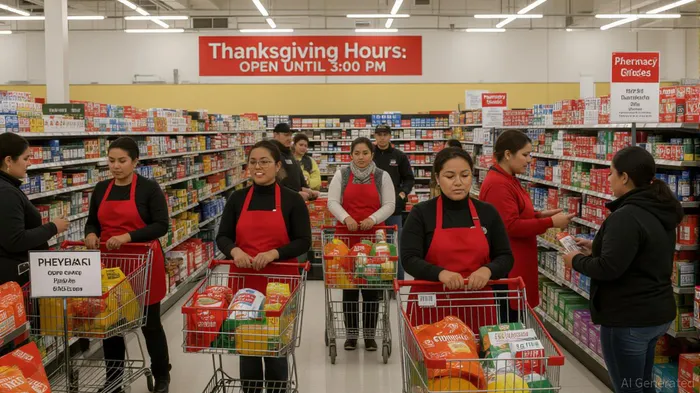
However, operational challenges persist. The 2025 holiday season is marked by a compressed shopping window, with retailers facing record 186.9 million shoppers from Thanksgiving through Cyber Monday according to NRF research. To manage this, companies are prioritizing hiring in September–October rather than November, a shift driven by labor cost pressures and automation adoption. For example, Giant Eagle's focus on core grocery and pharmacy operations-after divesting non-core assets like GetGo Café-demonstrates a strategic reallocation of resources to optimize efficiency according to Progressive Grocer.
Consumer Behavior: Inflation-Conscious Shifts and Digital Engagement
Consumer behavior is increasingly shaped by economic uncertainty, including inflation and rising prices. Data from Placer.ai reveals that grocery visits in 2025 grew year-over-year, with consumers making more frequent but shorter trips. This trend underscores a shift toward cost-conscious shopping, where convenience and price transparency are paramount.
Giant Eagle's Thanksgiving hour adjustments have also sparked heightened online engagement, with social media discussions emphasizing store availability according to WTAE. This mirrors a broader reliance on digital platforms to inform purchasing decisions, a trend that regional grocers are leveraging through omnichannel strategies. For instance, Aldi's 51.2% increase in foot traffic since 2019 is partly attributed to its digital tools and private-label offerings according to JLL. Investors should note that retailers integrating technology-such as virtual marketplaces or AI-driven inventory systems-are better positioned to meet evolving expectations according to Upside.
Financial Resilience and Investment Potential
Regional grocery chains demonstrated resilience in 2024 despite inflationary pressures and rising labor costs. Independent grocers, for example, managed 25.8% of sales in expenses, with labor and benefits accounting for 16.3% of net sales according to The Shelby Report. However, their ability to adapt through localized strategies and smaller-format stores has offset these challenges. Smaller-format grocers outperformed mid- and large-sized competitors in 2025, reflecting consumer demand for convenience according to The Shelby Report.
Giant Eagle's reinvestment in core operations-such as stand-alone pharmacies and store remodels-positions it to capitalize on these trends according to Progressive Grocer. The company's focus on high-growth areas like Columbus, Ohio, aligns with the industry's shift toward urban and suburban markets where demand for fresh and value-oriented offerings is rising according to Progressive Grocer. Additionally, grocery-anchored retail properties remain attractive to investors due to low vacancy rates and sustained rent growth according to Brevitas.
Investor Implications: Strategic Adaptation and Long-Term Viability
For investors, the key takeaway is the importance of operational agility. Regional grocers like Giant Eagle are differentiating themselves through localized customer relationships and strategic divestitures, enabling them to compete with national chains and discounters like Aldi and Lidl according to Progressive Grocer. The rise of automation and AI tools further enhances their ability to manage demand fluctuations and optimize inventory according to Convenience.org.
Moreover, the industry's competitive landscape favors regional players with strong real estate fundamentals. Grocery-anchored properties offer long-term stability, with investors benefiting from recession-resilient demand and low vacancy rates according to Brevitas. As highlighted by Bain & Company, regional grocers can leverage "virtual scale" through digital platforms to maintain relevance in an increasingly fragmented market according to Progressive Grocer.
Conclusion
The 2025 holiday season underscores a critical inflection point for retailers. Giant Eagle's operational adjustments and broader industry trends illustrate how regional grocers are navigating economic headwinds through strategic reinvestment, digital innovation, and customer-centric policies. For investors, these adaptations signal a resilient sector where companies prioritizing flexibility and localized strategies are well-positioned for long-term growth. As consumer expectations continue to evolve, the ability to balance operational efficiency with customer convenience will remain a defining factor in retail success.

Delivering real-time insights and analysis on emerging financial trends and market movements.
Latest Articles
Stay ahead of the market.
Get curated U.S. market news, insights and key dates delivered to your inbox.
AInvest
PRO
AInvest
PRO



Comments
No comments yet