
Consumer Resilience Amid Trade Wars: How Retail Outperformance Signals Strategic Buying Opportunities
 Aime Summary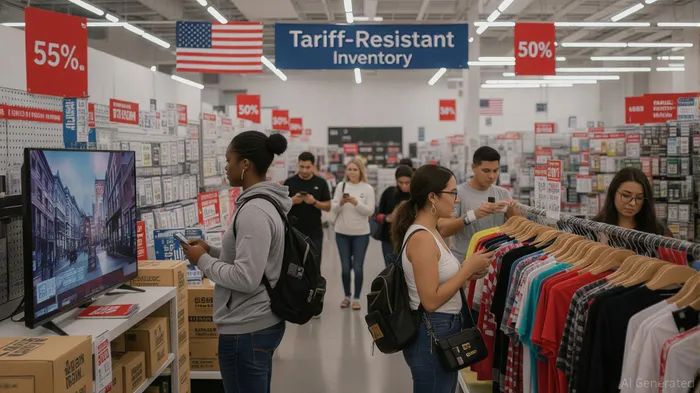
The U.S. retail sector is navigating a complex web of trade tensions, inflationary pressures, and shifting consumer behavior. Yet, amid these headwinds, certain segments are defying expectations, offering a roadmap for investors seeking undervalued consumer-facing stocks. By dissecting Q2 2025 earnings data and macroeconomic trends, we uncover how strategic adaptation to protectionism is creating asymmetric opportunities.
Sectoral Divergence: Winners and Losers in a Protectionist Era
The LSEG U.S. Retail and Restaurant Q2 2025 earnings index highlights stark contrasts. The Broadline Retail sector is projected to surge 30.8% year-over-year, led by Amazon's 33.3% earnings growth. This outperformance stems from Amazon's dominance in e-commerce and its ability to scale logistics while reducing reliance on tariff-affected supply chains. Meanwhile, the Hotels, Restaurants & Leisure sector is thriving, with Hilton Grand VacationsHGV-- (1150% growth) and CarnivalCCL-- Corp. (780% growth) capitalizing on pent-up demand for travel and dining.
Conversely, the Textiles, Apparel & Luxury Goods sector is collapsing, with NikeNKE-- and G-III Apparel GroupGIII-- reporting 86.1% and 82.5% declines, respectively. These struggles reflect overexposure to global supply chains and a mismatch with current consumer priorities. The lesson? Retailers that pivot quickly to localize production or diversify sourcing—like Target, which reduced Chinese sourcing from 60% to 30%—are better positioned to weather trade wars.
Consumer Resilience: The Power of Value and Novelty
Despite macroeconomic uncertainty, consumer spending remains robust. The LSEG Same Store Sales (SSS) index is projected to rise 4.1% in Q2 2025, driven by discount retailers like WalmartWMT-- (3.8% SSS) and Costco (5.1% SSS). These chains thrive by offering affordability in a high-inflation environment. Meanwhile, apparel brands that prioritize novelty—such as Aritzia (16.1% SSS) and Ralph LaurenRL-- (8.6% SSS)—are capturing discretionary spending, proving that innovation can offset broader economic headwinds.
Foot traffic data reinforces this trend. While home improvement and electronics stores see declining visits, off-price retailers and fitness centers are attracting more customers. High-income households, less sensitive to price, are fueling this demand, suggesting that value-driven and experience-based offerings will dominate in 2025.
Strategic Buying Opportunities: Where to Allocate Capital
Tariff-Resistant Retailers: Companies like Target (TGT) and Walmart (WMT) are reducing exposure to China and leveraging domestic manufacturing. Target's plan to cut Chinese sourcing below 25% by 2025 aligns with long-term protectionist policies, making it a defensive play.
Restaurant Chains with Pricing Power: Brinker International (EAT) and Texas Roadhouse (TXRH) are outperforming with 20.1% and 5.2% SSS growth, respectively. These brands balance menu price increases with customer loyalty programs, mitigating inflationary pressures.
Discount Retailers with Strong ESG Profiles: Costco (COST) and Ollie's Bargain Outlet (OLLI) are expanding their U.S. footprint while emphasizing sustainability. Ollie's, for instance, has grown its store count by 15% annually, tapping into middle-income consumers seeking value.
Tech-Driven Retailers: Amazon (AMZN) and Best Buy (BBY) are leveraging AI and automation to optimize inventory and reduce costs. Amazon's 33.3% earnings growth underscores the power of tech-driven efficiency in a fragmented market.
Risks and Mitigation Strategies
While the outlook is optimistic, investors must remain cautious. The Textiles sector's collapse and underperforming mall-based retailers (e.g., Kohl'sKSS--, -5.0% SSS) highlight the dangers of rigid business models. To mitigate risk, focus on companies with:
- Flexible supply chains (e.g., those using nearshoring or 3D printing).
- Strong balance sheets to withstand interest rate volatility.
- Data-driven customer insights to adapt to shifting preferences.
Conclusion: Positioning for a Protectionist Future
The retail sector's Q2 2025 performance underscores a critical truth: resilience is born from adaptation. As trade wars intensify, companies that localize production, prioritize value, and innovate in customer experience will outperform. For investors, this means doubling down on undervalued stocks like Target, Costco, and Brinker International—businesses that are not just surviving but thriving in a protectionist world.
The key takeaway? In times of economic uncertainty, the best opportunities often lie where others see chaos. By analyzing earnings data and macro trends, we can identify the retailers poised to redefine consumer resilience—and reap the rewards.

Stay ahead of the market.
Get curated U.S. market news, insights and key dates delivered to your inbox.
AInvest
PRO
AInvest
PRO



Comments
No comments yet