
Consumer Resilience in a Cooling Job Market: A Defensive Investment Case for Financial Services and Regional Banks


 Aime Summary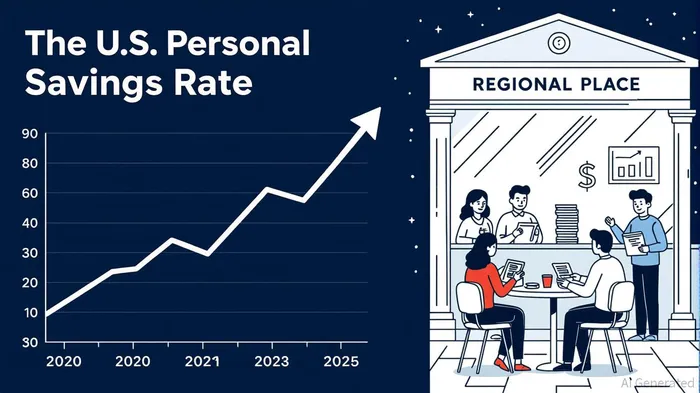
The U.S. economy is navigating a delicate balancing act in 2025. While the labor market cools—job gains averaging under 50,000 monthly and wage growth moderating—households are demonstrating unexpected resilience. This resilience, driven by underappreciated shifts in financial behavior, is reshaping the credit landscape and creating a compelling defensive investment opportunity in financial services and regional banks.
The Resilience Equation: Savings, Literacy, and Debt Dynamics
1. Emergency Savings as a Buffer
Bankrate's 2025 Emergency Savings Report reveals that 46% of U.S. adults have at least three months of expenses saved, a critical threshold for financial stability. While younger generations lag (28% of Millennials and 34% of Gen Z have no savings), the national average masks a broader trend: households are prioritizing liquidity. The 4.4% personal savings rate in July 2025, though lower than the 5.0% peak in April, reflects a cautious but stable approach to income retention. This liquidity buffer reduces the likelihood of defaults, even as job insecurity rises.
2. Financial Literacy Gains
K-12 financial education is reshaping long-term behavior. California's 2024 mandate for personal finance courses in high schools is part of a national shift, with 23.6% of students now exposed to such education. These programs emphasize budgeting, debt management, and emergency savings, fostering habits that stabilize household balance sheets. For example, students participating in school-based banking programs are more likely to open low-fee accounts and avoid predatory financial services. This generational shift could reduce delinquency rates over the next decade.
3. Debt Dynamics and Credit Quality
While credit card debt remains a concern (33% of Americans have more debt than emergency savings), the composition of debt is changing. Auto and student loan delinquencies are rising modestly, but credit card delinquencies—historically volatile—are stabilizing. Banks are adapting: JPMorganJPM-- Chase's Q2 2025 earnings show a 9% increase in card outstandings but net charge-offs at $2.4 billion, near historical lows. This suggests consumers are managing debt cautiously, prioritizing essential expenses over discretionary spending.
Banking Executives' Cautious Optimism
The ABA Credit Conditions Index (32.1 in Q2 2025) signals deteriorating credit quality expectations, but regional banks are faring better than expected. Stress tests reveal that 22 regional banks passed 2025 simulations, with M&T Bank and Wells FargoWFC-- emerging as leaders in capital strength. These institutions are leveraging their community ties to offer tailored financial education and low-cost banking services, aligning with the Federal Reserve's emphasis on financial inclusion.
Regional banks with diversified revenue streams and conservative lending practices are outperforming peers. For instance, M&T's focus on CRE risk management and Wells Fargo's deposit growth (despite a 2% decline in Q2) highlight the importance of balance sheet resilience. Meanwhile, large banks like JPMorgan are capitalizing on their retail moats, with a 21% return on tangible common equity and $15 billion in net income.
Investment Implications: Defensive Opportunities in Financial Services
1. Regional Banks with Strong Community Ties
Banks that integrate financial literacy programs into their operations—such as offering school-based banking services or partnering with nonprofits—are better positioned to capture long-term customer loyalty. These institutions also benefit from CRA-qualified activities, which enhance their regulatory standing and attract socially conscious investors.
2. Large Banks with Conservative Credit Profiles
JPMorgan Chase and similar institutions with fortress balance sheets and low delinquency rates are prime defensive plays. Their ability to maintain deposit growth and manage credit risk in a cooling economy makes them less vulnerable to sector-wide downturns.
3. Fintechs and Digital Innovators
The rise of challenger banks and AI-driven financial tools is reshaping consumer expectations. Institutions that adopt AI for fraud detection, personalized budgeting, and cross-border payment solutions—such as those serving SMEs in APAC—stand to gain market share.
Conclusion: A Strategic Shift in Risk Management
The interplay of improved financial literacy, emergency savings, and prudent debt management is creating a buffer for U.S. households. This resilience is not just a consumer phenomenon—it's a structural shift that supports credit quality and stabilizes regional bank balance sheets. For investors, the takeaway is clear: defensive positions in financial services and regional banks with strong community engagement and conservative risk profiles offer a hedge against macroeconomic uncertainty. As the job market cools, these institutions are poised to outperform, turning today's challenges into tomorrow's opportunities.

Stay ahead of the market.
Get curated U.S. market news, insights and key dates delivered to your inbox.
AInvest
PRO
AInvest
PRO



Comments
No comments yet